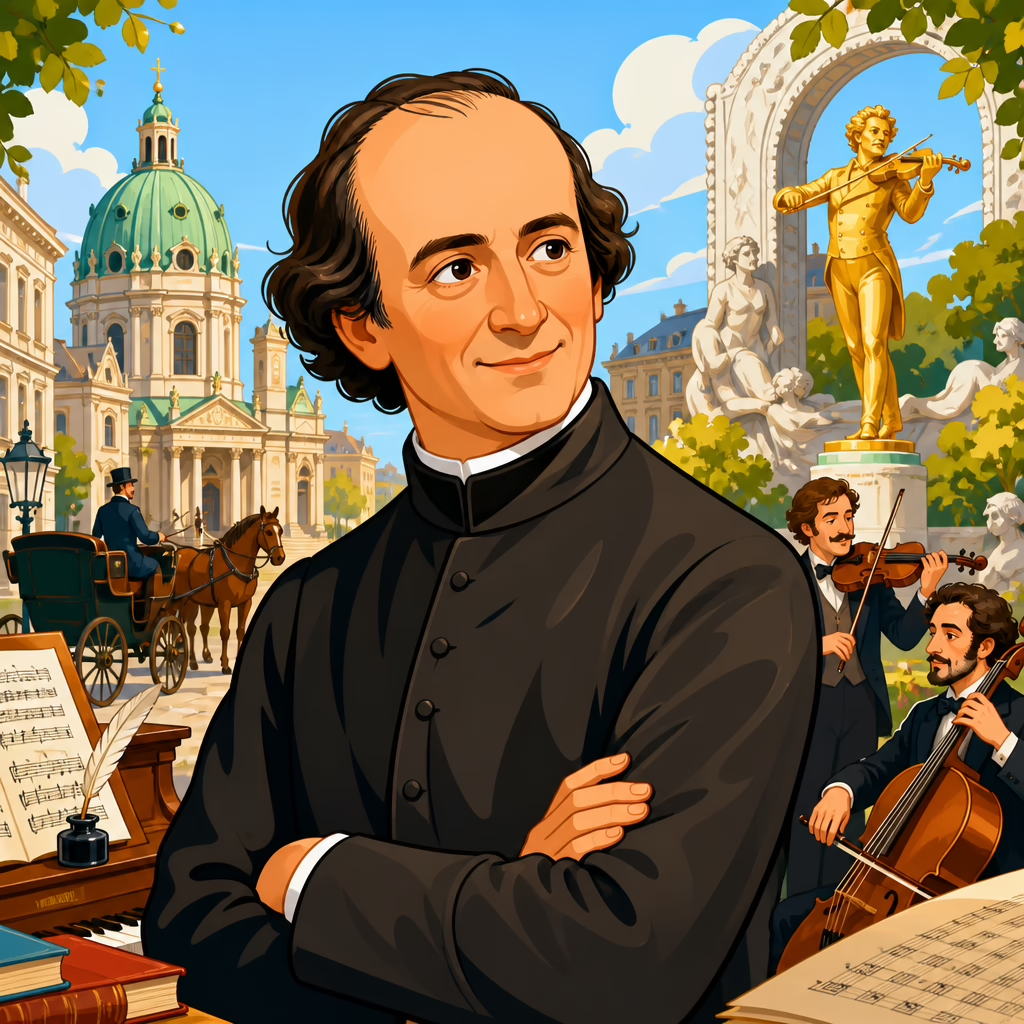
Abbe Stadler and Viennese Musical Intelligence
Abbe Maximilian Stadler belongs among the most revealing figures for understanding Viennese musical intelligence at the turn of the nineteenth century. The phrase does not refer simply to talent, nor only to education, but to a distinct way of hearing, classifying, remembering, and transmitting music within Vienna’s dense network of monasteries, salons, theaters, publishers, and private circles. Stadler was a priest, scholar, composer, performer, archivist, and trusted witness to the lives of Mozart, Haydn, Schubert, and Beethoven. Because he stood at the intersection of clerical learning and practical musicianship, his career shows how musical knowledge functioned in Vienna before conservatory systems fully standardized training. When historians speak about influence and contemporaries, they often favor dramatic creators over patient mediators. Stadler matters precisely because he was a mediator of exceptional range.
In my work with eighteenth- and early nineteenth-century sources, I have repeatedly found that people like Stadler explain more about musical culture than isolated masterpieces do. He copied manuscripts, advised collectors, wrote essays on older music, and helped shape how repertory survived. That activity was not secondary. In Vienna, preserving a score, recognizing a hand, distinguishing sacred style from theatrical style, or tracing a work’s provenance could alter what later generations believed about major composers. Stadler’s intelligence was therefore both analytical and social. He knew music as notation, sound, memory, liturgy, pedagogy, and historical artifact. This is why his name deserves focused attention rather than a passing footnote.
Calling his outlook “Viennese” also requires precision. Vienna around 1800 was not merely a capital overflowing with concerts. It was an information system. Aristocratic patronage, church institutions, Masonic and intellectual circles, domestic music making, and a thriving manuscript economy produced a city where musicians had to read people as well as scores. Stadler thrived in exactly that environment. He could move from learned discussion of counterpoint to practical decisions about repertory, from priestly duties to informed commentary on a composer’s unfinished legacy. His example clarifies how musical intelligence in Vienna combined erudition with adaptability, and why that combination shaped the reception of Beethoven and his contemporaries.
Stadler’s Formation and the Clerical-Musical Network
Born in 1748, Maximilian Stadler entered a world in which church service remained one of the strongest paths toward serious musical literacy. His title “Abbe” signals the ecclesiastical identity through which many cultivated musicians moved in Habsburg lands. Clerical institutions trained memory, discipline, Latin literacy, and routine contact with complex repertory. For a musician-scholar, that environment fostered habits of comparison and preservation. Stadler did not emerge from a modern conservatory model centered on public virtuosity. He came from a broader culture in which sacred music, administration, and scholarship supported each other. That background helps explain why he later proved so valuable as an assessor of manuscripts and styles.
Viennese musical intelligence depended heavily on such networks. Monasteries and churches maintained archives, copied parts, commissioned works for feast days, and sustained traditions older than the commercial concert scene. A person trained there learned to judge whether a piece was functional for liturgy, technically sound for available singers and instrumentalists, and stylistically appropriate to context. Stadler’s intelligence was practical in this exact sense. He could hear structure while also thinking institutionally. Which choir could sing this? Which archive preserves the source? Which work reflects a learned stile antico and which belongs to newer concerted church idioms? Those questions mattered daily.
His clerical formation also made him unusually receptive to older repertories. At a time when fashionable taste could move quickly toward novelty, Stadler retained serious interest in historical continuity. He studied earlier sacred music, wrote about music history, and treated archival labor as part of musicianship. That orientation is central to understanding his place among contemporaries. He was not simply a companion of famous composers. He represented a cognitive style in which historical depth itself counted as musical competence. Vienna rewarded that skill because its musical life was cumulative. New works circulated beside inherited liturgical traditions, copied masses, keyboard reductions, and private collections amassed over decades.
What “Viennese Musical Intelligence” Meant in Practice
To define Viennese musical intelligence through Stadler, it helps to identify the specific capacities he embodied. First came stylistic fluency: the ability to distinguish idioms quickly, whether sacred, theatrical, chamber, or pedagogical. Second was documentary awareness: knowing manuscripts, copyists, provenance, and the reputations attached to names. Third was social credibility: composers, patrons, and collectors trusted Stadler because he combined discretion with competence. Fourth was historical judgment: he could place a work within a lineage rather than treating each piece as isolated. Finally, there was memory, a vital currency in a city where not every important work existed in reliable print and where personal recollection often shaped later narratives.
These capacities were not abstract. Consider the daily realities of Vienna around 1800. A collector asks whether a newly found manuscript is genuinely by Mozart. A church musician needs a mass suited to local forces. A publisher wants advice on what older repertory may attract educated buyers. A friend of Beethoven seeks contextual knowledge about sacred style. In each case, musical intelligence means integrated judgment, not one narrow specialty. Stadler could answer because he had lived inside multiple systems at once. He belonged to the class of musicians who made a culture legible to itself.
One reason this matters for readers studying Beethoven’s circle is that Viennese intelligence was cumulative, not merely innovative. Beethoven arrived with formidable training and transformed what he inherited, yet he entered a city where reputations were filtered through people like Stadler. To understand that environment, readers may also want the broader context of early musical formation discussed in the main pillar guide, Christian Gottlob Neefe and Beethoven’s Earliest Training. Stadler complements that story by showing what Beethoven encountered in Vienna: a culture where judgment about music included archival knowledge, sacred practice, and historically informed listening.
Stadler and Mozart’s Posthumous Reputation
Stadler is especially important because he became one of the figures involved in the preservation and interpretation of Mozart’s legacy after 1791. That role alone places him near the center of Viennese musical intelligence. In the years after Mozart’s death, manuscripts, recollections, unfinished materials, and contested stories circulated through personal networks rather than modern scholarly institutions. Stadler was among those trusted to handle that inheritance. His association with Mozart’s papers and with efforts to make sense of unfinished works gave him influence over what later generations would accept as authentic, plausible, or authoritative.
The most frequently discussed example is his relationship to the Requiem materials. Any responsible account must acknowledge complexity. Stadler did not “complete” the Requiem in the way Franz Xaver Sussmayr did, and his role has often been overstated in popular writing. Yet he was close enough to the documentary and social aftermath to matter. He copied materials, possessed knowledge of sources, and stood within the circle of men whose testimony affected reception history. That makes him valuable not because he solved every authorship question, but because he exemplifies how Viennese knowledge worked: through proximity, memory, manuscript handling, and informed comparison.
His writings on Mozart also reveal a mind committed to order and evidence. Stadler did not approach Mozart merely as an idol. He treated the composer as a historical subject whose works required accurate transmission. This approach now seems scholarly, but in his period it depended heavily on personal credibility. Without institutional archives catalogued to modern standards, a witness like Stadler became a living index. He could identify a source, recall a circumstance, or challenge a rumor with practical authority. For historians, that is the essence of musical intelligence in Vienna: the fusion of ear, memory, and documentary judgment within a trusted human network.
His Relationship to Beethoven’s Vienna
Stadler was not one of Beethoven’s primary teachers, and it is misleading to cast him as a formative master in the direct pedagogical sense. His significance lies elsewhere. He formed part of the learned environment through which Beethoven’s music circulated and was assessed. Vienna judged new music through overlapping communities of performers, clerics, aristocrats, copyists, scholars, and connoisseurs. Stadler belonged to the subsection of that world able to connect Beethoven’s innovations to older traditions, especially in sacred and contrapuntal terms. Such figures mattered because Beethoven’s ambitions often required listeners capable of understanding structural seriousness rather than surface brilliance alone.
When Beethoven wrote works that invoked older learned techniques, including fugue and dense contrapuntal writing, he addressed a city whose best-informed listeners could recognize the move. Stadler was one of those listeners. He represented the enduring authority of church-trained musicianship inside an urban culture often described primarily through public concerts and virtuoso display. In plain terms, he was the kind of contemporary who could hear when Beethoven was not just being difficult but entering dialogue with inherited compositional disciplines. That insight is easy to miss if Vienna is reduced to a marketplace of fashionable premieres.
There is also a broader interpretive point. Beethoven’s Vienna was sustained by cultural memory. The city did not hear him in a vacuum. It heard him against Haydn, Mozart, liturgical repertory, contrapuntal study, and the habits of domestic performance. Stadler’s intelligence embodied that memory. Even where direct documentary links between the two men are limited, Stadler helps explain the listening culture surrounding Beethoven. He is therefore useful not as a dramatic biographical character but as a representative of the evaluative class that made serious music intelligible, discussable, and preservable within Vienna.
Stadler as Historian, Cataloger, and Source Critic
Modern musicology values source criticism, provenance research, and historical cataloging, but these disciplines did not appear fully formed. Stadler practiced early versions of them through habit and necessity. He wrote essays on the history of music, took interest in older masters, and approached manuscripts as objects requiring judgment. That combination distinguishes him from composers who left memoiristic remarks without systematic method. Stadler’s method was not modern in every respect, and some attributions from his era remain debatable, but his basic instinct was rigor: compare sources, observe stylistic traits, preserve what can be verified, and resist careless confusion.
His contribution becomes clearer when set against the fragility of musical transmission before complete critical editions. Manuscripts could be incomplete, copied inaccurately, mislabeled, or altered for local performance. Printed editions were not automatically reliable. In that world, the person who knew repertory deeply and could compare hands, styles, and contexts held unusual authority. Stadler did exactly that kind of work. He helped maintain continuity between living performance and historical record. Many later scholars depend indirectly on such mediators, even when their names remain less famous than the composers they served.
| Capacity | How Stadler Used It | Why It Mattered in Vienna |
|---|---|---|
| Stylistic recognition | Distinguished sacred, chamber, and historical idioms | Helped musicians choose appropriate repertory and judge authenticity |
| Manuscript knowledge | Copied, compared, and preserved sources | Supported reliable transmission before modern editions |
| Historical memory | Connected living composers to older traditions | Gave context to innovation, especially in Beethoven’s era |
| Social trust | Worked within clerical and artistic networks | Made his testimony influential in disputed cases |
That table captures the practical architecture of his intelligence. Importantly, none of these capacities functioned alone. A manuscript expert without stylistic fluency could be deceived by an elegant copy. A performer without historical memory might misread a work’s significance. A scholar without social trust would not gain access to crucial papers. Stadler’s value came from accumulation. He was useful because he could combine archival caution, trained listening, and institutional credibility. That integrated authority is one of the most distinctive features of Viennese musical life in his generation.
Why Stadler Still Matters for Focused Beethoven-Era Study
For readers interested in influences and contemporaries, Stadler offers a corrective to hero-centered history. Great composers do not operate in cultural emptiness. They depend on copyists, patrons, church musicians, editors, collectors, amateur performers, and historically minded scholars. Stadler sat close to the center of that matrix. He reminds us that intelligence in music is not exhausted by composing original masterpieces. It also includes remembering, sorting, interpreting, and preserving the conditions under which masterpieces can be recognized. This is especially relevant in Vienna, where rapid stylistic change coexisted with strong institutional memory.
His case also sharpens how we think about authority. Stadler was not famous because he dominated the stage. He was authoritative because others relied on his judgment. In practical terms, that meant he could shape what survived in repertoire, what stories hardened into accepted biography, and what manuscripts entered later scholarship with credible provenance. Those functions may appear modest beside symphonies and sonatas, yet they are structurally essential. Without them, musical culture loses continuity. Vienna around 1800 produced extraordinary creators, but it also depended on expert custodians. Stadler was one of the best examples.
Another reason he matters is that he bridges worlds often separated in modern writing. Today, church music history, manuscript studies, performance practice, and Beethoven-era biography can become specialized silos. Stadler lived before those divisions hardened. His career moved naturally across them. That is why he remains valuable for close study: he shows how one informed musician could think across sacred function, historical style, documentary evidence, and living artistic society. If you want a clearer picture of how Beethoven’s Vienna actually processed musical meaning, Stadler provides one of the cleanest vantage points.
Abbe Stadler and Viennese musical intelligence belong together because his life demonstrates how a great musical city thinks. Vienna’s culture was built not only by composers of genius but by interpreters of context, guardians of sources, and listeners trained to recognize lineage inside innovation. Stadler exemplified that class at a high level. He brought clerical discipline, historical curiosity, stylistic command, and trusted social presence to the musical world around Mozart, Haydn, Schubert, and Beethoven. Seen this way, he is not marginal at all. He is a key to understanding how knowledge circulated, how reputations were stabilized, and how works survived long enough to become canonical.
The central takeaway is simple. If Beethoven’s Vienna produced enduring music, it did so within a culture of memory and judgment, and Stadler was one of its clearest representatives. Studying him reveals the mechanisms behind influence: archives, institutions, informed ears, and credible witnesses. It also protects us from reducing history to a parade of isolated geniuses. Musical intelligence in Vienna was collaborative, cumulative, and deeply embedded in everyday practice. Stadler’s career makes that visible with unusual clarity.
To deepen your understanding of Beethoven’s world, use Stadler as a lens rather than a footnote. Follow the networks he inhabited, compare the functions he performed, and read his contemporaries with his kind of intelligence in mind. That approach will make the era sharper, more human, and far more accurate.
Frequently Asked Questions
Who was Abbe Maximilian Stadler, and why is he important to understanding Viennese musical intelligence?
Abbe Maximilian Stadler was far more than a minor cleric with musical interests. He was a priest, composer, performer, scholar, archivist, and an exceptionally well-connected observer of musical life in Vienna around the turn of the nineteenth century. That combination of roles makes him unusually valuable for anyone trying to understand what might be called Viennese musical intelligence: the practical and intellectual habits through which musicians, patrons, clerics, copyists, publishers, and educated listeners heard, organized, remembered, discussed, and transmitted music. Stadler moved across several worlds at once. He belonged to ecclesiastical institutions, but he also participated in urban artistic culture; he knew repertories preserved in monasteries while also engaging with the living circulation of music in salons, theaters, and private households.
His importance lies in the way he connects musical thought to musical infrastructure. Vienna was not simply a city of inspired geniuses. It was a city of libraries, manuscript collections, teaching lineages, sacred institutions, domestic performance, and social trust. Stadler stood inside those systems. He helped preserve older repertories, documented musical practices, and served as a witness to the careers and posthumous reputations of major figures, including Mozart. Because he combined memory with documentation, and scholarship with active musicianship, he helps modern readers see how music in Vienna was understood not only as art, but as a disciplined body of knowledge. In that sense, Stadler is a revealing guide to the habits of perception and classification that shaped Viennese culture itself.
What does the phrase “Viennese musical intelligence” actually mean in the context of Stadler’s world?
In this context, “Viennese musical intelligence” does not simply mean brilliance, talent, or formal education. It refers to a specific cultural capacity: the ability to hear structural relationships in music, to recognize style and authorship, to compare sources, to preserve repertories, to remember performance traditions, and to move fluently between sacred, theatrical, domestic, and scholarly musical settings. Vienna at the turn of the nineteenth century was not musically intelligent only because it produced gifted composers. It was musically intelligent because it sustained a dense ecosystem in which music was constantly analyzed, copied, taught, cataloged, debated, adapted, and socially exchanged.
Stadler embodies that idea especially well because his career demonstrates how musical understanding depended on more than composition alone. He was involved in archives and manuscript culture, meaning he understood the importance of preserving and identifying works. As a performer and composer, he also understood music from the inside, as something sounded and shaped in real time. As a priest and scholar, he participated in institutions where memory, discipline, and classification mattered deeply. So the phrase points to a collective way of thinking through music: hearing it historically, socially, and intellectually. Stadler shows that in Vienna, musical culture operated through a sophisticated network of attention, expertise, and transmission, not merely through isolated moments of genius.
How did Stadler’s roles as priest, scholar, and archivist shape his musical influence?
Each of Stadler’s roles reinforced the others, and that is exactly what makes him such a significant figure. As a priest, he belonged to institutional environments where music was not ornamental but integral to liturgical life, education, and memory. Monasteries and ecclesiastical centers were among the most important repositories of musical manuscripts, traditions, and trained listening. That setting gave him access to repertories and habits of preservation that many purely theatrical or freelance musicians would not have possessed in the same way.
As a scholar, Stadler approached music analytically. He was concerned with attribution, historical context, repertorial continuity, and the reliability of sources. This scholarly orientation mattered enormously in a period when music circulated widely in handwritten copies, arrangements, recollections, and partial archives. The ability to distinguish, verify, compare, and classify was not a secondary skill; it was central to the life of music in Vienna. Stadler’s scholarship therefore contributed to how music was understood, not just how it was performed.
As an archivist, or at least as an archival-minded figure, he helped stabilize cultural memory. Music survives not only because it is composed, but because someone preserves manuscripts, organizes collections, records provenance, and transmits judgments about authenticity and value. Stadler’s involvement in these processes gave him real influence over what later generations could know about earlier musicians and repertories. Taken together, these roles made him a mediator between sound and record, between living performance and historical remembrance. His influence was subtle but foundational: he helped create the conditions under which Vienna could know its own musical past and narrate its own musical identity.
Why is Stadler often discussed in relation to Mozart and other major Viennese musicians?
Stadler is often discussed alongside Mozart and other major Viennese figures because he belonged to the circle of individuals who did more than admire great composers from a distance; he participated in the networks that remembered, interpreted, and transmitted their work. In a city like Vienna, reputations were not formed by compositions alone. They were shaped by conversation, manuscript circulation, testimony, pedagogical use, commemorative writing, and archival care. Stadler’s credibility as a cleric, scholar, and musician made him a trusted witness within those processes.
His relationship to major composers matters because it reveals how musical history was constructed close to the source. People like Stadler occupied the space between firsthand experience and later historiography. They knew the social environments in which composers worked, understood the repertories being discussed, and could often assess works through informed comparison rather than mere anecdote. That makes Stadler especially valuable in understanding how Mozart’s legacy, for example, was preserved and interpreted in the decades following his death. More broadly, Stadler helps show that Viennese musical greatness was sustained by a supporting culture of witnesses, collectors, editors, and interpreters. Without such figures, the image of Vienna as a musical capital would be much thinner and far less reliable. His presence reminds us that musical history depends not only on creators, but also on the people who recognize significance and know how to preserve it.
What can modern readers learn from Stadler about music culture in Vienna around 1800?
Modern readers can learn that Vienna’s musical culture around 1800 was extraordinarily interconnected and intellectually active. Stadler’s life demonstrates that music was not confined to public concerts or famous premieres. It lived in monasteries, aristocratic salons, teaching studios, theaters, publishers’ workshops, private homes, and manuscript collections. To understand that world, one must think not only about composers and masterpieces, but also about systems of circulation, memory, trust, and expertise. Stadler is useful precisely because he stands at the intersection of all those systems.
He also teaches us that musical knowledge in this period was embodied as much as it was written down. People learned by hearing, comparing, copying, discussing, and recalling. Style recognition, source criticism, and repertorial memory were practical skills embedded in everyday cultural life. Stadler’s example makes clear that the musical sophistication of Vienna depended on a community capable of sustaining these skills across institutions and generations. For readers today, that widens the picture of what a musical center really is. It is not merely a place where genius appears; it is a place where listening becomes organized knowledge, where preservation shapes reputation, and where figures like Stadler quietly bind together the sacred, social, scholarly, and artistic dimensions of music. That is why he remains so revealing for anyone interested in the deeper mechanics of Viennese musical intelligence.