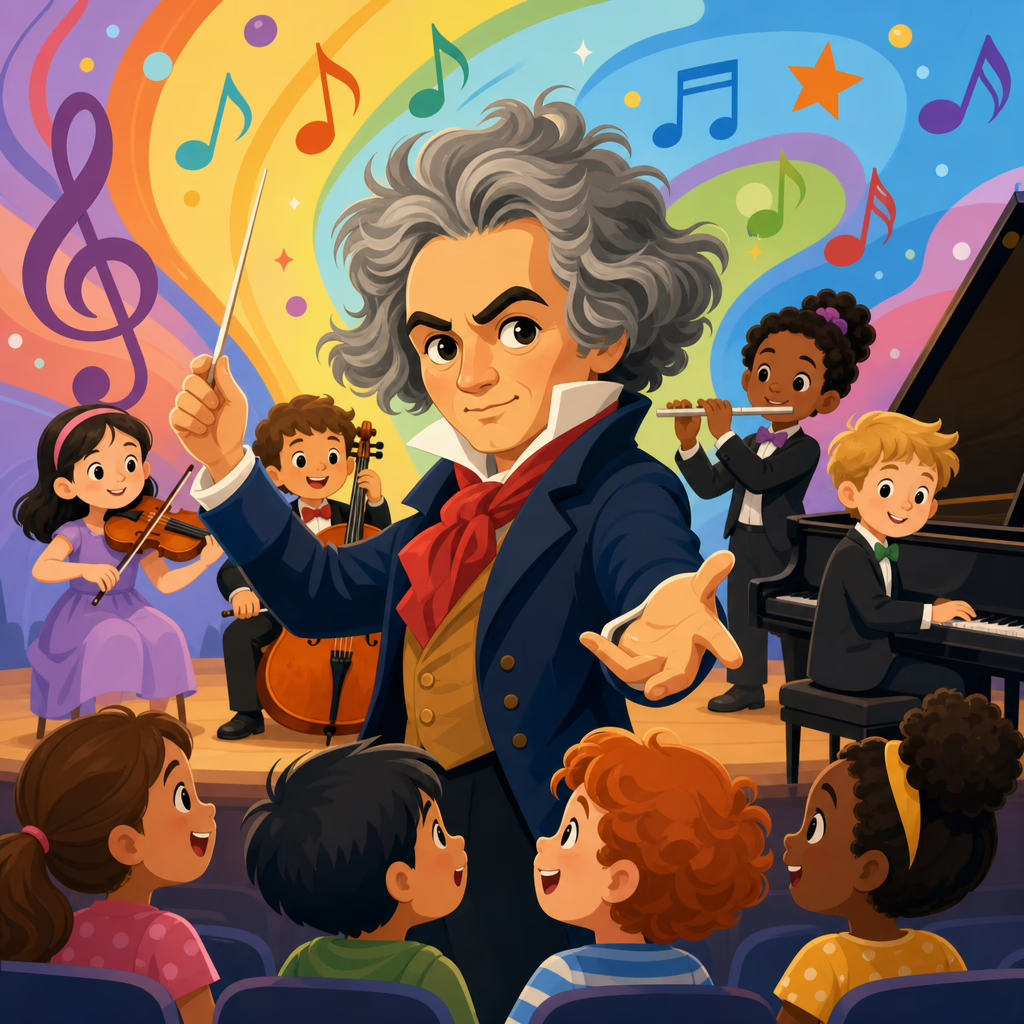
Beethoven in Children’s Concert Programming
Beethoven in children’s concert programming remains one of the most effective ways to introduce young audiences to orchestral music because his works combine memorable rhythm, clear emotional contrasts, and stories that children can genuinely hear. In this context, children’s concert programming means selecting, framing, and presenting repertoire for school-age listeners in a format that matches their attention span, developmental stage, and prior musical exposure. A hub article on this miscellaneous area must therefore cover repertoire choices, concert design, narration, education strategy, accessibility, and community engagement, because successful youth programming is never just about choosing a famous composer. In my work with family concerts, school matinees, and pre-concert teaching sessions, Beethoven consistently proves useful not because he is automatically familiar, but because his music gives presenters concrete material to explain: pulse, motif, contrast, surprise, character, and orchestral color. That matters in community and education settings, where a concert is often a first live encounter with classical music, and the experience can shape whether a child returns. Beethoven also sits at a practical crossroads. He is historically central, widely recognized by adults who bring children, and represented in works that can be adapted for different ensemble sizes and program lengths. Used well, he supports listening skills, music history, emotional literacy, and ensemble awareness in a single event.
Programming Beethoven for children requires clarity about purpose. Are you introducing the orchestra, teaching specific musical concepts, supporting school curriculum, or creating a family outing with broad appeal? The answer changes everything from repertoire length to speaking style. Key terms help. A motif is a short musical idea that returns and develops; Beethoven’s Fifth Symphony provides the classic example. Orchestration refers to how music is distributed across instruments; even in works originally written for piano, orchestral arrangements can help children identify timbres. Audience engagement includes guided listening prompts, call-and-response rhythm work, movement, and visual supports. Developmentally appropriate pacing usually means frequent transitions, spoken framing, and excerpts rather than uninterrupted long forms for younger listeners. These principles matter because children do not need simplification so much as structure. When presenters assume that “great music speaks for itself,” attention often drifts. When they build a program around hearing one rhythm transform, one emotion intensify, or one instrumental color emerge, children listen closely. Beethoven is ideal for that approach, but only if institutions resist tokenism and instead design concerts that connect his music to questions children naturally ask: What is happening, how do the instruments do that, why does it sound dramatic, and what should I listen for next?
Why Beethoven Works So Well for Young Audiences
Beethoven fits children’s concert programming because his music is built from strong musical building blocks that can be perceived without specialist training. Repetition, dynamic contrast, rhythmic drive, and vivid shifts of mood are audible even to first-time listeners. I have seen seven-year-olds track the famous opening of the Fifth Symphony after one demonstration because the motif is short, distinctive, and physically countable. That kind of immediate recognition is valuable in educational programming, where success often depends on whether a child can latch onto one idea and hear it return.
Another advantage is emotional directness. Beethoven frequently writes music that sounds determined, playful, solemn, tender, or triumphant in ways that children can name in plain language. Presenters can ask, “Does this sound like sneaking, marching, celebrating, or arguing?” and get meaningful responses. This does not reduce the music; it creates an access point. From there, educators can add more precise vocabulary such as tempo, articulation, phrase, and cadence.
Beethoven is also useful because his catalogue includes multiple entry points. The “Ode to Joy” theme from the Ninth Symphony works for sing-alongs and community choruses. The Pastoral Symphony supports discussion of nature, storms, and scene-painting. Bagatelles and dances can serve shorter formats. Even excerpts from piano sonatas can introduce form and character when adapted carefully. This range allows organizations to build series-wide pathways rather than one-off novelty events.
Best Beethoven Repertoire for Children’s Concerts
The best Beethoven repertoire for children depends on age, concert length, and the educational goal, but some works consistently succeed. For very young audiences, concise excerpts are more effective than complete symphonic movements unless the concert includes active listening prompts. The opening of Symphony No. 5, selected excerpts from Symphony No. 6 “Pastoral,” the “Ode to Joy” finale theme from Symphony No. 9, excerpts from the Violin Concerto’s lyrical passages, and short piano pieces arranged for ensemble are reliable choices.
Symphony No. 6 is especially strong for elementary listeners because it offers obvious imagery without needing a literal story. The movement titles suggest arrival in the countryside, a brook scene, a peasant gathering, a storm, and thanksgiving. Educators can ask children to identify repeated bird calls, flowing motion, and the transition into thunder and rain. This creates a straightforward listening arc. By contrast, the Fifth Symphony is excellent for teaching motif and transformation. Children can hear how four notes become an entire movement and then compare that economy of material with film music techniques they already know.
For mixed-age family concerts, “Ode to Joy” is often the single best anchor because it can be sung, played by different sections in sequence, and connected to ideas of community. It also works across skill levels in participatory formats. Many organizations pair it with student ensembles, youth choirs, or side-by-side community players. The key is to keep the excerpt musically intact while shortening transitions and surrounding it with explanation that helps listeners follow what changes from statement to statement.
| Work or Excerpt | Best Use in Children’s Programming | Main Teaching Point | Typical Age Fit |
|---|---|---|---|
| Symphony No. 5, opening movement excerpt | Introductory orchestra concert | Motif, rhythm, dynamic contrast | Ages 7 and up |
| Symphony No. 6, storm and brook excerpts | Nature-themed school matinee | Musical imagery, orchestral color | Ages 6 and up |
| Symphony No. 9, “Ode to Joy” theme | Sing-along or community concert | Melody, variation, participation | All ages |
| Ecossaise or Bagatelle arrangements | Short attention-span formats | Dance rhythm, form, character | Ages 5 and up |
How to Build a Child-Centered Beethoven Concert
A successful Beethoven program for children is usually built around one central listening question. For example: how can one short idea grow into a big piece, how does music paint weather, or how do instruments pass a tune around an orchestra? Once that question is clear, repertoire and narration become easier to shape. In practice, the best concert length for elementary school audiences is often forty-five to fifty-five minutes, with no single uninterrupted segment lasting too long unless there is visual or verbal framing.
Sequencing matters. Start with something immediately graspable, such as the Fifth Symphony motif clapped by audience and orchestra together. Then broaden into a contrasting excerpt that highlights a different dimension of Beethoven, perhaps the pastoral calm of the Sixth. End with a participatory finale such as “Ode to Joy.” This arc moves from recognition to exploration to collective release. It gives children a sense of progression rather than a chain of unrelated excerpts.
Hosts and narrators should speak plainly and briefly. The most effective script writing uses short prompts before listening, not lectures afterward. Saying “Listen for the lower strings when the storm starts” is better than delivering a historical paragraph first. Children need orientation more than background detail. Historical context still matters, especially Beethoven’s hearing loss and his place in music history, but it should support listening rather than replace it. One or two strong facts are enough if they are tied to what the audience will hear.
Teaching Strategies That Make Beethoven Understandable
Children understand Beethoven best when educators externalize musical structure. Clapping the Fifth Symphony rhythm, tracing melodic shape in the air, comparing instrumental timbres, or inviting students to predict whether a passage will get louder or softer all help convert abstract listening into active participation. In classroom partnerships, I have found that pre-concert lessons dramatically improve focus during performance. Even a ten-minute introduction to motif and dynamics can transform the concert from passive exposure into intentional listening.
Storytelling can help, but it should be disciplined. Beethoven’s music does not require invented plots to become accessible. Instead, use guided imagination grounded in the score. In the Pastoral Symphony, ask what in the orchestra sounds like water, wind, birds, or thunder. In “Ode to Joy,” ask why the melody feels easy to sing and why each repetition feels larger. These are real musical questions, not gimmicks.
Visual reinforcement is useful when handled carefully. Projected instrument names, thematic diagrams, or simple listening maps can help children follow form. Leonard Bernstein demonstrated decades ago in Young People’s Concerts that serious repertoire can be taught through vivid explanation without talking down to the audience. Modern presenters can use that same principle with contemporary tools such as live camera close-ups, projected rhythm patterns, and bilingual captioning. The point is not spectacle. It is alignment between what children hear, see, and do.
Common Mistakes in Beethoven Programming for Kids
The most common mistake is programming Beethoven because adults think children should know him, without defining what children are supposed to experience. That leads to overlong excerpts, dense commentary, and fatigue. A second mistake is choosing only the most famous material and assuming recognition equals engagement. Familiar openings help, but novelty, contrast, and participation are what sustain attention. A third mistake is reducing Beethoven to biography alone, especially a simplified narrative about struggle. His hearing loss is important, but children deserve to encounter his craft as well as his life story.
Another recurring problem is underestimating the role of pacing. Children’s concerts fail when transitions are slow, stage logistics are visible but unexplained, or spoken sections interrupt momentum. Rehearsing presenter timing is as important as rehearsing the music. I also advise organizations not to overload school concerts with educational objectives. If every excerpt is attached to a new concept, retention drops. One or two concepts taught well are far more effective.
Accessibility is sometimes treated as an add-on when it should be built in from the start. Family programming should account for sensory sensitivities, provide clear house guidance, and consider relaxed performance practices when possible. Printed or digital materials should use readable language. Community and education work succeeds when barriers are reduced, not when institutions simply shorten the standard concert model and call it outreach.
Community Impact and Long-Term Education Value
Beethoven programming has lasting value when it connects the concert hall to schools, families, and local ensembles. A strong miscellaneous hub in the community and education space should recognize that the concert itself is only one touchpoint. Pre-concert classroom visits, teacher guides, instrument petting zoos, family workshops, and youth ensemble collaborations all increase the odds that a Beethoven event becomes part of a learning pathway rather than an isolated field trip.
Community-based presentations can also broaden whose Beethoven is being heard. Children respond when presenters connect canonical repertoire with local participation: a neighborhood chorus singing “Ode to Joy,” student composers creating response pieces to the Fifth Symphony motif, or dance groups interpreting the storm from the Pastoral. These additions should illuminate Beethoven, not bury him, but when designed well they show that classical music is a living civic practice. That message is crucial for institutions trying to build relevance and trust.
Evaluation matters here. The best organizations collect more than attendance numbers. They ask teachers whether students remembered specific musical ideas, track repeat family attendance, and review which participatory segments held attention. Named tools such as post-event surveys, QR feedback forms, and simple observation rubrics can reveal whether children recognized instruments, retained themes, and felt welcome. Those data points help refine future programming and justify investment in education work.
Beethoven in children’s concert programming works best when presenters choose repertoire with clear listening hooks, frame it with concise teaching, and treat young audiences as capable listeners rather than passive recipients. His music offers exceptional material for teaching rhythm, motif, orchestral color, emotion, and collective music making, but results depend on thoughtful design. The strongest programs center one question, use age-appropriate excerpts, pace transitions carefully, and build participation into the musical experience. They also connect the performance to broader community and education goals through school partnerships, family access strategies, and follow-up learning resources.
For organizations building a miscellaneous hub under community and education, Beethoven should not be a ceremonial inclusion. He should be a flexible anchor for articles and programs on family concerts, school matinees, narrated performances, youth chorus collaborations, accessible concert design, and music appreciation methods. That is the main benefit of using Beethoven well: his repertoire can support both immediate audience engagement and long-term musical literacy. If you are planning a children’s concert, start by selecting one Beethoven excerpt with a clear teaching purpose, design the listening journey around it, and build outward with intention.
Frequently Asked Questions
Why is Beethoven such a strong choice for children’s concert programming?
Beethoven works especially well in children’s concert programming because his music is immediately recognizable, rhythmically vivid, and emotionally direct. Young listeners often respond best to music that gives them something clear to hold onto, and Beethoven provides that through strong motifs, repeated rhythmic cells, dramatic contrasts, and bold changes in mood. Even children with no formal musical training can hear the difference between tension and release, quiet and loud, playful and serious, or steady pulse and sudden interruption. That makes his music unusually accessible in a live educational setting.
Another reason Beethoven is effective is that his works invite storytelling without reducing the music to a simple plot. Teachers, presenters, and conductors can frame a symphonic excerpt as a musical journey, a conversation, a surprise, or a moment of triumph, and children can follow those ideas through sound. This is particularly valuable for school-age audiences, who are still developing listening stamina and often engage more deeply when repertoire is introduced through imagery, movement, or questions to listen for. Beethoven’s music supports that kind of guided listening exceptionally well.
Just as importantly, Beethoven helps children encounter orchestral music as something alive and expressive rather than distant or overly formal. His music can feel energetic, human, and even rebellious, which makes it easier to connect with than repertoire that relies more heavily on subtle stylistic nuance. In a well-designed program, Beethoven becomes a bridge: he introduces fundamental orchestral sounds and forms while also showing children that classical music can be exciting, dramatic, and emotionally meaningful.
Which Beethoven pieces or excerpts are most appropriate for school-age audiences?
The most effective Beethoven selections for children are usually shorter movements or carefully chosen excerpts that showcase clear rhythm, memorable themes, and strong contrast. Well-known examples include the opening of Symphony No. 5, excerpts from Symphony No. 6 “Pastoral,” selected passages from Symphony No. 7, and energetic overture material such as the Egmont Overture when presented with context. These pieces work because they are structurally clear enough for guided listening and vivid enough to sustain attention. For younger audiences especially, excerpts often serve better than complete large-scale works, since attention span and listening endurance vary significantly by age and experience.
The “Pastoral” Symphony is often especially useful in children’s programming because it offers natural imagery that listeners can connect to immediately. Presenters can invite children to listen for flowing movement, storm energy, calm atmosphere, and changing orchestral color. Symphony No. 5 is effective for different reasons: its famous opening motif allows children to hear how a tiny musical idea can shape an entire movement. That creates an excellent opportunity to teach basic concepts such as repetition, development, and musical memory without becoming overly technical.
Piano miniatures, dances, and chamber excerpts can also be excellent choices, particularly in smaller venues or education-focused concerts. Not every successful Beethoven experience has to center on a full symphony orchestra performance. The key is matching the repertoire to the audience’s developmental stage, prior exposure, and the format of the event. A strong children’s program usually favors excerpts with immediate character, manageable duration, and obvious points of engagement, rather than assuming that “important” repertoire automatically works in its complete form for every age group.
How should Beethoven be introduced so children stay engaged instead of feeling overwhelmed?
The most successful approach is to frame Beethoven through active listening rather than lecture. Children do not need an exhaustive biography before hearing the music. What they need are clear entry points: a rhythm to clap, a theme to recognize when it returns, an emotion to listen for, or a contrast to notice between instruments or sections. Instead of asking children to appreciate Beethoven because he is historically important, effective presenters help them discover what is happening in the music right now. That shift makes the experience more participatory and much less intimidating.
It also helps to keep spoken introductions concise, vivid, and purposeful. A presenter might ask, “Can you hear how this short rhythm keeps coming back?” or “What changes when the music moves from calm to stormy?” Questions like these focus attention and turn listening into a game of discovery. Live demonstrations by the orchestra or conductor are equally valuable. Hearing a motif played by one section and then by the full ensemble helps children understand texture, dynamics, and orchestral color in a concrete way.
Engagement improves further when the programming respects children’s attention span. Rather than presenting long uninterrupted stretches of music, many family and school concerts benefit from a sequence of short listening segments, demonstrations, brief narration, and audience interaction. This does not dilute Beethoven; it makes him more audible to listeners who are still learning how to follow extended forms. When the framing is thoughtful, children come away not just having “sat through” Beethoven, but having actually heard and understood something meaningful in his music.
What educational goals can Beethoven support in a children’s concert setting?
Beethoven can support a wide range of musical and educational goals, which is one reason he appears so often in programming for young audiences. At the most basic level, his music helps children identify pulse, rhythm, repetition, contrast, motif, dynamics, tempo change, and instrumental color. Because these elements are often so clearly expressed in his works, they can be taught in ways that are audible even to inexperienced listeners. A single well-chosen Beethoven excerpt can reinforce listening skills that connect directly to classroom learning in music appreciation, ensemble participation, and general arts education.
Beyond core musical concepts, Beethoven also supports emotional literacy and interpretive thinking. Children can be asked how the music feels, what changed, why a return of a theme matters, or how the orchestra creates excitement or calm. These are not superficial questions. They build habits of focused attention, inference, and evidence-based response. In other words, children learn to support what they hear with what the music is actually doing. That kind of listening has educational value beyond music because it strengthens observation, interpretation, and verbal expression.
Beethoven can also be used to explore broader themes such as creativity, perseverance, and artistic voice, provided those topics are handled with accuracy and age-appropriate nuance. His life story is often compelling to children, but it should support the listening experience rather than overshadow it. The most effective educational programs connect biography, sound, and structure: children hear a musical idea, learn how Beethoven develops it, and begin to understand composition as an act of imagination and problem-solving. That combination makes the concert both artistically rich and pedagogically useful.
How can presenters make Beethoven feel relevant to modern children and families?
Relevance comes from presentation, not from forcing the music to become something it is not. Children and families do not need Beethoven to be simplified into a novelty act; they need clear, welcoming ways into the listening experience. That means connecting the music to universal experiences such as suspense, surprise, motion, celebration, nature, conflict, and resolution. Beethoven already contains these qualities in abundance. When conductors, educators, or hosts draw attention to those human elements, the music feels current because the emotional experience is current.
Interactive format choices can also make a significant difference. Call-and-response rhythm work, brief listening prompts, projected visuals used sparingly, or side-by-side demonstrations of themes and orchestral sections can help families stay involved. For younger listeners, movement-based activities are especially effective: stepping a pulse, tracing the contour of a melody with the hand, or signaling when a famous motif returns. These strategies do not distract from the repertoire when used well; they help children build the listening habits needed to follow it.
Finally, relevance depends on respecting the audience. Children respond positively when programming assumes curiosity and intelligence rather than passivity. A thoughtfully designed Beethoven concert for young audiences does not merely “introduce the classics.” It invites listeners into the experience of hearing patterns, emotion, drama, and imagination unfold in real time. That is what makes Beethoven endure in children’s concert programming: not only his historical stature, but his continued ability to speak clearly and powerfully to first-time listeners of many ages.