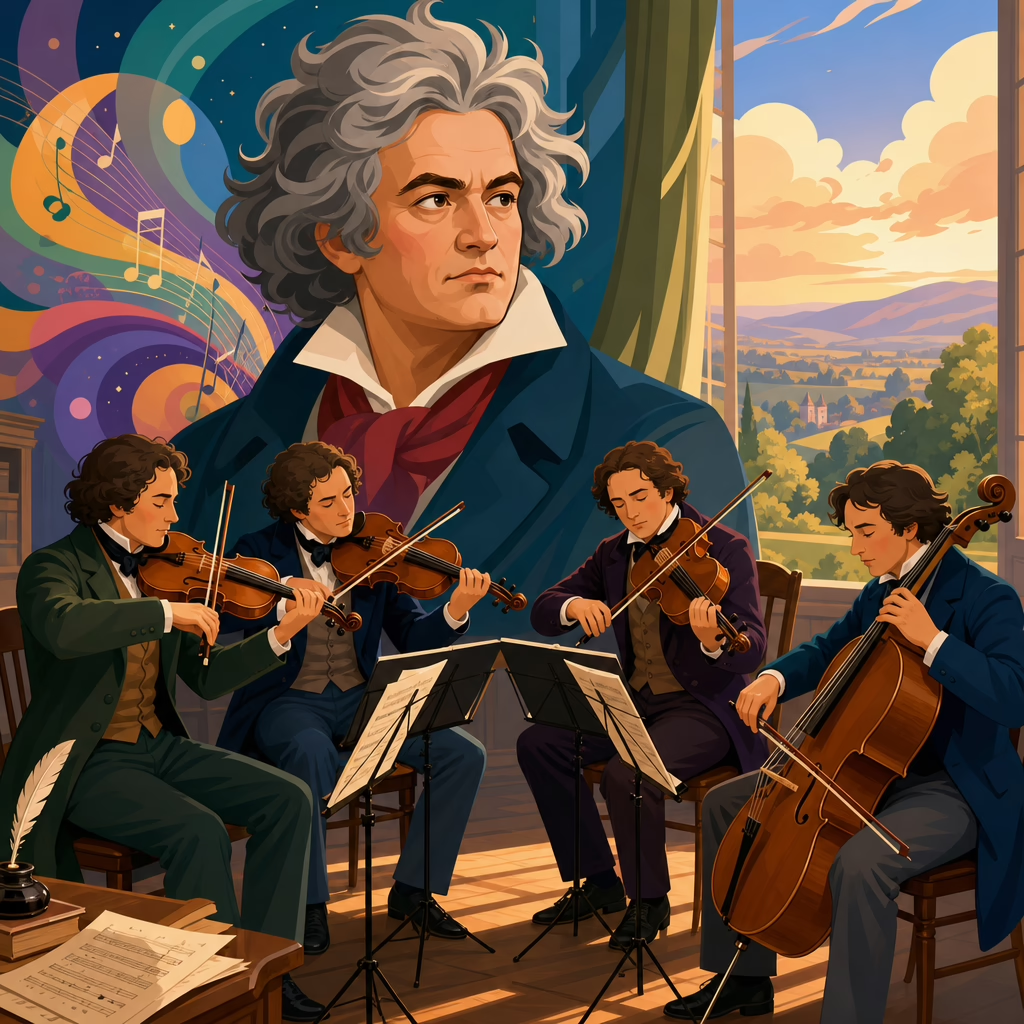
The Late String Quartets: Beethoven’s Final Statement
Beethoven’s late string quartets stand at the summit of chamber music because they compress a lifetime of craft, struggle, experiment, and spiritual searching into works that still sound startlingly modern. Written mostly between 1824 and 1826, the late quartets usually refer to Opp. 127, 130, 131, 132, 133, and 135, with the Grosse Fuge originally serving as the finale to Op. 130 before being published separately as Op. 133. In practical terms, these works are Beethoven’s final statement in the string quartet medium, and for many listeners they are his final statement as a composer, since they were among the last major scores he completed before his death in 1827. They matter not simply because they came last, but because they rethink what a quartet can do: structure becomes more flexible, harmony more daring, rhythm more volatile, and expression more personal than anything in his earlier chamber music.
When I have guided listeners through these quartets in classes, pre-concert talks, and close score sessions, the same questions always emerge. Why do they sound so different from Haydn, Mozart, or even Beethoven’s own middle-period quartets? Why do some movements feel prayerful while others seem almost comic, rustic, or violently abstract? And why have performers and scholars treated them not as difficult footnotes, but as a central test of musical understanding? The answer begins with context. By the 1820s Beethoven was completely deaf, physically fragile, and socially isolated, yet artistically uncompromising. He had already transformed the symphony, sonata, concerto, and piano variation set. In the quartets, however, he turned inward, using four instruments to explore fugue, variation, dance, recitative, hymn, march, folk inflection, and extreme contrast with unprecedented concentration.
As a hub within Beethoven’s chamber music, this article maps the late quartets as a connected group and points toward the main issues listeners, students, and performers should track across the subtopic. Key terms help. A string quartet is music for two violins, viola, and cello, but in Beethoven’s hands it becomes a forum for four independent voices rather than a melody with accompaniment. “Late style” describes the concentrated, unpredictable manner of his final years: abrupt juxtapositions, compressed motives, archaic forms such as fugue, and an emotional range that can move from private introspection to public declaration in a few measures. Understanding these features makes the late quartets less intimidating and far more rewarding.
Why the late quartets mark a turning point
The late quartets represent a turning point because they reject the expectation that a quartet should mainly provide elegant conversation within stable classical forms. Beethoven had already expanded the genre in the Razumovsky quartets and in Op. 95, but the late works go further by loosening standard four-movement plans, enlarging slow movements into spiritual centers, and making finales less predictable. Op. 131 has seven continuous movements. Op. 132 contains the “Heiliger Dankgesang,” one of the longest and most searching slow movements in the literature. Op. 130 originally ended with the immense Grosse Fuge, a finale so uncompromising that early listeners struggled to absorb it. These are not eccentric gestures for their own sake. They reflect Beethoven’s conviction that form must follow expressive necessity.
Commission history also matters. Prince Nikolai Galitzin requested “one, two, or three new quartets” from Beethoven in 1822, and the commission helped trigger Opp. 127, 132, and 130. Yet the project soon expanded beyond obligation. Once Beethoven re-entered the quartet medium after many years, ideas multiplied, and the late quartets became a final laboratory for everything he knew. In rehearsals, musicians often discover that each instrument carries unusually exposed material, from bare unisons to intricate contrapuntal strands. That equality of voices is one reason these works remain a benchmark for ensemble playing. Intonation, balance, articulation, pacing, and structural memory are tested at the highest level.
The six works at a glance
Although each quartet is unique, hearing the group in sequence reveals Beethoven’s broader design. Op. 127 in E-flat major opens the set with grandeur and lyric breadth. Op. 132 in A minor turns suffering and recovery into large-scale musical narrative. Op. 130 in B-flat major ranges astonishingly from wit to profundity and originally culminated in the Grosse Fuge. Op. 131 in C-sharp minor unfolds without pause across seven movements and was considered by Wagner one of the greatest works in music. Op. 135 in F major, the last completed quartet, is shorter and outwardly clearer, yet its finale carries the enigmatic motto “Muss es sein?” and “Es muss sein!” Op. 133, the Grosse Fuge, stands apart as one of Beethoven’s fiercest statements in counterpoint and rhythmic dislocation.
| Work | Date | Defining feature | What to listen for |
|---|---|---|---|
| Op. 127 | 1824–25 | Majestic opening, variation slow movement | Contrast between ceremonial scale and inward lyricism |
| Op. 130 | 1825–26 | Six-movement design, original fugue finale | Rapid shifts among humor, dance, aria, and severity |
| Op. 131 | 1826 | Seven continuous movements | Unbroken narrative and cumulative emotional architecture |
| Op. 132 | 1825 | “Heiliger Dankgesang” slow movement | Alternation of chorale-like stillness and renewed energy |
| Op. 133 | 1825–26 | Standalone Grosse Fuge | Dense fugue writing, rhythmic violence, structural command |
| Op. 135 | 1826 | Compressed final quartet with motto finale | Classical clarity shadowed by philosophical ambiguity |
For a sub-pillar hub on miscellaneous late-quartet topics, this overview is essential because many focused articles branch from these distinctions: movement architecture, Beethoven’s late counterpoint, performance history, manuscript issues, programmatic interpretations, and the relation between the original and replacement finale of Op. 130. Readers exploring Beethoven’s chamber music need a clear map before diving into single-work analysis.
Musical language: form, fugue, variation, and extreme contrast
The late quartets sound radical because Beethoven intensifies older techniques rather than abandoning tradition. Fugue is the clearest example. He studied Bach and Handel deeply, and in these quartets he treats counterpoint not as academic display but as dramatic action. In the Grosse Fuge, subjects collide under syncopation, inversion, augmentation, and brutal accents. In Op. 131, the opening fugue feels less combative and more grave, establishing a world of disciplined sorrow. Variation technique is equally central. The slow movements of Opp. 127 and 132 transform simple material through register, texture, ornament, and harmonic color, creating the sense that time has slowed so listeners can inspect every expressive possibility inside a theme.
Harmony and rhythm also push beyond late eighteenth-century norms. Sudden remote key changes, startling pauses, obsessive repeated notes, and asymmetrical phrase lengths unsettle the listener’s footing. Beethoven often places rough, almost peasant-like dance ideas beside passages of pure devotional stillness. That contrast can feel jarring on first hearing, but it is part of the design. The quartets do not present a single polished surface. They preserve tension between the earthly and the transcendent, between formal control and emotional urgency. Performers know that this means every transition matters. A weak tempo relation or generalized dynamic plan can flatten the music’s argument. The score demands decisions that are technical, historical, and philosophical at once.
Op. 132, Op. 131, and the inward voice
If one question listeners ask is which late quartet best reveals Beethoven’s inner world, Op. 132 and Op. 131 are usually at the center of the discussion. Op. 132 emerged after Beethoven recovered from a serious intestinal illness, and the third movement bears the title “Holy song of thanksgiving of a convalescent to the Deity, in the Lydian mode.” That title matters: Beethoven explicitly frames the movement as gratitude after suffering. The use of the Lydian mode, with its raised fourth, gives the chorale writing an archaic, purified color. Between the slow hymn sections, the music turns to marked passages of “new strength,” where motion and pulse return. The result is not a generic slow movement but a staged experience of weakness, contemplation, and renewal.
Op. 131 is more elusive. Because all seven movements connect without break, the piece feels like a single psychological arc rather than a sequence of separate numbers. The opening fugue is hushed and severe; the brief inner movements act as transitions, scherzo, and variations within a continuous narrative; the final movement releases tremendous energy without offering easy triumph. In coaching sessions, I often tell players that Op. 131 resists interpretation built on isolated effects. Its meaning emerges from proportion and memory. A gesture in the second movement changes character when heard against the first; a rhythmic figure near the end can sound like the return of a long-buried impulse. This long-range integration is one reason many musicians consider Op. 131 Beethoven’s most perfectly realized late quartet.
Op. 130, the Grosse Fuge, and the problem of difficulty
No discussion of Beethoven’s final statement can avoid Op. 130 and the Grosse Fuge. Originally, Beethoven placed the fugue at the end of Op. 130, after five highly contrasted movements that include a tender Cavatina and lighter dance-based episodes. Early audiences and players found the finale bewildering. The publisher, concerned about reception, persuaded Beethoven to write a new final movement, and the fugue was issued separately as Op. 133. Modern listeners usually encounter both versions, and both are valuable. The substitute finale gives Op. 130 a more approachable closure. The original fugue, however, transforms the entire quartet into a journey that ends not in ease but in confrontation.
The Grosse Fuge was once dismissed as chaotic, but that view does not survive close analysis. Its architecture is rigorous. Beethoven presents a bold overture, states sharply profiled fugue subjects, and works them through contrapuntal procedures with relentless logic. What makes the piece difficult is not lack of order but the density of information: violent accents, registral extremes, metric disruption, and severe harmonic tension arrive at high speed. Igor Stravinsky famously called it “an absolutely contemporary piece of music forever,” and the description remains apt. For readers navigating miscellaneous late-quartet topics, the fugue opens wider questions about revision, reception, audience expectation, and whether difficulty is a barrier or a sign that a composer has outrun current taste.
Performance, reception, and why these quartets still challenge us
The reception history of the late quartets is a story of gradual understanding rather than instant consensus. Some early listeners admired them; others were baffled. Even today, they ask unusual patience. They are not background music, and they resist purely sentimental listening. Yet they have become central repertoire for ensembles such as the Busch Quartet, the Budapest Quartet, the Alban Berg Quartet, the Takács Quartet, the Juilliard String Quartet, and the Quatuor Ébène, each bringing different priorities of tempo, sonority, vibrato, and structural emphasis. Modern scholarship, critical editions, and historically informed performance practice have sharpened this conversation rather than closing it. Questions about Beethoven’s metronome marks, bowing conventions, portamento, and articulation remain relevant.
For listeners building a path through Beethoven’s chamber music, the practical advice is simple. Do not wait to “understand everything” before engaging these works. Start with one quartet and return to it repeatedly. Follow the score if possible, even a study score. Compare recordings, especially in Op. 130 and Op. 131, where pacing changes the architecture profoundly. Notice how Beethoven writes silence, not just sound. Hear how the cello can launch an argument, how the viola can become a pivot voice, how the first violin often leads but does not dominate. The late string quartets reward exactly this kind of active listening. They show Beethoven at his most concentrated, most searching, and most fearless. As a hub for this subtopic, they invite deeper exploration of each individual work, each movement type, and each interpretive problem. If you want to grasp Beethoven’s chamber music at its highest level, begin here, listen closely, and keep coming back.
Frequently Asked Questions
What are Beethoven’s late string quartets, and which works are included in the group?
Beethoven’s late string quartets usually refer to the final cluster of quartets he composed in the last years of his life, mainly between 1824 and 1826. The core set includes String Quartets Op. 127, Op. 130, Op. 131, Op. 132, and Op. 135, along with the Grosse Fuge, Op. 133. Historically, the Grosse Fuge was first written as the original finale to Op. 130, but it was later published separately after listeners and players found it exceptionally difficult and bewildering. That publishing history matters, because it shows how radically Beethoven was stretching the quartet form at the very end of his career.
These works are often described as Beethoven’s final statement in chamber music because they gather together the defining qualities of his entire artistic life: formal mastery, emotional intensity, rhythmic daring, deep introspection, and a fearless willingness to experiment. They are not “late” merely in a chronological sense. They sound late in the sense that they seem to come from beyond convention, beyond public expectation, and in some passages even beyond the musical language of his own time. Each quartet has its own identity, but together they form an extraordinary final chapter in which Beethoven rethinks what a string quartet can say and how it can say it.
Why are the late string quartets considered so important in the history of music?
The late quartets are widely regarded as one of the supreme achievements in Western music because they combine technical command with emotional and philosophical depth at an almost unmatched level. Beethoven takes a genre that had already been refined by Haydn, Mozart, and his own middle-period works, and turns it into something more inward, more searching, and far less predictable. These quartets do not simply aim to entertain or impress. They confront questions of suffering, endurance, consolation, mystery, humor, memory, and transcendence. That breadth of human expression is one reason musicians and scholars return to them again and again.
They are also historically important because they changed the future of composition. Their unusual forms, abrupt contrasts, fugues, variation structures, spiritual slow movements, and compressed thematic thinking opened paths later explored by composers such as Schubert, Brahms, Bartók, Schoenberg, and Shostakovich. In some movements, Beethoven seems to anticipate modernism through fragmentation, harmonic ambiguity, and startling juxtapositions. Yet the music never feels experimental for its own sake. Its innovations are tied to expressive necessity. That combination of intellect and urgency is why the late quartets are often heard not just as masterpieces of chamber music, but as some of the most profound artistic statements ever made.
What makes these quartets sound so modern, even to contemporary listeners?
One reason the late quartets still sound modern is that Beethoven constantly resists easy symmetry and familiar expectations. Movements may connect without pause, as in Op. 131, or unfold in highly unusual sequences that ignore standard Classical patterns. He can move from a hymn-like stillness to a violent outburst in seconds. Rhythms become jagged, phrases can feel suspended or interrupted, and harmonies often create a sense of instability that was far ahead of its time. Even when the underlying craft is rigorous, the surface can feel unpredictable, as though the music is thinking aloud in real time.
Another reason is the psychological complexity of the writing. Beethoven does not present emotion in a simple, neatly labeled way. Instead, the quartets often contain conflicting states at once: tenderness mixed with irony, serenity shadowed by pain, learned counterpoint set beside rustic dance, or spiritual calm interrupted by almost defiant struggle. The Grosse Fuge is a famous example of this modern quality, with its fierce dissonance, obsessive motivic development, and uncompromising intensity. But even the more lyrical quartets reveal a boldness that still feels fresh. Modern listeners often recognize in these works a fractured, searching, deeply personal voice that speaks across centuries.
How does Beethoven’s personal situation shape the late string quartets?
By the time Beethoven wrote the late quartets, he was profoundly deaf, physically unwell, and living under considerable emotional strain. He had endured years of illness, social isolation, and disappointment, while also navigating family turmoil, including the painful struggle over the guardianship of his nephew. It would be too simple to treat the quartets as direct autobiography, but his circumstances undeniably form part of their background. These works emerge from the final period of a composer who had already transformed nearly every genre he touched and who was now writing with little need to satisfy public taste. That freedom gives the music its unusual inwardness and its sense of speaking from necessity rather than convention.
This context is especially important in works such as Op. 132, whose central movement bears the famous title indicating a “Song of Thanksgiving” from a convalescent to the Deity. Here Beethoven makes suffering and recovery part of the musical structure itself, alternating solemn, prayer-like passages with sections marked by renewed strength. Across the late quartets more broadly, many listeners hear a voice wrestling with mortality, memory, faith, and endurance. Yet these works are not simply bleak or tragic. They also contain wit, dance, warmth, tenderness, and moments of astonishing lightness. Beethoven’s personal struggles deepen the music, but what makes the quartets lasting is that they transform private hardship into something universal.
What is the best way to listen to Beethoven’s late string quartets for the first time?
The best approach is to listen with patience and curiosity rather than expecting immediate familiarity. These quartets can feel more demanding than Beethoven’s earlier chamber music because they do not always present their logic in obvious ways. A good starting point is to begin with one or two works rather than all of them at once. Op. 127 offers grandeur and lyric breadth, Op. 132 provides spiritual depth and one of Beethoven’s most moving slow movements, and Op. 135 can serve as a relatively concise entry point. Op. 131 and the Grosse Fuge are monumental experiences, but they may reveal themselves more fully after some acquaintance with Beethoven’s late style.
It also helps to listen more than once, ideally while following the movement titles or a brief guide to the structure. Notice how Beethoven handles contrast: a severe fugue followed by dance-like relief, a chant-like section opening into luminous variation, or a terse musical gesture expanding into an entire argument. Try not to worry about “understanding” everything on first hearing. These are works that reward return visits, and even expert performers spend a lifetime discovering new relationships inside them. Hearing different ensembles can be illuminating as well, since interpretation strongly affects how the music’s architecture and emotional world come across. In the end, the most rewarding way to hear the late quartets is to let them unfold gradually. Their power often grows not through instant clarity, but through repeated encounters that reveal just how vast Beethoven’s final statement really is.