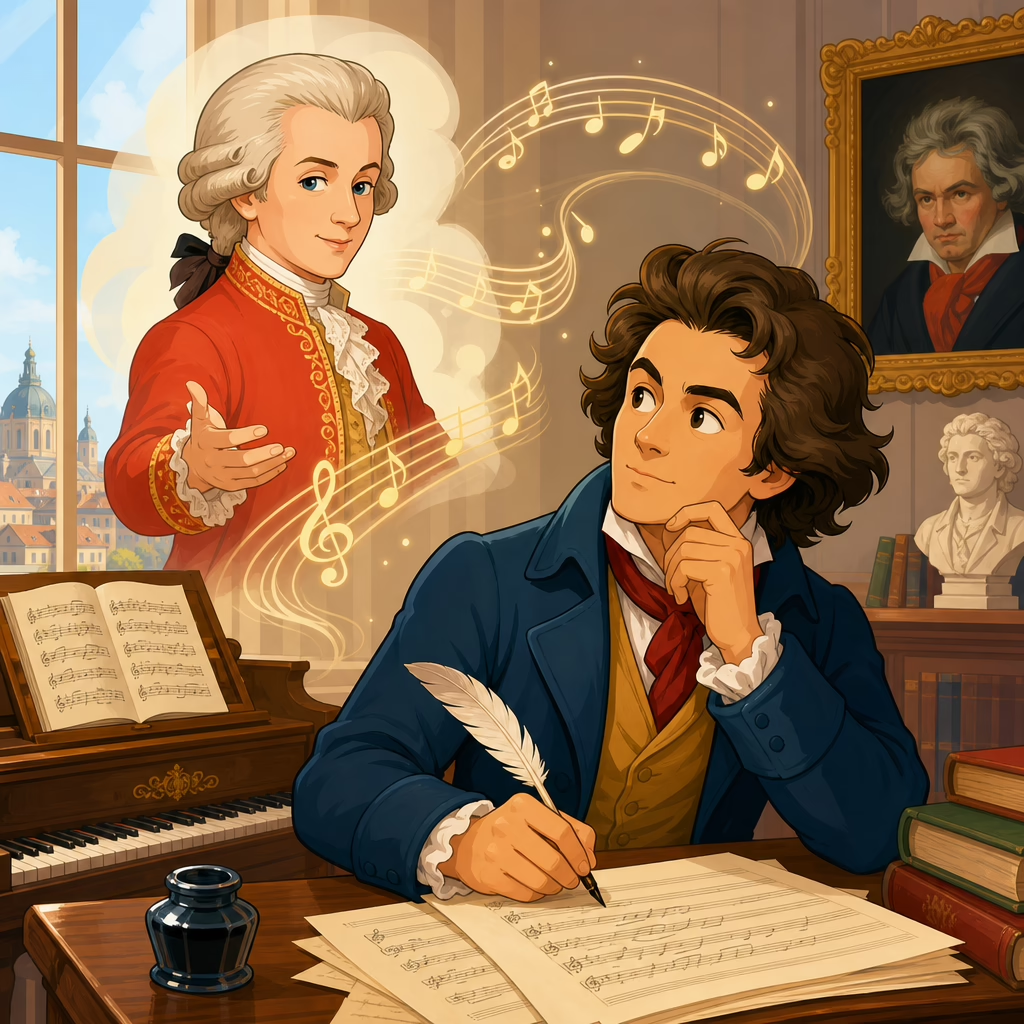
How Mozart Influenced Beethoven’s Early Style
Wolfgang Amadeus Mozart shaped Ludwig van Beethoven’s early style in ways that were structural, expressive, pianistic, and strategic, and understanding that influence is essential to understanding how Beethoven became Beethoven. When musicians speak about “early Beethoven,” they usually mean the works from roughly the Bonn years through the first Viennese decade, culminating around the turn of the nineteenth century. “Style” in this context is not a vague label. It includes formal design, melodic construction, harmonic pacing, keyboard texture, chamber dialogue, dramatic timing, and even the way a composer positions himself in relation to audiences and patrons. I have spent years comparing scores, teaching sonata form, and listening for what younger composers borrow before they transform it, and Beethoven’s relationship to Mozart is one of the clearest case studies in Western music. Mozart gave Beethoven a living model of how Classical language could sound elegant, emotionally alert, and theatrically alive without losing structural discipline. Beethoven absorbed that model deeply, then toughened it, expanded it, and pushed it toward a new century.
This matters because the old shorthand—Mozart graceful, Beethoven heroic—hides the real continuity between them. Beethoven did not emerge fully formed as the composer of the “Eroica” Symphony or the late quartets. His early piano sonatas, chamber works, concertos, and variation sets show a younger musician studying what Mozart had already solved: how to balance lyricism with motivic economy, how to make a piano sing and argue at once, how to use silence and surprise, and how to write music that satisfies connoisseurs while still landing with audiences. Beethoven probably encountered Mozart’s music intensively in Bonn before moving to Vienna, where Mozart’s works remained central to performance culture even after Mozart’s death in 1791. The result is not imitation in the shallow sense. It is apprenticeship through repertoire. To trace Mozart’s influence on Beethoven’s early style is to hear Beethoven learning the grammar of Viennese Classicism from its most fluent speaker, then developing a dialect unmistakably his own.
Beethoven’s Mozart education in Bonn and Vienna
Before Beethoven became Vienna’s most talked-about young composer-pianist, he was a court musician in Bonn exposed to a serious repertory under Elector Maximilian Franz. The Bonn environment mattered. Beethoven played viola in the court orchestra, encountered opera, and absorbed a repertoire that included Mozart’s stage works and instrumental music. By the late 1780s, Mozart’s piano concertos, symphonies, and chamber pieces were not abstract monuments; they were practical models for ambitious musicians. Beethoven’s teachers and colleagues knew that Mozart represented the highest standard of modern composition. That is why Mozart influence on Beethoven was not occasional. It was built into the musical air he breathed.
The famous but uncertain story that the teenage Beethoven played for Mozart in Vienna in 1787 is less important than the documented stylistic evidence. Whether or not Mozart predicted his future, Beethoven clearly studied his music intensely. After relocating permanently to Vienna in 1792, Beethoven entered a city where Mozart’s authority remained immediate. Lessons with Haydn, work with Albrechtsberger and Salieri, and constant public performance all took place against a Mozartian backdrop. In practical terms, that meant Beethoven learned what audiences expected from a sonata exposition, what keyboard brilliance sounded idiomatic, and how a chamber movement could unfold through conversation rather than accompaniment. These are specific inheritances, not general admiration.
How Mozart shaped Beethoven’s early piano writing
The piano was the most obvious channel through which Beethoven absorbed Mozart. In Mozart’s mature keyboard style, Beethoven found clarity of texture, flexible phrase rhythm, singing right-hand lines, and left-hand patterns that support without clogging the harmony. Early Beethoven sonatas often begin from that world. Listen to the Op. 2 sonatas or the Op. 7 Sonata and you hear a composer using Mozartian balance: clear periodic themes, transparent passagework, Alberti-derived support figures transformed into more muscular textures, and elegant dialogue between registers. Beethoven’s innovation lies in pressure, but the underlying keyboard rhetoric often starts with Mozart.
One revealing example is Beethoven’s Piano Concerto No. 1 in C major, Op. 15. Although published first, it follows Mozart’s concerto model closely: orchestral ritornello framing, poised thematic presentation, and solo writing that alternates brilliance with vocal lyricism. The slow movement especially shows Beethoven learning from Mozart’s ability to suspend time through ornamented song. Yet Beethoven enlarges the rhetoric through stronger accents, denser development, and a more assertive solo persona. In lessons and rehearsals, I often point out that Beethoven’s early keyboard textures are not simply louder Mozart. They preserve Mozart’s clean articulation and dramatic pacing while introducing heavier bass emphasis and more insistently worked motives.
Form, phrase structure, and the discipline of Classical architecture
Mozart taught Beethoven how to make form audible. That may sound basic, but it is one of the deepest parts of Mozart’s influence. In Mozart, exposition, development, recapitulation, and coda are not academic compartments. They are dramatic spaces with changing levels of tension and release. Beethoven’s early works show how carefully he learned that lesson. The first movement of Beethoven’s Piano Sonata in F minor, Op. 2 No. 1, for instance, uses compact motives and sharp contrasts, but its architecture remains legible because Beethoven controls phrase length, cadential arrival, and tonal balance in a thoroughly Classical way.
What Beethoven particularly gained from Mozart was command over phrase design. Mozart could write four-bar units that feel inevitable, then destabilize them through extension, overlap, or deceptive harmonic motion. Beethoven’s early style uses that same toolkit. The difference is degree. Where Mozart often lets asymmetry create wit or tenderness, Beethoven uses it to create urgency. This is why Beethoven’s early sonata form feels both inherited and energized. The discipline came from Mozart and Haydn alike, but Mozart offered a special model of formal fluency: structure that sounds natural rather than schematic. Without that model, Beethoven’s later expansions would have had less coherence.
Opera, lyricism, and dramatic characterization
One of the most underrated ways Mozart influenced Beethoven’s early style is through operatic thinking. Mozart’s operas taught European composers how music can reveal character through pacing, contrast, and melodic profile. Beethoven, even in instrumental works, often thinks dramatically. Themes enter like personalities. Transitions interrupt, negotiate, or resist. Slow movements unfold like arias without words. That instinct owes much to Mozart. In Beethoven’s early chamber music and piano concertos, lyrical secondary themes often carry a vocal quality traceable to Mozart’s mature operatic style, especially the capacity to combine expressive warmth with formal control.
Beethoven’s admiration for Mozart’s operatic command can also be sensed in his handling of ensemble texture. In Mozart, instruments converse. They do not merely fill harmony. Beethoven’s String Trios, Op. 9, and early violin sonatas show the same principle. Inner voices matter, exchanges are pointed, and accompaniment figures frequently become thematic agents. This conversational writing is central to Classical style, but Mozart refined it with exceptional theatrical intelligence. Beethoven adopted that intelligence early. Even when his rhetoric becomes more forceful than Mozart’s, the underlying concept of musical dialogue remains visible. That is one reason Beethoven’s early chamber works feel so alive in performance.
Direct models: works and techniques Beethoven studied
Specific Mozart works seem to have provided Beethoven with working models. Scholars and performers often note the relationship between Mozart’s Piano Concerto No. 24 in C minor, K. 491, and Beethoven’s Piano Concerto No. 3 in the same key. The emotional terrain is not identical, but the idea of a serious, symphonically weighted minor-key concerto with concentrated drama clearly mattered to Beethoven. Likewise, Beethoven’s wind writing in early chamber and orchestral works shows close attention to Mozart’s mature handling of clarinets, bassoons, and horns as independent coloristic voices rather than mere harmonic padding.
| Mozart model | Beethoven early response | What changed |
|---|---|---|
| Piano concertos K. 466, K. 491, K. 503 | Piano Concertos Op. 15, Op. 19, Op. 37 | More forceful solo rhetoric and denser development |
| String quartets dedicated to Haydn | Op. 18 String Quartets | Sharper contrasts and stronger motivic insistence |
| Operatic lyricism and ensemble balance | Early violin sonatas and chamber works | Greater dramatic compression and accentuation |
| Transparent keyboard textures | Op. 2, Op. 7, Op. 10 piano sonatas | Heavier bass drive and broader dynamic range |
The variation principle is another direct link. Mozart’s variations often preserve surface elegance while quietly testing harmony, register, and character. Beethoven’s early sets, including his many published variations for piano, show him using the genre as a laboratory. He learned from Mozart how to keep a listener oriented while changing texture, pulse, figuration, and emotional weight. In my experience coaching these pieces, players often miss how much discipline lies beneath the virtuosity. Beethoven’s later transformations become radical, but the early habit of extracting multiple characters from one theme is strongly Mozartian in method.
Where Beethoven departed from Mozart
Influence matters most when it clarifies difference. Beethoven’s early style is shaped by Mozart, but it is never confined by him. The most obvious divergence is rhythmic insistence. Beethoven tends to turn motives into engines. A short cell can dominate a movement with a persistence rarer in Mozart. He also thickens textures more readily, gives the bass greater argumentative force, and uses sforzandi and sudden dynamic shifts with a new level of confrontation. Mozart can shock, certainly, but Beethoven makes disruption a core expressive resource much earlier and more systematically.
Another difference lies in scale. Even before the middle period, Beethoven often enlarges codas, intensifies transitions, and treats development sections as sites of conflict rather than elegant modulation. His Op. 18 quartets still show Mozart’s influence in texture and dialogue, yet their argumentative energy points beyond Mozart’s equilibrium. This is why the question is not “Did Beethoven copy Mozart?” but “How did Beethoven use Mozart as a foundation for expansion?” The answer is that Mozart gave him compositional solutions; Beethoven turned them into pressure points. He preserved clarity while amplifying tension, and that combination defines the best of early Beethoven.
Why this influence still matters for listeners and for the wider Beethoven inspirations hub
Understanding Mozart’s role in Beethoven’s early style helps listeners hear continuity instead of myth. Beethoven’s originality becomes more impressive, not less, when we recognize how deliberately he learned from Mozart’s formal grace, pianistic sophistication, chamber dialogue, and dramatic lyricism. For readers exploring Beethoven’s inspirations and influence, this topic connects naturally to pages on Haydn, C. P. E. Bach, Handel, operatic models, piano culture in Vienna, and Beethoven’s later impact on composers from Schubert to Brahms. Mozart sits near the center of that network because he offered Beethoven both repertory and a benchmark.
The key takeaway is simple: Mozart influenced Beethoven’s early style by giving him a masterclass in how Classical music could speak clearly, move deeply, and sustain large forms through proportion and character. Beethoven then intensified that inheritance until it became unmistakably his own. If you want to hear the process for yourself, compare Mozart’s late piano concertos, quartets, and operatic ensembles with Beethoven’s Op. 2 sonatas, first three piano concertos, and Op. 18 quartets. Follow the shared language, then listen for the new pressure Beethoven adds. That is where influence becomes transformation, and where this entire subtopic begins to make sense.
Frequently Asked Questions
How did Mozart influence Beethoven’s early musical style most directly?
Mozart influenced Beethoven’s early style in several closely connected ways, especially through formal clarity, thematic balance, expressive control, and keyboard writing. In Beethoven’s early works, you can hear a strong absorption of Mozart’s approach to musical architecture: phrases are often neatly proportioned, themes are clearly profiled, and movements unfold with a sense of logic that feels both elegant and inevitable. This is one of the clearest signs of Mozart’s presence. Beethoven did not begin by inventing an entirely new language from nothing; he learned by working within the highest Classical models available to him, and Mozart was one of the most important of those models.
That influence also appears in the way Beethoven handles contrast. Mozart was a master of setting one musical idea against another without losing coherence, and Beethoven adopted that principle early on. In sonata movements, for example, Beethoven learned how to create drama through the opposition of themes, keys, textures, and moods while still maintaining structural unity. At the same time, Mozart’s expressive range gave Beethoven a model for writing music that could be graceful, lyrical, witty, tense, and emotionally searching within a single movement.
On the pianistic side, Mozart helped shape Beethoven’s early understanding of what keyboard writing could accomplish. Mozart’s piano music combines brilliance with transparency, and Beethoven’s early piano sonatas often reflect that inheritance. Even when Beethoven’s personality pushes toward greater force and density, the underlying discipline of Mozartian texture and articulation remains visible. In short, Mozart gave Beethoven a framework: how to build a movement, how to shape melody, how to dramatize contrast, and how to write for the piano in a way that is both idiomatic and expressive. Beethoven’s originality emerged through that framework, not apart from it.
In what ways did Beethoven’s early works resemble Mozart’s music?
Beethoven’s early works resemble Mozart’s music most noticeably in their formal design, phrase structure, melodic elegance, and conversational texture. In many early compositions, Beethoven uses the Classical language that Mozart had refined to an exceptional level: balanced antecedent-consequent phrasing, clear tonal planning, lucid accompaniment patterns, and themes that are memorable without being overstated. This resemblance is especially apparent in Beethoven’s early piano sonatas, chamber music, and works from his transition from Bonn to Vienna.
Another important similarity lies in the treatment of sonata form. Mozart’s example showed Beethoven how an opening theme could establish character quickly, how a contrasting second group could deepen rather than merely interrupt the argument, and how development sections could generate tension by transforming compact motives. Beethoven would later stretch and intensify these procedures far beyond Mozart’s typical scale, but in his early period he often works from Mozartian premises. The result is music that sounds disciplined, proportionate, and rooted in late eighteenth-century Viennese Classicism.
There is also a strong resemblance in expressive tact. Mozart had an extraordinary ability to sustain emotional nuance without sacrificing formal poise, and early Beethoven often follows that model. Rather than relying only on sheer power, he frequently writes with delicacy, irony, grace, and lyric inwardness. His textures can feel surprisingly transparent, his ornamentation can be refined, and his slow movements often reveal a singing style that owes much to Mozart’s cantabile sensibility.
That said, resemblance does not mean imitation in a simplistic sense. Even where Beethoven sounds closest to Mozart, there are signs of a different temperament: sharper accents, more muscular rhythms, stronger motivic insistence, and a tendency to push material toward higher levels of tension. The early resemblance is real, but it is best understood as Beethoven learning from Mozart’s language while beginning to bend it toward his own expressive priorities.
Did Beethoven simply imitate Mozart, or did he transform Mozart’s influence into something original?
Beethoven did not simply imitate Mozart; he absorbed Mozart’s methods and then transformed them. That distinction is crucial. All major composers begin by learning existing styles, and Beethoven’s early engagement with Mozart was part of a larger process of mastering the Classical tradition. What makes Beethoven remarkable is not that he borrowed from Mozart, but that he learned how to turn inherited forms and gestures into vehicles for a much more concentrated and forceful kind of musical argument.
One of the clearest examples of this transformation is Beethoven’s handling of motive. Mozart’s themes are often beautifully shaped and highly expressive, but Beethoven tends to seize on small cells and drive them more insistently through a movement. Even when the surface style may recall Mozart, the inner pressure often feels different. Beethoven compresses, repeats, fragments, and develops ideas with unusual intensity. This gives his early music a stronger sense of propulsion and struggle, even within forms that remain recognizably Classical.
He also transforms Mozart’s dramatic contrasts. Mozart could move fluidly between light and shadow, elegance and agitation, but Beethoven often sharpens those contrasts into something more confrontational. Dynamic changes become more emphatic, rhythmic patterns more commanding, and cadences more strategic. In this sense, Beethoven took Mozart’s lessons in structure and expression and infused them with a heightened sense of will.
Perhaps the best way to understand the relationship is to say that Mozart helped teach Beethoven how to speak the language of Viennese Classicism, but Beethoven quickly developed a different accent. The syntax, so to speak, may initially sound Mozartian, but the rhetoric becomes unmistakably Beethovenian. His originality lies not in rejecting influence, but in converting influence into a new mode of musical thought.
Why is Mozart’s influence especially important for understanding early Beethoven rather than middle or late Beethoven?
Mozart’s influence is especially important in early Beethoven because this is the period when Beethoven was still working most directly within inherited Classical norms. During his Bonn years and first decade in Vienna, he was establishing himself as a composer and pianist in a musical culture shaped profoundly by Haydn and Mozart. To understand how Beethoven developed, it matters enormously to hear what he inherited before tracing how he expanded, challenged, and eventually redefined that inheritance.
In the early period, Mozart’s presence is often close to the surface. The proportions of movements, the elegance of thematic presentation, the treatment of accompaniment, and the interplay between lyricism and structure all show how deeply Beethoven had internalized Mozart’s example. These features become the baseline against which Beethoven’s innovations can be measured. Without recognizing that baseline, it is easy to mishear Beethoven as if he arrived already fully formed in his heroic middle style. In reality, the path to the “Eroica” Beethoven runs through a phase of disciplined engagement with Mozartian and Haydnesque principles.
By the middle period, Beethoven’s style becomes more expansive, disruptive, and unmistakably individual. Forms grow larger, developments become more dramatic, codas take on unprecedented weight, and expressive aims become more public and monumental. Mozart’s influence does not vanish, but it becomes less central as Beethoven’s own mature procedures dominate the musical surface. In the late works, the picture is more complex still: Beethoven draws on many traditions, including counterpoint, variation practice, and a highly personal reimagining of Classical form.
So Mozart matters especially in early Beethoven because that is where the process of formation is most audible. If you want to understand how Beethoven became Beethoven, you listen first to the music in which Mozart’s influence is still clearly present, and then to the ways Beethoven begins stretching that influence into something unprecedented.
Which aspects of Mozart’s style did Beethoven adopt in piano writing, expression, and musical strategy?
In piano writing, Beethoven adopted from Mozart a refined sense of keyboard idiom: clarity of texture, intelligent distribution of registers, elegant passagework, and the ability to make melody and accompaniment interact naturally. Mozart’s piano style is often transparent rather than thick, and early Beethoven learned a great deal from that transparency. Even when Beethoven writes with greater weight, the basic lesson remains Mozartian: the piano should speak clearly, articulate character instantly, and sustain a dialogue between brilliance and singing tone.
In expressive terms, Beethoven absorbed Mozart’s ability to combine emotional depth with formal composure. Mozart showed that intensity does not require disorder. A movement can be lyrical, tragic, playful, or deeply unsettled while still remaining perfectly shaped. Early Beethoven frequently follows this model, especially in slow movements and in passages where emotional nuance depends on subtle harmonic coloring rather than overt theatricality. Mozart also offered Beethoven a model of expressive multiplicity, the capacity to shift mood rapidly yet convincingly within a single movement.
Strategically, Mozart influenced Beethoven in how to manage expectations. This includes how to introduce themes for maximum memorability, how to balance symmetry with surprise, how to delay or redirect cadences, and how to use contrast as a structural tool rather than mere decoration. Beethoven learned that large-scale impact depends on control: control of timing, pacing, tension, release, and return. That strategic intelligence is one of Mozart’s deepest gifts to him.
What Beethoven then did with those lessons was characteristically bold. He intensified the rhetoric, increased the dynamic span, and made motivic work more insistent. But the foundation is unmistakable. In piano writing, in expressive design, and in broader compositional strategy, Mozart helped equip Beethoven with the technical and artistic means to establish himself. Understanding that inheritance makes Beethoven’s later departures all the more impressive, because