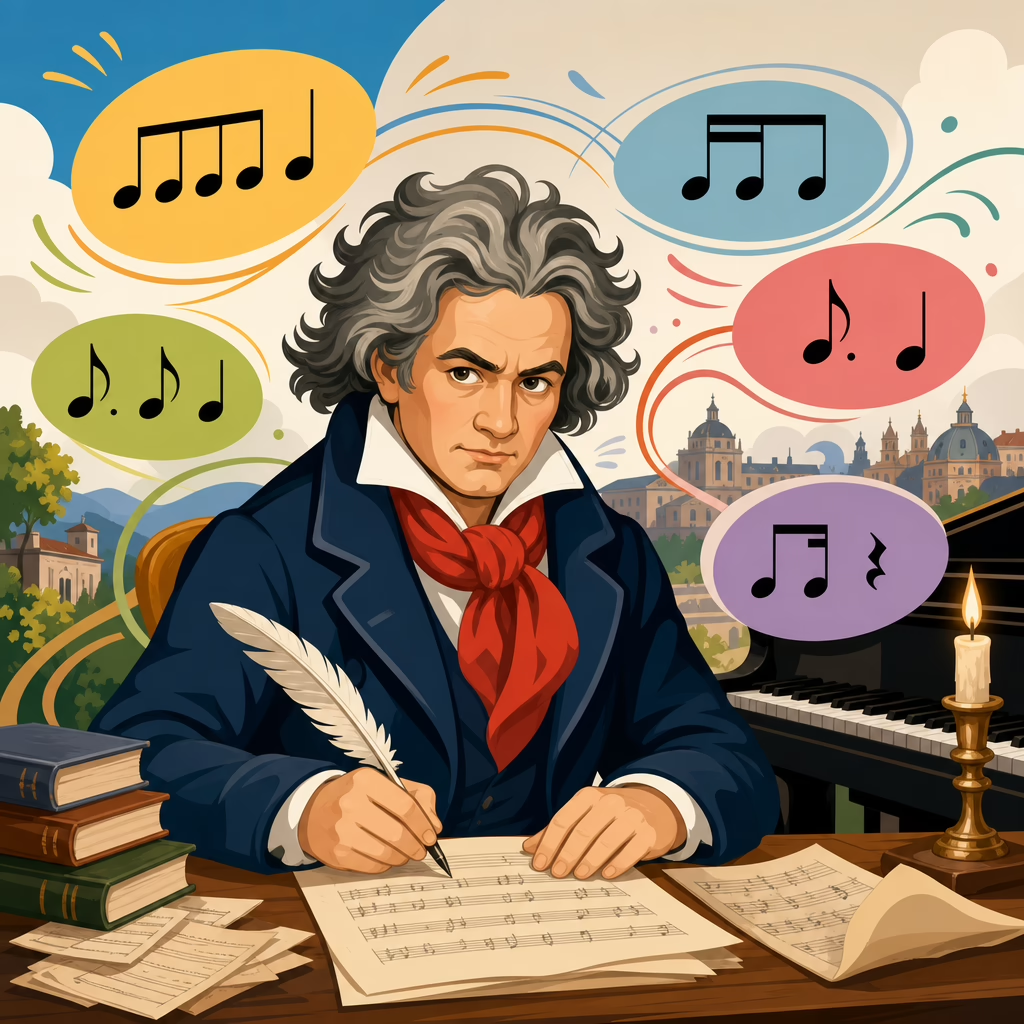
Common Rhythmic Motifs in Beethoven’s Works
Common rhythmic motifs in Beethoven’s works are among the clearest fingerprints of his style, shaping momentum, tension, and memorability across symphonies, sonatas, quartets, and chamber music. In this sub-pillar hub under Beethoven’s Compositional Tools, “rhythmic motif” means a short, recognizable pattern of durations, accents, rests, or repeated pulses that can be developed throughout a movement. Beethoven did not treat rhythm as background support for melody; he used it as primary material. When listeners identify the four-note opening of the Fifth Symphony, the pounding dotted figures of the “Pathétique,” or the obsessive drive of many scherzos, they are responding first to rhythm. That matters because rhythmic design helps explain why Beethoven’s music feels urgent, argumentative, and structurally inevitable even when the melodic content is sparse. From my own score study and rehearsal work, the most revealing moments are often not the famous themes themselves but the tiny rhythmic cells that keep returning in altered form. This article surveys the common rhythmic motifs that appear across Beethoven’s output, shows how they function in real pieces, and provides a hub-level map for exploring related articles on his compositional methods. If you want to understand Beethoven’s musical language beyond biography and masterwork lists, start with rhythm.
Short-short-short-long and the power of compressed cells
The most famous Beethoven rhythmic motif is the short-short-short-long pattern, often counted as three quick attacks followed by a sustained note. Its canonical example is Symphony No. 5 in C minor, first movement, where the opening four notes establish both rhythm and character before harmony has fully stabilized. The reason this cell matters is not simply its recognizability. Beethoven builds transitions, accompaniments, sequences, and climaxes from the same durational profile, proving that a rhythmic idea can unify an entire movement. In practical analysis, this is motivic economy: a small cell generates large form. Similar compressed cells appear elsewhere, though not always in the same exact shape. In the Piano Sonata in C minor, Op. 13, Beethoven uses terse, charged rhythmic attacks to create declamatory force. In string quartets and piano trios, he often strips a passage down to repeated rhythmic insistence, then reharmonizes or re-registers it. The lesson is that Beethoven’s motifs are rarely decorative tags. They act as engines of development. For performers, articulating the cell consistently while allowing dynamic and harmonic context to change is essential. For listeners, these compact patterns explain why a movement can feel tightly argued even through dramatic contrasts.
Dotted rhythms, martial rhetoric, and ceremonial weight
Dotted rhythms are another recurring Beethoven tool, and they carry distinct expressive associations. A dotted rhythm typically lengthens the first note and snaps into a shorter follower, producing firmness, grandeur, or a march-like edge. Beethoven inherited this rhetoric from Baroque overture style and Classical ceremonial writing, but he sharpened it with stronger accents and more abrupt formal deployment. The “Pathétique” Sonata opens with grave dotted figures that sound almost public in tone, like a formal announcement translated to the keyboard. In the “Eroica” Symphony, dotted rhythm contributes to the heroic profile of themes and fanfares. Beethoven also uses dotted gestures ironically or disruptively, placing them in unstable harmonic contexts so that a rhythm associated with order starts to feel strained. I have found that these passages become clearer when one tracks not just the notes but the accent logic: the dotted figure often projects hierarchy, telling the ear where authority lies. Yet Beethoven rarely leaves such authority unchallenged. He may fracture the figure, sequence it through remote keys, or answer it with smoother note values. That dialectic between firmness and destabilization is central to his mature style and links this topic to related studies of Beethoven’s rhetoric, formal drama, and expressive contrast.
Repeated notes, pedal pulses, and obsessive rhythmic drive
One of Beethoven’s most effective strategies is the use of repeated notes or pedal-like rhythmic pulses to generate pressure. In many works, a single reiterated pitch or accompanimental figure can feel more urgent than a lyrical theme. The Piano Sonata in D minor, Op. 31 No. 2, often called “Tempest,” offers striking examples of repeated rhythmic activity creating suspense before melodic release. In the Seventh Symphony, steady pulsation becomes almost the subject itself; Richard Wagner famously called the work the “apotheosis of the dance,” and that judgment reflects Beethoven’s reliance on recurring pulse patterns rather than songlike melody alone. Repetition in Beethoven is seldom static. He changes orchestration, register, articulation, harmony, and dynamic profile so that the same pulse acquires new meaning. A repeated note can sound threatening in one context, humorous in another, and triumphant in a climax. This technique also supports long-range structure. By sustaining a motor rhythm through sequential passages, Beethoven can span large transitions without losing coherence. Analysts sometimes describe this as rhythmic saturation: the texture becomes dominated by one persistent cell. For composers and students, it is a reminder that insistence is not monotony when supported by harmonic motion and textural transformation.
Syncopation, off-beat accents, and rhythmic dislocation
Beethoven repeatedly animates his textures with syncopation and displaced accents, creating the sensation that meter is being tested from within. Syncopation occurs when expected strong beats are weakened or when notes are held across beats so that emphasis falls in unexpected places. In Beethoven’s hands, this can feel like resistance. The first movement of the “Eroica” contains syncopated tensions that intensify development, while late piano sonatas and quartets use off-beat articulation to blur the line between stable pulse and expressive disruption. This matters because Beethoven’s drama is often rhythmic before it is harmonic. A listener may sense conflict simply because the pattern refuses to sit comfortably in the bar. In rehearsal, these passages demand precise subdivision; otherwise, performers smooth over the very friction Beethoven wrote. Syncopation also helps Beethoven avoid predictability in phrase structure. Instead of allowing cadences and downbeats to align neatly, he delays arrival and increases suspense. The result is a musical argument that seems to push against its own framework. This hub connects naturally to deeper articles on Beethoven’s metric play, hemiola-like effects, and the relationship between rhythmic displacement and formal expansion in middle- and late-period works.
Scherzo rhythms, metric wit, and kinetic surprise
Beethoven transformed the inherited minuet into the scherzo partly through rhythm. Compared with the courtly balance of many eighteenth-century minuets, Beethoven’s scherzos are quicker, more volatile, and often built from abrupt rhythmic jokes. Sudden silences, whisper-to-shout dynamics, repeated-note flickers, and unexpected accent patterns all contribute to their character. The Scherzo of Symphony No. 9 demonstrates how a sharply profiled rhythmic idea can dominate a movement, while the symphonies, quartets, and piano sonatas repeatedly show Beethoven treating triple meter not as elegance but as propulsion. In my experience, scherzo rhythm is where Beethoven’s humor and ferocity often meet. A figure that seems playful at first can become obsessive through repetition or expansion. He also exploits contrast between scherzo and trio sections by shifting rhythmic density or articulation rather than merely changing melody. That makes the return of the scherzo material feel inevitable and freshly charged. For readers using this page as a hub, related articles should explore Beethoven’s treatment of dance types, his handling of trio texture, and his use of silence as a rhythmic event. In Beethoven, rests are never empty; they are part of the motif, shaping expectation as actively as sounded notes.
Common rhythmic motifs across Beethoven’s output
The following comparison summarizes recurring Beethoven rhythmic motifs, what they typically express, and representative works where they are especially audible.
| Rhythmic motif | Typical effect | Representative works |
|---|---|---|
| Short-short-short-long | Compression, urgency, motivic unity | Symphony No. 5, String Quartet Op. 18 passages, motivic development across sonatas |
| Dotted figures | Grandeur, rhetoric, march or overture character | Piano Sonata Op. 13 “Pathétique,” Symphony No. 3 “Eroica” |
| Repeated-note pulse | Drive, suspense, cumulative pressure | Symphony No. 7, Piano Sonata Op. 31 No. 2 “Tempest” |
| Syncopation and off-beat stress | Instability, resistance, delayed arrival | Symphony No. 3, late sonatas, late quartets |
| Scherzo flicker with rests | Humor, surprise, kinetic unpredictability | Symphony No. 9 Scherzo, symphonic and quartet scherzos |
| Triplet versus duplet friction | Surface tension, textural animation | Many piano sonatas, concerto transitions, developmental passages |
This overview is not exhaustive, but it captures the motifs most useful for orientation. Beethoven recombines them constantly, and a single movement may feature several at once. That combinatorial flexibility is a major reason his rhythmic language remains so distinctive.
How Beethoven develops rhythm across form, texture, and genre
A crucial point for any hub article on Beethoven’s compositional tools is that rhythmic motifs do not stay fixed. Beethoven develops them through augmentation, diminution, fragmentation, displacement, and textural transfer. Augmentation stretches a motif into longer note values, often making a previously urgent cell sound monumental. Diminution compresses it, increasing energy. Fragmentation isolates part of a pattern, allowing it to circulate independently. Displacement shifts the motif against the bar line, unsettling meter. Textural transfer moves the rhythm from melody to accompaniment, bass line, inner voices, or full ensemble. These operations appear across genres. In piano sonatas, Beethoven can spotlight rhythm through registral contrast and articulation. In symphonies, orchestration lets him assign the same motif to strings, winds, brass, or timpani, changing its force without changing its identity. In quartets, the intimacy of four voices reveals how rhythmic motives can pass conversationally from part to part. This is why Beethoven rewards close listening and close reading of scores. The same tiny pattern can govern local gesture and large-scale architecture simultaneously. If you are building expertise in Beethoven’s methods, the next logical steps from this miscellaneous hub are dedicated studies of motif transformation, phrase rhythm, meter, accompaniment patterns, and the relation between rhythmic design and sonata form. Rhythm is not a side issue in Beethoven. It is one of the main ways he thinks.
Common rhythmic motifs in Beethoven’s works provide a practical entry point into his entire compositional world. Short compressed cells, dotted proclamations, repeated-note drive, syncopated resistance, and scherzo wit all show the same principle: Beethoven turns small rhythmic ideas into structural arguments. That is why his music often feels both memorable and inevitable. Even when themes are simple, the rhythmic profile carries identity, emotion, and form. For students, performers, and curious listeners, this matters because rhythm is often easier to trace than harmony on a first encounter, yet it leads directly to deeper analysis. Use this hub as a map for the broader “Miscellaneous” area within Beethoven’s Compositional Tools, then move outward to linked topics such as motivic development, metric ambiguity, dance influence, accompaniment design, and late-style compression. The more you listen for recurring durations, accents, and rests, the more Beethoven’s craft becomes audible. Start with the Fifth Symphony, the “Pathétique,” the Seventh, and a late quartet, and follow the rhythmic cells from opening gesture to final cadence.
Frequently Asked Questions
What is a rhythmic motif in Beethoven’s music, and why is it so important to his style?
A rhythmic motif in Beethoven’s music is a short, recognizable pattern of durations, accents, rests, or repeated pulses that returns often enough to shape a movement’s identity. It may be as compact as a few notes, but its effect can be enormous. In Beethoven’s hands, rhythm is not merely a frame for melody or harmony. It is often the central idea from which an entire passage, section, or movement grows. This is one reason listeners so often experience Beethoven’s music as unusually direct, memorable, and driven. Even when the melodic material changes, the rhythmic profile can continue to unify the music and keep the listener oriented.
What makes this especially important in Beethoven is the way he develops rhythmic cells with relentless logic. A small pattern may first appear plainly, then return in sequence, in a different register, under harmonic tension, in fragmented form, or distributed across multiple instruments. The motif can become the engine of momentum, the source of conflict, or the thread that ties contrasting themes together. This approach helps explain why so many Beethoven movements feel tightly constructed: the listener is not simply hearing one tune after another, but rather a persistent rhythmic identity being tested, expanded, and transformed.
In practical terms, rhythmic motifs also let Beethoven create tension without relying solely on speed or volume. Repetition, syncopation, off-beat stress, sudden rests, and obsessive pulse patterns can all produce urgency. Because of this, rhythm in Beethoven often feels active and argumentative. It pushes forward, interrupts itself, resists closure, and then reasserts control. That quality is one of the clearest fingerprints of his compositional voice across symphonies, sonatas, quartets, and chamber works.
What are some of the most common rhythmic motifs Beethoven uses across his works?
Several recurring rhythmic types appear again and again in Beethoven’s output, even though he continually reshapes them for different expressive ends. One of the most famous is the short-short-short-long pattern, often discussed because of its role in the Fifth Symphony, but that figure is only one example of a broader Beethovenian habit: building large structures from compact, sharply profiled rhythmic cells. He frequently uses repeated-note figures, driving ostinato-like pulses, dotted rhythms, syncopations, sforzando-accented attacks, and gestures that alternate motion with abrupt rests. These are not decorative features; they are structural tools.
Repeated-note rhythms are especially important. Beethoven can turn them into insistence, agitation, suspense, or mechanical drive depending on context. Dotted rhythms, by contrast, often add firmness, ceremonial weight, or a sense of rhetorical declaration. Syncopated figures destabilize the meter and create friction between the expected pulse and the actual accents, something Beethoven uses to intensify drama without changing the fundamental meter. Sudden rests or withheld downbeats are equally characteristic, because they create the sensation of interruption or delayed release. In many movements, the silence between attacks matters almost as much as the attacks themselves.
Another common tendency is rhythmic compression and expansion. A motif may first appear in a stable form, then Beethoven shortens it, fragments it, overlaps it, or stretches it across a wider span. This makes the rhythm feel alive rather than fixed. In sonata movements, scherzos, and finales especially, these recurring rhythmic designs often become the basis for development sections and transitions. Instead of treating themes as self-contained melodies, Beethoven frequently extracts the rhythmic core and uses that core as the true material of composition.
How does Beethoven develop a simple rhythmic idea into an entire movement?
Beethoven’s method often begins with extraordinary economy. He introduces a concise rhythmic figure and then subjects it to continuous reinterpretation. That process can include repetition, sequencing, inversion of accent patterns, fragmentation into smaller units, shifts in harmony, transfer between instruments, and changes in dynamics or articulation. The key point is that the motif remains recognizable enough to preserve coherence while being varied enough to sustain interest. This balance between sameness and transformation is one of Beethoven’s greatest strengths.
In many movements, the rhythmic motif acts as a kind of generative seed. It may underlie the principal theme, reappear in accompaniment figures, surface in transitions, and then dominate the development section in increasingly compressed or unstable forms. Even a lyrical second theme may share a hidden rhythmic relationship with the opening material. That is why Beethoven’s movements can feel more unified than they first appear: the continuity often lies not only in melody or key relationships, but in the persistence of rhythmic character.
He also uses rhythm to control large-scale drama. A motif may begin with firmness and clarity, then be broken apart as the music moves into conflict, then return with greater force at a structural climax. In other cases, a repeated rhythmic cell can create mounting pressure simply through accumulation. Because Beethoven thinks architecturally, rhythmic development is not random variation. It usually serves form. It marks transitions, drives developmental argument, prepares climaxes, and helps make the recapitulation feel earned rather than merely repeated. This is one reason analysis of Beethoven so often begins with a small rhythmic gesture and ends with an understanding of the whole movement.
Why does the short-short-short-long pattern matter so much in discussions of Beethoven?
The short-short-short-long pattern matters because it has become the most famous example of Beethoven’s ability to derive monumental musical consequences from minimal material. Its prominence in the Fifth Symphony has made it emblematic of his style, but its importance goes beyond simple familiarity. The pattern demonstrates how a compact rhythmic idea can function as theme, motive, accompaniment impulse, and structural binder all at once. It is easy to recognize, but difficult to exhaust, which makes it ideal for Beethoven’s developmental procedures.
Part of its power comes from its ambiguity and adaptability. The figure can sound like a command, a knock, a burst of energy, a breathless push, or a destabilizing interruption, depending on harmony, orchestration, articulation, and tempo. Beethoven can intensify it through repetition, shift it among instrumental groups, embed it in bass lines, or use it as a background pulse beneath more expansive melodic writing. In other words, the pattern is not just an opening hook. It becomes an organizing principle. That is exactly the kind of rhythmic thinking that defines much of Beethoven’s music.
It is also worth remembering that the fascination with this pattern should not reduce Beethoven’s rhythmic language to a single formula. The figure is famous because it vividly illustrates a larger truth: Beethoven had an exceptional ability to turn sharply defined rhythms into structural and expressive foundations. The short-short-short-long idea is the best-known case, but its real value in discussion is that it teaches listeners how Beethoven works more generally. Once you hear how rhythm can generate an entire musical argument in the Fifth Symphony, you begin to hear similar processes throughout the sonatas, quartets, concertos, and chamber music.
How can listeners identify common rhythmic motifs in Beethoven’s symphonies, sonatas, and chamber works?
A good way to identify rhythmic motifs in Beethoven is to listen for patterns that return even when the notes themselves change. Instead of focusing only on pitch, attend to the shape of durations and accents: Are there repeated short attacks followed by a longer note? Does a passage rely on repeated pulses? Is there a distinctive dotted figure, syncopation, or rest pattern that keeps resurfacing? Beethoven often hides unity in these recurring profiles. Once you begin hearing rhythm as thematic material, many movements become much easier to follow.
It also helps to compare different musical layers. A motif might first appear in the main theme, then migrate into accompaniment, inner voices, or bass lines. In chamber music and quartets especially, Beethoven frequently passes rhythmic identity from one instrument to another, creating conversation through shared pulse patterns rather than identical melodies. In piano sonatas, pay attention to left-hand figures as much as right-hand themes, because the rhythmic drive often resides in accompaniment textures that shape the character of the whole movement. In orchestral works, listen for how timpani, strings, and winds reinforce or challenge the same underlying rhythmic cell.
Finally, notice what happens at moments of tension. Beethoven often intensifies a movement by repeating a rhythmic figure more insistently, placing accents in unexpected places, or interrupting the flow with rests. These are strong clues that rhythm is doing structural work. A listener does not need formal analysis to hear this. If a passage feels especially driven, obsessive, suspenseful, or argumentative, a rhythmic motif is often responsible. The more you listen for recurrence, transformation, and accent pattern, the more clearly Beethoven’s rhythmic imagination comes into focus as one of the defining forces of his music.