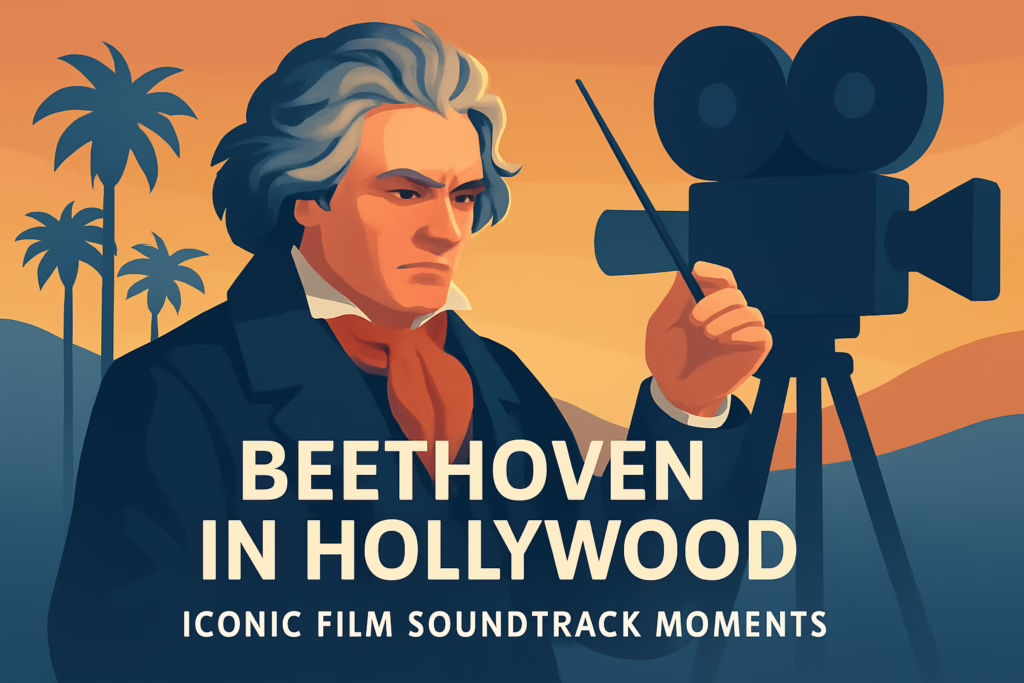
Beethoven in Hollywood: Iconic Film Soundtrack Moments
Beethoven has occupied a singular place in Hollywood for nearly a century, serving directors, composers, and music supervisors as shorthand for grandeur, menace, wit, obsession, and hard-won transcendence. In film, “Beethoven” usually means more than Ludwig van Beethoven the historical composer. It refers to a set of instantly recognizable motifs, especially the Fifth Symphony’s four-note opening, the pastoral expanses of the Sixth, the volcanic drama of the Seventh, and the choral idealism of the Ninth. Those works carry cultural baggage that audiences already understand, which makes them unusually powerful soundtrack tools. I have seen this firsthand in film analysis and music supervision work: when a scene uses Beethoven, viewers rarely hear it as neutral background. They hear authority, tension, destiny, civilization, rebellion, or irony before a line of dialogue lands. That is why Beethoven in Hollywood matters. His music helps films communicate complex emotional and thematic ideas quickly, across genres as different as war cinema, science fiction, animation, noir, romantic drama, and satire.
This article maps the key ways Beethoven functions in movies and highlights the most iconic film soundtrack moments built around his work. It also serves as a hub for the broader miscellaneous branch of Beethoven in pop culture, where references range from prestige cinema to cartoons, trailers, parody, and character branding. A soundtrack moment, in this context, is not merely a cue featuring a classical piece. It is a scene where the placement of Beethoven shapes audience interpretation, becomes inseparable from the film’s identity, or influences how later filmmakers use classical music. Hollywood here is used broadly, covering major American studio filmmaking and internationally known titles that circulate through the same mainstream film culture. Understanding these moments requires attention to both musicology and cinema craft: tempo, orchestration, diegetic versus non-diegetic placement, editorial rhythm, and the contrast between what the audience hears and what the image shows. When Beethoven appears on screen, filmmakers are almost always making an argument. The most memorable examples endure because the argument is clear, dramatically earned, and impossible to forget.
Why filmmakers return to Beethoven again and again
Directors rely on Beethoven because his music offers immediate recognizability without feeling disposable. A contemporary pop song can date a film to a specific release year, but Beethoven carries transhistorical weight. The Fifth Symphony can suggest fate knocking at the door, a phrase tied to nineteenth-century reception history even if the anecdote itself is partly mythologized. The “Ode to Joy” from the Ninth can evoke brotherhood, triumph, European high culture, or utopian aspiration. The Moonlight Sonata can imply introspection, mourning, or restrained turbulence. Those associations are useful because they let filmmakers build meaning efficiently.
There is also a practical reason. Beethoven’s major works sit securely in the public domain, which removes composition licensing barriers, though specific recordings still require clearance. That gives filmmakers freedom to commission new performances tailored to a scene’s tempo and texture. I have watched editors temp with famous recordings by Herbert von Karajan or Carlos Kleiber, then shift to bespoke versions once they know the emotional timing they need. Beethoven adapts well because his themes survive different orchestrations, recording styles, and acoustic treatments. A cue can sound polished and symphonic, intimate and chamber-like, distorted through a record player, or ominous in electronic arrangement while remaining unmistakable.
Most importantly, Beethoven brings built-in dramatic architecture. He wrote in long arcs, with strong rhythmic identities and sharply profiled transitions. That makes his music especially useful in montage, chase sequences, ironic counterpoint, and scenes where inner turmoil needs a formal musical mirror. Great soundtrack placement depends on fit, not prestige. Beethoven lasts in Hollywood because his structures and emotional range fit cinema exceptionally well.
A Clockwork Orange and the dark reinvention of Beethoven
No discussion of Beethoven in film can begin anywhere else. Stanley Kubrick’s A Clockwork Orange transformed Beethoven from a symbol of elevated culture into a tool for exploring violence, conditioning, and moral contradiction. The protagonist Alex adores Beethoven, especially the Ninth Symphony, and Kubrick uses that love to complicate any easy division between refinement and brutality. Beethoven does not civilize Alex. It energizes his fantasies and exposes the terrifying coexistence of aesthetic sensitivity and cruelty.
Wendy Carlos’s electronic arrangements were decisive. By synthesizing Beethoven, the film reframed canonical music through a futuristic, alienating sonic palette. The result was not respectful museum presentation but aggressive reinterpretation. In practical soundtrack terms, this mattered because the music no longer functioned as generic “classical.” It became part of the film’s world-building and psychological design. The Ninth in particular acquired a new cinematic life after Kubrick. For many viewers, its choral climax could never again be heard as purely uplifting. It now carried traces of satire, state power, and disturbed ecstasy.
The famous Ludovico treatment scenes demonstrate why the film remains a benchmark. Alex is conditioned to feel sick when exposed to violence, and Beethoven becomes collateral damage because it accompanies the films he is forced to watch. Kubrick turns a beloved masterpiece into evidence of spiritual mutilation. Few soundtrack moments better illustrate how preexisting music can be narratively weaponized. The scene is iconic not just because Beethoven is audible, but because the audience understands exactly what is being stolen from the character.
Immortal Beloved and Beethoven as emotional biography
Where Kubrick used Beethoven ironically, Immortal Beloved used him as biography, romance, and psychological excavation. Bernard Rose’s 1994 film is imperfect as history, and musicologists have pointed out its speculative approach to Beethoven’s love life. Yet its soundtrack strategy is often effective because it treats the compositions as narrative evidence. Instead of placing famous excerpts as decorative cues, the film ties specific works to memory, longing, ambition, and personal fracture.
The best-known example is the use of the Seventh Symphony’s second movement. That Allegretto has become a cinematic favorite because of its inexorable pulse and grave nobility, but in Immortal Beloved it works with particular force. The piece conveys forward motion without optimism, making it ideal for scenes of emotional reckoning. The film also draws on the Ninth Symphony and the Moonlight Sonata to connect public achievement with private torment. Even when the screenplay stretches historical certainty, the soundtrack captures an essential truth: Beethoven’s music is compelling in cinema when it is treated as a lived necessity rather than a heritage accessory.
For audiences new to the composer, the film also performed an educational function. It linked titles, themes, and emotional colors in accessible ways. That matters for a hub article on miscellaneous Beethoven in pop culture because many viewers meet classical repertoire through narrative film before they seek out complete performances. Hollywood often becomes the gateway.
Die Hard, Saturday Night Fever, and the power of quotation
Some of the most memorable Beethoven soundtrack moments are brief quotations rather than full-scale set pieces. In Die Hard, Michael Kamen incorporates the “Ode to Joy” into the score around Hans Gruber and the apparent elegance of the heist. The choice is witty and pointed. A theme associated with universal brotherhood shadows greed, performance, and criminal sophistication. Because the melodic reference is recognizable, the audience gets an extra layer of commentary without the film stopping to explain it.
This technique appears across Hollywood. A Beethoven quotation can signal intelligence, arrogance, order, or theatrical villainy in only a few bars. It is especially effective in thrillers because it gives antagonists cultural polish while hinting at emotional coldness. The same principle applies in comedy, where a grand Beethoven motif can exaggerate a small conflict to absurd scale.
Saturday Night Fever offers a different kind of example through the Fifth Symphony. The film is defined by disco, but the brief invocation of Beethoven in the opening credits tradition around “Night on Disco Mountain,” a disco adaptation structurally indebted to the Fifth, shows how deeply Beethoven’s motifs circulate in mainstream audio culture. Hollywood frequently uses such mediated Beethoven, not always in pure concert form. That matters because pop-cultural Beethoven is often Beethoven refracted through arrangement, pastiche, and genre blending rather than literal symphonic performance.
Children, comedy, and family films using Beethoven
Family films often deploy Beethoven to create instant contrast between elevated music and chaotic behavior. The 1992 film Beethoven, about the St. Bernard, is the obvious case, and its very title demonstrates how completely the composer’s name signifies oversized personality in popular culture. The movie’s score and marketing play on the association between Beethoven and grandeur, using it for affectionate comic inflation. A slobbering dog framed with cultural prestige becomes funny because the gap is so large.
Animation has done similar work for decades. Studios have paired Beethoven with slapstick chases, exaggerated conducting gags, or characters whose seriousness collapses under physical comedy. These uses can seem lightweight, but they perform important cultural labor. They keep Beethoven audible to audiences who may never attend a symphony concert, and they teach recognition through repetition. A child who laughs at a comic cue built on the Fifth Symphony is learning a musical reference that will reappear later in thrillers, advertisements, and prestige dramas.
There is a limitation, however. Repeated comic deployment can reduce Beethoven to a stock signifier of “fancy music.” The best family films avoid that flattening by letting the music retain some force of character. When the cue still sounds powerful on its own terms, the joke lands harder and the cultural memory sticks.
How Beethoven cues function across genres
Beethoven is unusually flexible because different works solve different storytelling problems. The table below shows common patterns I have seen repeatedly in mainstream film scoring and music supervision.
| Beethoven work | Common film use | Why it works on screen |
|---|---|---|
| Symphony No. 5, first movement | Fate, urgency, comic exaggeration, looming threat | The four-note motif is instantly identifiable and rhythmically forceful |
| Symphony No. 6 “Pastoral” | Nature, innocence, irony before disruption | Its lyric calm creates a strong contrast with conflict or urban intrusion |
| Symphony No. 7, second movement | Grief, procession, determination, historical drama | The repeating pulse sustains tension without sentimental excess |
| Symphony No. 9 “Ode to Joy” | Triumph, satire, villain elegance, public spectacle | The melody carries cultural prestige and collective emotional scale |
| Moonlight Sonata, first movement | Mourning, introspection, gothic mood, restrained danger | Its sparse texture and harmonic tension support intimate scenes |
| Für Elise | Recognition, irony, childhood lessons, sonic shorthand for classical music | Nearly every audience knows it within seconds |
Genre shapes interpretation. In horror, Beethoven can become uncanny because listeners expect dignity and receive dread. In war films, the same cue may underscore the collapse of European ideals. In romance, it can elevate longing or suggest impossible standards. In science fiction, especially after A Clockwork Orange, Beethoven can imply the persistence of old cultural artifacts inside technologically altered futures. The same piece changes meaning depending on framing, performance style, and what happens in the image.
Diegetic versus non-diegetic Beethoven: why placement changes meaning
One of the most important technical distinctions in film music is whether a piece is diegetic, meaning heard by the characters within the story world, or non-diegetic, meaning heard only by the audience as score. Beethoven behaves differently in each mode. When a character puts on a record of the Ninth Symphony, the choice reveals class aspiration, personal taste, education, emotional need, or manipulation. When the same music enters as score over a montage, it functions more like authorial commentary.
Filmmakers often blur these modes for dramatic effect. A scene may begin with a visible piano performance of the Moonlight Sonata and gradually expand into a fuller orchestral version beyond realistic acoustics. That transition tells the viewer to move from observed action into subjective interiority. I have found that some of the strongest Beethoven scenes use exactly this shift, because it honors the realism of performance while unlocking cinema’s ability to externalize thought and memory.
Placement also affects irony. A villain choosing Beethoven diegetically is a character statement. A director placing Beethoven non-diegetically over that villain’s actions is a judgment. The difference sounds subtle, but on screen it changes the entire ethical frame of a scene.
Lasting influence on trailers, prestige cinema, and soundtrack culture
Hollywood’s use of Beethoven has shaped media far beyond the original films. Trailer editors frequently borrow Beethoven-like rhythms, especially Fifth Symphony knock motifs, because they cut cleanly with action visuals. Prestige dramas still reach for the Seventh Symphony’s Allegretto when they want seriousness without syrup. Crime films and corporate satires continue to use “Ode to Joy” as a knowing contrast between idealistic rhetoric and self-interest. These are not isolated references. They form a shared audiovisual vocabulary.
That influence extends to original film scores. Composers from Michael Kamen to Hans Zimmer have written cues that do not quote Beethoven directly but inherit his sense of rhythmic propulsion, motivic development, and monumental climax. Filmmakers have also learned caution from overuse. A Beethoven cue can overwhelm a scene if the emotional meaning is too obvious or the recording too familiar. The most successful placements either deepen character, sharpen irony, or unlock scale that dialogue alone cannot provide.
For a miscellaneous hub within Beethoven in pop culture, that is the core takeaway. Beethoven in Hollywood is not a narrow topic about a few famous symphonies dropped into prestige films. It is a broad ecosystem of quotation, adaptation, parody, biography, children’s entertainment, villain coding, and emotional architecture. If you are exploring this subtopic further, follow the thread from A Clockwork Orange to Immortal Beloved, from Die Hard to family comedy and animation, and pay attention to how each film answers the same question differently: what does Beethoven mean here? Start with those scenes, listen closely to placement and context, and the larger map of Beethoven in pop culture will come into focus.
Frequently Asked Questions
Why does Beethoven appear so often in Hollywood film soundtracks?
Beethoven shows up in Hollywood again and again because his music is both emotionally powerful and immediately legible to audiences. Directors and music supervisors often need a piece of music that can communicate scale, tension, irony, nobility, or psychological intensity within seconds, and Beethoven does that better than almost anyone. His themes are memorable, his rhythmic ideas are bold, and his music carries enormous cultural prestige. Even viewers who cannot name a specific symphony usually recognize the emotional charge of the famous motifs, especially the opening of the Fifth Symphony or the surging momentum of the Seventh.
Just as importantly, Beethoven functions in film as a kind of cinematic shorthand. His music can suggest a character’s grandeur, obsession, education, instability, or longing for transcendence without lengthy exposition. In one context, a Beethoven cue can elevate a scene into something heroic or spiritual; in another, it can create dark irony by placing “high art” against violence, absurdity, or moral collapse. That flexibility is one reason he has remained so useful for filmmakers across genres, from prestige drama and wartime cinema to thrillers, science fiction, and satire. Hollywood has embraced Beethoven not simply because he is canonical, but because his music continues to solve storytelling problems with unusual force and clarity.
Which Beethoven works are most commonly used in movies, and why are they so effective?
The works most often associated with film are the Fifth Symphony, Sixth Symphony, Seventh Symphony, and Ninth Symphony, along with selected piano sonatas and shorter orchestral excerpts. The Fifth Symphony is perhaps the most iconic because its four-note opening is one of the most recognizable gestures in all of Western music. That motif can signal fate, urgency, confrontation, danger, or unstoppable momentum almost instantly. Filmmakers rely on it when they want a cue that feels monumental from the first beat.
The Sixth Symphony, often called the “Pastoral,” offers a different cinematic toolset. Its expansive, nature-filled character makes it ideal for scenes of reflection, landscape, innocence, or the fragile peace that may precede conflict. The Seventh Symphony is prized for its rhythmic drive and emotional volatility, especially the famous Allegretto, which has become a staple for scenes involving grief, resolve, solemn procession, or hard-won endurance. The Ninth Symphony, especially the “Ode to Joy,” carries an even larger symbolic burden. It can represent universal brotherhood, triumph, civilization, idealism, or, in darker films, the corruption of those very ideals. That range makes Beethoven uniquely effective in cinema: the same piece can function sincerely, ironically, or ambiguously depending on how the filmmaker frames it.
How do filmmakers use Beethoven to create irony, menace, or psychological complexity?
One of the most fascinating things about Beethoven in film is that his music is not used only for uplift or grandeur. Filmmakers frequently deploy it against expectation. A majestic Beethoven passage can be paired with disturbing imagery, morally compromised characters, or scenes of emotional breakdown, creating a tension between what the music traditionally signifies and what the audience is seeing. That clash can produce irony, deepen discomfort, or reveal something unsettling about a character who identifies with greatness while behaving monstrously or delusionally.
Beethoven is especially effective in psychologically complex scenes because his music often feels larger than ordinary life. It can suggest that a character experiences the world in extreme, even operatic terms. A director may use a Beethoven cue to imply obsession, inner torment, intellectual vanity, or a desperate hunger for meaning. In thrillers and psychologically charged dramas, the music can feel almost invasive, as though it is giving voice to a character’s private grandiosity or collapsing emotional boundaries. This is one reason Beethoven has remained so potent on screen: his music does not merely accompany emotion, it can complicate it. It can make a scene feel noble and threatening at the same time, or beautiful and deeply unstable.
What makes Beethoven different from other classical composers in Hollywood soundtracks?
Many classical composers appear in film, but Beethoven occupies a particularly distinctive place because his music combines immediate recognizability with extraordinary emotional and symbolic breadth. Mozart may suggest elegance, wit, or formal brilliance; Bach may imply order, spirituality, or intellectual architecture; Wagner may evoke mythic scale and overwhelming intensity. Beethoven, by contrast, often feels intensely human while still sounding monumental. His music can express struggle, defiance, aspiration, tenderness, and victory in ways that seem direct rather than remote. That emotional accessibility makes him especially valuable in film.
Another difference is the cultural meaning attached to Beethoven himself. In popular imagination, he is not just a composer but a symbol of artistic genius, heroic struggle, and personal transcendence. That biographical aura matters in cinema. When a film uses Beethoven, it often taps into more than the notes on the page; it activates an entire tradition of meaning around genius, suffering, destiny, and the promise that chaos can be transformed into art. This gives filmmakers a rich palette to work with. Beethoven can support a sweeping emotional climax, but he can also be used critically, even subversively, to question elitism, romantic mythology, or the gap between civilization and violence. Few composers offer that combination of instant recognition, dramatic flexibility, and cultural weight.
How has Beethoven shaped some of Hollywood’s most iconic soundtrack moments?
Beethoven has shaped iconic film moments by giving them a scale and permanence they might not otherwise have achieved. When a director places Beethoven at the center of a scene, the music often does more than heighten the emotion; it reframes the entire sequence as part of a larger human drama. A chase becomes a confrontation with fate, a landscape becomes a vision of spiritual renewal, a moment of grief becomes communal rather than private, and a burst of triumph can feel almost civilizational in scope. Beethoven’s music has that enlarging effect, which is why scenes built around it are often remembered long after viewers forget the surrounding dialogue.
His influence also extends beyond direct quotation. Even when films do not use Beethoven literally, many composers working in Hollywood have learned from his methods: the force of rhythmic cells, the architectural buildup of tension, the transformation of small motifs into major emotional statements, and the ability to make music feel like destiny unfolding in real time. In that sense, Beethoven is not only present in famous licensed soundtrack moments but also embedded in the language of film scoring itself. He has helped define how Hollywood sounds when it wants to communicate struggle, grandeur, danger, resolve, and transcendence. That is why Beethoven remains such a central figure in cinema history: he is both a source of unforgettable individual moments and a foundational influence on the broader emotional vocabulary of film music.