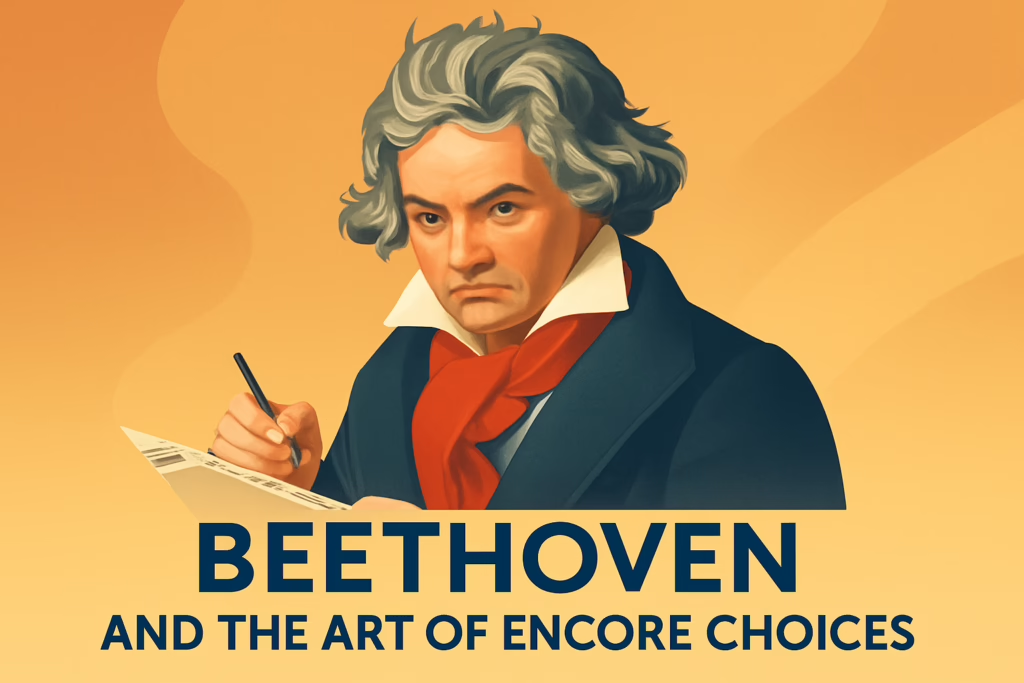
Beethoven and the Art of Encore Choices
Beethoven and the art of encore choices belong together more closely than many concertgoers assume, because the composer’s music shapes expectations about form, gravity, virtuosity, and what a performer says after the official program ends. In recital planning, an encore is not a throwaway extra. It is a final editorial decision: a short performance offered after applause that can confirm the evening’s emotional arc, relieve tension, reveal personality, or redirect listeners toward a fresh perspective. In the Beethoven in performance world, encores matter especially because Beethoven’s repertory carries unusual weight. A pianist ending the “Appassionata,” a violinist closing the Kreutzer Sonata, or a quartet finishing Op. 132 cannot simply tack on any brilliant miniature without consequences. I have seen encores deepen a program’s meaning, and I have also heard them flatten it by sounding opportunistic, sentimental, or stylistically careless. This hub article maps the miscellaneous but important territory around Beethoven encore choices: history, audience psychology, instrument-specific practice, programming logic, venue context, and the practical criteria performers use when selecting a final piece. It also serves as a guide to the wider subtopic, linking the most common performance questions under one umbrella so readers, teachers, and artists can compare approaches and make better decisions.
What Counts as a Beethoven Encore and Why It Is Harder Than It Looks
A Beethoven encore can mean three different things in practice. First, it may be a short work by Beethoven himself: a Bagatelle, a movement from a sonatina, a set of variations excerpt, a folk-song arrangement, or a transcription. Second, it may be a non-Beethoven piece chosen after Beethoven formed the main program, with the encore acting as commentary on what preceded it. Third, it may be a stylistic gesture connected to Beethoven performance, such as ending with Schubert after late Beethoven, or with Bach after a Beethoven concerto, to restore scale and intimacy. The challenge is that Beethoven’s music creates strong proportions. His sonata movements, variation cycles, and chamber works often feel architecturally complete. A weak encore can seem like an appended footnote after a signed conclusion.
That is why performers usually evaluate encores through four filters: duration, character, technical fatigue, and historical plausibility. Duration matters because five focused minutes can feel generous after a major Beethoven work, while twelve minutes may test the audience’s concentration and undermine the program’s cadence. Character matters because Beethoven spans wit, fury, nobility, dance, prayer, and irony; the encore should either complement that final character or deliberately offset it with a clear reason. Technical fatigue matters because after Op. 106 or the Violin Concerto, the body may not support another high-risk display. Historical plausibility matters because Beethoven performance today is scrutinized for style, articulation, tempo relationships, pedaling, and sound production; an encore that ignores those concerns can sound disconnected from the evening’s musical language.
Historical Practice: Did Beethoven-Era Performers Even Give Encores?
The modern encore, where applause prompts a brief extra piece, is partly a nineteenth-century and twentieth-century concert convention, but audience repetition, insertions, and additional offerings existed in Beethoven’s time. Viennese concert culture was less rigid than today’s polished recital format. Programs mixed genres, performers, and lengths more freely, and audiences often responded audibly in ways modern halls regulate. Individual movements or arias might be repeated, and virtuosi commonly tailored material to audience appetite. Beethoven himself operated within that fluid culture, yet his large-scale works also helped establish the idea of musical integrity that later discouraged interruption.
This historical tension still shapes encore choices. If a performer emphasizes Beethoven as revolutionary architect, the argument against encores after the late sonatas becomes stronger. If the performer emphasizes Beethoven as improviser, pianist, and public musician who understood occasion and response, then a concise encore can feel entirely appropriate. Scholars and performers often cite Carl Czerny, Ferdinand Ries, and Anton Schindler with caution, because their accounts vary in reliability, but together they reinforce a key point: Beethoven was not writing for a silent museum. He expected impact. He valued concentration, but he also knew performance was social. The best modern encore practice respects both truths by preserving the integrity of the main work while acknowledging live exchange.
How Performers Match Encore Type to Beethoven Repertoire
Encore logic changes dramatically depending on the Beethoven work just performed. After an early sonata such as Op. 2 No. 3, a bright Classical encore by Haydn, Mozart, Hummel, or Beethoven himself can underline elegance and wit. After a middle-period “heroic” work, performers often choose something shorter and inward, because another extroverted statement feels redundant. After late Beethoven, especially Opp. 109 through 111, Op. 130 with the Cavatina, or Op. 132, the strongest choice is often no encore at all. Silence can be the most intelligent encore substitute.
Instrument type matters too. Pianists have the richest reservoir of Beethoven miniatures, including Bagatelles Op. 33, Op. 119, and Op. 126. Violinists and cellists often look instead to arrangements, variation movements, or repertory adjacent to Beethoven, because the standalone Beethoven encore shelf is smaller. String quartets face a special problem: ensemble reset. After forty minutes of concentrated Beethoven, a compact canonic work, a slow movement excerpt from another composer, or a tiny dance can work, but only if intonation, bow control, and collective pulse remain fresh. Conductors with orchestras are even more constrained; after a Beethoven symphony or concerto, encores require logistical simplicity and rehearsal efficiency. In my experience, the practical limit is often not musical imagination but stage management, orchestral stamina, and the time expectations of the hall.
Practical Criteria for Strong Encore Choices
The most successful Beethoven-related encores satisfy a set of practical criteria that performers use repeatedly across recital planning. They should be short enough to feel like a gift rather than a second ending. They should present a distinct affect, whether consoling, playful, intimate, or gently brilliant. They should not require a complete recalibration of touch, instrument setup, or ensemble seating. They should sound intentional in relation to Beethoven’s rhetoric. They should also fit the room: dry acoustics reward clarity and wit, while resonant halls favor slower cantabile lines and transparent textures over fast passagework that blurs.
Audience profile is equally important. A specialist Beethoven festival audience may welcome a rare Bagatelle or a fragmentary curiosity explained from the stage. A mixed public recital audience often responds more strongly to a recognizable song transcription, a concise Schubert piece, or a Bach movement played with luminous restraint. The encore should answer the question listeners are already asking: after everything we heard tonight, what final gesture feels true? When that answer is obvious, applause after the encore has a different quality. It sounds less like appreciation for bonus content and more like recognition of a complete artistic statement.
| Main Beethoven Program | Encore Approach That Usually Works | Why It Works |
|---|---|---|
| Early piano sonata recital | Beethoven Bagatelle or Haydn miniature | Keeps Classical scale, wit, and textual clarity intact |
| “Appassionata” or “Waldstein” ending | Quiet lyrical encore, often Schubert or late Beethoven Bagatelle | Releases tension without competing with the sonata’s drive |
| Late sonata recital | No encore, or one very brief inward piece | Protects the spiritual and architectural finality of the program |
| Violin sonata program including Kreutzer | Songful miniature or variation movement | Balances intensity and showcases partnership rather than bravura |
| String quartet with Op. 132 or Op. 131 | Usually no encore | These works often function as complete emotional worlds |
Specific Beethoven Pieces That Function Well as Encores
Among Beethoven’s own works, the Bagatelles are the natural starting point. Not every Bagatelle works equally well. The concise pieces of Op. 119 can be excellent because they pivot quickly between humor, tenderness, and surprise. Several of the Op. 126 Bagatelles, however, carry enough depth and harmonic ambiguity that they must be chosen carefully; they can sound less like encores than compressed late-style meditations. “Für Elise,” despite overexposure, remains effective only in unusual contexts: educational concerts, audience-engagement events, or programs about reception history. In standard recitals, it often brings unwanted familiarity that trivializes the surrounding repertory.
For violin and piano, arrangements of Beethoven songs or Scottish, Irish, and Welsh folk-song settings can make elegant encores if edited intelligently. They show Beethoven’s melodic directness and social side, two qualities listeners do not always hear in sonata recitals. For cello and piano, selected variation themes or lyrical slow-movement excerpts can work, although performers must avoid turning a substantial movement into a decontextualized souvenir. Singers have still more options, particularly the songs and concert arias, but diction, language, and accompanimental balance must remain at the same level as the main program. An encore is a magnifying glass; any drop in standards becomes obvious immediately.
When a Non-Beethoven Encore Serves Beethoven Better
Many great Beethoven performances end most convincingly with music by someone else. That is not betrayal; it is curatorial intelligence. Schubert is the most common partner because his lyric inwardness can absorb the shock of Beethoven’s extremes without sounding decorative. Bach is another wise choice, especially after orchestral Beethoven or large sonatas, because contrapuntal transparency resets the ear. Haydn can restore proportion after Beethovenian monumentality, reminding listeners of the style Beethoven inherited and stretched. Even Bartók or Webern can work in modern programming when the performer wants to illuminate Beethoven’s compression, motivic economy, or rhythmic edge.
The key is explanatory coherence, whether spoken aloud or embedded in the program. If a pianist plays Op. 111 and then a Schubert Impromptu, the encore should not imply that Schubert is mere dessert. It should complete a thought about transcendence, song, or farewell. Likewise, a quartet that follows Op. 18 with a Haydn movement can underline lineage and conversation across generations. I have programmed Bach as an encore after Beethoven concertos for exactly this reason: not to cool down the hall, but to let listeners hear structure and breath with cleansed ears. The right non-Beethoven encore can reveal Beethoven more sharply than a lesser Beethoven piece can.
Why Some Beethoven Works Should Usually Not Be Followed by an Encore
Certain Beethoven works generate enough finality that an encore is usually counterproductive. The late piano sonatas are the clearest example, especially Op. 111, whose Arietta variations already function as both culmination and release. Adding another piece afterward can feel like speaking after a benediction. The same caution applies to String Quartet Op. 131, which unfolds as an uninterrupted seven-movement arc; and to Op. 132, where the Heiliger Dankgesang creates a spiritual frame difficult to follow meaningfully. The Missa solemnis, Ninth Symphony, and Fidelio finale belong to a similar category in larger forms.
This does not mean encores are forbidden. It means the burden of justification is higher. The performer must judge whether the audience needs closure, relief, or silence. In top-level halls, silence is often the bravest choice, because it trusts listeners to carry the ending home unbroken. That instinct is part of mature Beethoven performance. Not every ovation requires response. Sometimes the most disciplined answer to sustained applause is a bow, a shared acknowledgment among players, and departure.
Encore Choices as a Hub for the Wider “Beethoven in Performance” Subtopic
Encore planning sits at the intersection of nearly every performance issue in this sub-pillar. It touches tempo, because a rushed main performance may leave no physical reserve for an extra piece. It touches pedaling, articulation, and instrument choice, because a modern Steinway supports different encore repertory than a Graf-inspired fortepiano. It touches acoustics, audience development, historical practice, memorization, page turns, stagecraft, and spoken introductions. It also links to broader questions this hub should organize for readers: how Beethoven endings function in recital design, whether applause between movements should be welcomed, how performers build stamina for monumental works, which editions influence articulation choices, and how recording practice differs from live concert logic.
For that reason, this miscellaneous hub is useful precisely because the topic appears small but is not. Encore choices expose a performer’s priorities. They show whether Beethoven is being treated as monument, living theater, pedagogical heritage, social ritual, or all four at once. If you are exploring Beethoven in performance, use encore decisions as a diagnostic tool. Study concert programs, compare artist habits, note which works invite silence, and listen for whether the final miniature clarifies or confuses what came before. Done well, the encore is not an afterthought. It is the last piece of interpretation. Explore the related articles in this subtopic with that question in mind, and you will hear Beethoven concerts more sharply from the first note to the last bow.
Frequently Asked Questions
Why does Beethoven matter so much when performers choose an encore?
Beethoven matters because his music changes the listener’s sense of scale, meaning, and closure. After a program centered on Beethoven, the audience is rarely sitting in a neutral state. They have usually been taken through a carefully built musical argument marked by tension, release, rhythmic drive, dramatic contrast, and a strong feeling that every gesture carries weight. That means the encore cannot simply be pleasant or flashy. It has to respond, in some way, to the world Beethoven has just created.
In practical terms, performers often treat the encore as the final sentence after the official essay has ended. With Beethoven, that last sentence becomes especially important because his works so often feel complete, architecturally satisfying, and emotionally consequential. If an artist adds something trivial, the effect can feel like an afterthought. If the artist chooses something too grand, the encore may compete with the main work rather than complement it. The best Beethoven-related encore choices understand this balance. They acknowledge that the audience has just heard music that set high expectations for seriousness, structure, and expressive honesty.
Beethoven also matters because he occupies a symbolic place in concert culture. He represents not just a composer, but a set of artistic values: integrity, struggle, invention, and intensity. An encore placed after Beethoven therefore sends a message about how the performer understands those values. A gentle miniature may suggest humility and gratitude. A witty bagatelle may reveal Beethoven’s lighter side. A transcription or short lyrical piece by another composer may show how later musicians responded to the expressive space Beethoven helped create. In each case, the encore becomes a form of interpretation, not merely an extra selection.
What makes a good encore after a Beethoven recital or Beethoven-centered program?
A good encore after Beethoven feels intentional. It should sound as though it belongs to the evening, even if it introduces contrast. The strongest choices usually do one of four things well: they confirm the emotional arc of the program, offer relief after a demanding conclusion, reveal a more intimate side of the performer, or gently redirect the audience toward a new perspective without breaking the spell of the concert.
Length is one important factor. Encores are usually brief, and after Beethoven that brevity can be a virtue. A compact work can function like a distilled afterimage, allowing listeners to leave with one final impression rather than reopening a full-scale argument. Character is equally important. If the program ended with a stormy sonata movement, a set of variations, or a large chamber work full of tension, a calm, songful encore can create a graceful emotional landing. On the other hand, if the evening has been especially severe or monumental, a playful or elegant encore may humanize the experience and remind listeners that Beethoven’s world includes wit, tenderness, and spontaneity as well as grandeur.
Stylistic fit matters too, but fit does not mean sameness. A performer does not need to choose another Beethoven work in order to make the encore feel right. In fact, too much continuity can sometimes weigh down the ending. The better question is whether the encore respects the atmosphere Beethoven established. A short Schubert piece, a Bach movement, a lyrical Chopin miniature, or a Beethoven bagatelle might all work, depending on the program and the performer’s intentions. What distinguishes a successful encore is not just repertoire, but proportion. It should feel like an insightful final gesture, not an unrelated bonus track.
Should an encore after Beethoven be another Beethoven piece, or is contrast more effective?
Either approach can work, and the best choice depends on what the performer wants to say at the end of the evening. Selecting another Beethoven piece can be highly effective when the goal is to deepen or clarify the audience’s understanding of him. A short bagatelle, dance, or lyrical miniature can reveal a side of Beethoven that the main program did not emphasize. If the recital focused on heroic rhetoric, a smaller Beethoven encore can remind listeners of his intimacy and humor. If the program highlighted intellectual rigor, a simple, singing encore by Beethoven can restore warmth and directness.
Contrast, however, is often just as powerful. After the density and dramatic logic of Beethoven, a performer may choose a work by another composer to shift the emotional temperature. This does not have to feel like a departure from Beethoven’s world. In many cases, contrast helps illuminate Beethoven indirectly. A transparent Bach movement can highlight the structural clarity Beethoven inherited and transformed. A Schubert encore can show how lyric inwardness follows from, and differs from, Beethoven’s dramatic urgency. A refined Romantic miniature can provide release after Beethoven’s rhetorical force while still honoring the seriousness of the program.
The key is not whether the encore is by Beethoven, but whether it acts as a thoughtful response to Beethoven. A same-composer encore can fail if it is too heavy or redundant. A contrasting encore can succeed brilliantly if it feels like a meaningful answer to what the audience has just heard. Performers are essentially curating the last emotional memory of the concert, so the decision should arise from musical logic, audience psychology, and the overall narrative of the recital.
How do encore choices shape the audience’s final impression of a Beethoven performance?
Encore choices shape the final impression because audiences tend to remember endings vividly. After the formal program concludes, applause creates a brief moment of openness. The structure of the evening has ended, but the emotional experience has not. What the performer offers next often determines whether the audience leaves feeling uplifted, consoled, challenged, surprised, or inwardly quiet. In a Beethoven program especially, that final impression can subtly reshape how the entire performance is remembered.
For example, if a recital ends with a powerful late Beethoven work, the room may be full of concentration and emotional tension. A wise encore can release that tension without erasing the gravity of what came before. A soft, reflective piece may help listeners absorb the experience rather than feeling abruptly dismissed into applause and exit noise. By contrast, a brilliant but lightweight virtuoso encore might generate excitement, yet it could also alter the memory of the concert by shifting attention away from the depth of the Beethoven performance and toward surface display.
This is why encores are often best understood as editorial decisions. They do not simply extend the concert; they frame its conclusion. They can confirm the central character of the evening, offer a new lens through which to hear what came before, or reveal something personal about the artist’s relationship to the repertoire. In Beethoven performance, where stakes of form, meaning, and expression are often especially high, that final framing matters enormously. A carefully chosen encore can make the whole evening feel more complete, more generous, and more intelligently shaped.
What are common mistakes performers make when choosing an encore after Beethoven?
One common mistake is choosing an encore that ignores the emotional and structural weight of the program. After Beethoven, audiences are often still processing music that feels decisive and deeply argued. If the encore is too glib, too sentimental, or too obviously designed for quick applause, it can break the atmosphere in a way that feels artistically careless. This does not mean the encore must be solemn, but it should show awareness of what has just happened in the room.
Another mistake is redundancy. Some performers select an encore that simply repeats the same emotional profile, tempo, and rhetorical intensity of the final programmed work. Instead of providing closure, this can leave the audience feeling that the concert has become overextended. Beethoven’s larger works already tend to make strong closing statements. Adding another intense, high-stakes piece risks dulling the effect of both the main ending and the encore. Often, a more restrained or more intimate choice creates a stronger sense of completion.
A third mistake is misjudging proportion and personality. Encores can reveal an artist’s individuality, but they should not feel self-indulgent. A performer who uses the encore purely to show off speed, volume, or novelty may win immediate enthusiasm while sacrificing the deeper coherence of the event. Likewise, an encore that is too long can undermine the elegant economy that makes the gesture meaningful in the first place. The most successful performers understand that after Beethoven, less can be more. A short, well-shaped, emotionally intelligent encore often leaves a more lasting impression than a louder or more elaborate one.