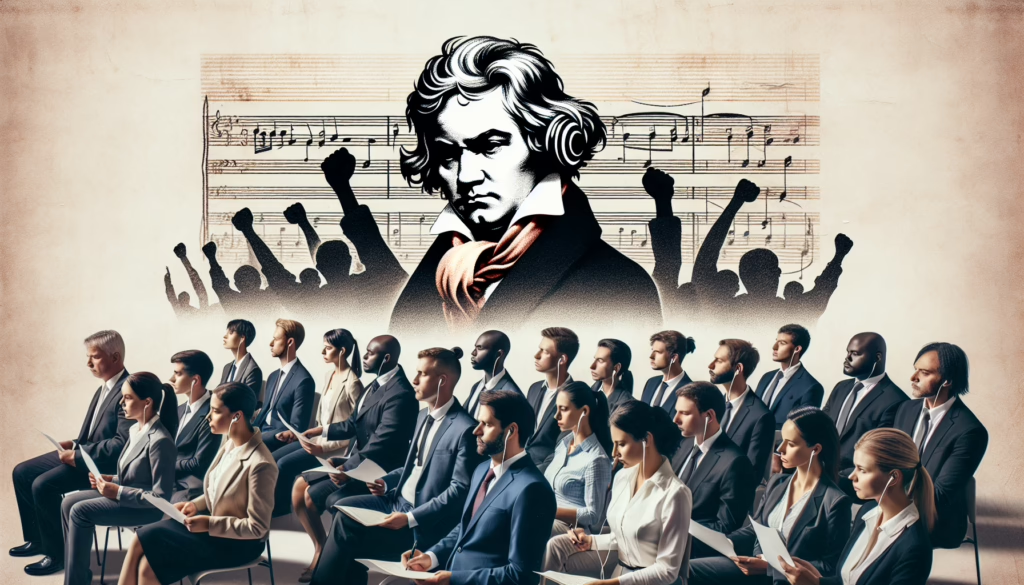
Why Beethoven Is Still Used in Political and Social Movements
Beethoven remains a recurring force in political and social movements because his music combines moral seriousness, public visibility, and emotional clarity in a way few composers can match. When people ask why Beethoven is still used in protests, revolutions, memorials, and campaigns for solidarity, the short answer is this: his works sound like struggle, dignity, defiance, and hope. In the broader conversation about Beethoven for modern audiences, this miscellaneous hub matters because it connects many threads at once—history, propaganda, democratic ideals, cultural memory, and the practical mechanics of how music gains political meaning. I have worked with concert programming, public-history interpretation, and audience education around Beethoven, and one lesson appears again and again: listeners do not approach him as a museum artifact. They hear him as a language of public feeling. Key terms help frame the topic. A political movement seeks power, reform, or resistance in public life. A social movement organizes around identity, justice, rights, or collective change. Political music is not only music written for a cause; it also includes music later adopted by communities who need symbols that carry authority. Beethoven is central because his reputation, especially since the nineteenth century, has made his music available for meanings far beyond the concert hall.
Why Beethoven’s Music Adapts So Easily to Public Causes
Beethoven’s music works in movements because it carries recognizable dramatic patterns. Tension builds, obstacles appear, resolution is delayed, and then a breakthrough arrives. That architecture mirrors the way campaigns describe themselves: hardship, perseverance, victory, or at least moral endurance. The Fifth Symphony is the classic example. Since the early nineteenth century, audiences have heard its opening motive as a sign of fate, conflict, or determination. During the Second World War, Allied propaganda linked the famous short-short-short-long rhythm to the letter V in Morse code, turning Beethoven into an audible emblem of victory. That was not hidden musicological symbolism; it was effective public messaging because the rhythm was already unforgettable.
The Ninth Symphony functions differently but just as powerfully. Its final movement, with Friedrich Schiller’s “Ode to Joy,” offers a direct text about human brotherhood. Even people who do not know German understand the social message through context: massed singers, cumulative orchestral force, and a melody simple enough to be sung by amateurs and arranged for ceremonies. Over time, that adaptability made the Ninth useful across ideologies. It has appeared at democratic celebrations, reunification events, labor gatherings, peace concerts, and official state functions. A movement borrows not just a tune but a ready-made aura of universality.
There is also a practical reason Beethoven lasts in public life: institutions already know his music. Orchestras program it, schools teach it, films quote it, and civic rituals reuse it. That familiarity lowers the barrier for political and social adoption. Activists often need symbols that are instantly legible, and Beethoven supplies them. A banner can cite a slogan, but a public event needs sound that can command a square, a hall, or a broadcast. Beethoven’s scores were built for scale, and scale matters in collective action.
Historical Moments That Fixed Beethoven in Political Memory
Beethoven’s political afterlife did not happen by accident. It was formed through repeated historical use. In the nineteenth century, he was framed as the independent artist, a creator answerable to conscience rather than court etiquette. That image was sharpened by stories about his admiration for republican ideals and his famous disappointment with Napoleon after initially seeing him as a liberating figure. The anecdote about the “Eroica” Symphony title page matters because it became part of a larger myth: Beethoven as a composer who rejects tyranny. Whether every retelling is tidy history is less important than the fact that generations believed the story and used it.
By the twentieth century, Beethoven had become politically contested territory. Democratic societies, communist states, fascist regimes, antiwar activists, and European institutions all claimed him. Nazi cultural policy promoted Beethoven as proof of German greatness, while resistance listeners and Allied broadcasters also deployed his music. After 1945, performances of the Ninth carried special weight in reconstruction and reconciliation. Leonard Bernstein’s 1989 Berlin performance, changing “Freude” to “Freiheit,” remains one of the clearest examples of Beethoven entering a live political moment. The point was not textual purity but public symbolism. When the Berlin Wall fell, organizers needed music that could speak to history, liberation, and transnational hope in one gesture. Beethoven provided exactly that.
Modern movements continue to inherit this layered history. In East Asia, Latin America, Europe, and the United States, Beethoven appears when organizers want a cultural symbol that sounds elevated without sounding obscure. His music can mark grief after national trauma, aspiration during constitutional change, or solidarity in cross-border events. Because the tradition is so long, every new use feels both fresh and endorsed by precedent.
Which Beethoven Works Appear Most Often, and Why
Not every Beethoven piece functions equally well in public action. A few works dominate because they are musically distinctive and socially legible.
| Work | Common movement use | Why it fits public causes |
|---|---|---|
| Symphony No. 5 | Resistance, wartime messaging, perseverance | Memorable opening motive, clear conflict narrative, immediate recognition |
| Symphony No. 9 | Unity, peace, European identity, democratic celebration | Choral finale offers explicit humanist text and singable melody |
| “Eroica” Symphony | Heroism, civic sacrifice, political transformation | Associated with revolution, leadership, and moral seriousness |
| “Egmont” Overture | Anti-tyranny messaging, commemorations, freedom themes | Linked to Goethe’s drama about resistance to oppression |
| “Moonlight” and late sonatas | Memorials, reflective activism, cultural programming | Less overtly political, but useful for gravity and introspection |
In practice, presenters choose among these works based on context. If a rally needs a short, recognizable signal, the Fifth is more useful than a long symphonic arc. If an event wants communal singing or a televised climax, the Ninth is unmatched. For commemorative programs, the “Egmont” Overture can be more precise than “Ode to Joy” because its dramatic association with oppression and liberation is tighter. I have seen organizers pair “Egmont” with readings from dissidents or civil-rights figures because the overture creates a frame of ethical struggle without requiring a full symphony performance.
How Different Movements Reinterpret the Same Music
One reason Beethoven persists is that his music does not dictate a single political message. It invites interpretation while preserving prestige. That flexibility is an advantage, but it also creates risk. “Ode to Joy” can symbolize European cooperation, yet it can also be criticized as elite ceremonial culture if used without attention to who feels included. The same Ninth Symphony has appeared in settings promoting human rights and in settings meant to project state power. Beethoven’s authority does not purify the politics around him.
This is why context matters more than abstract meaning. Who performs the music? Who is present? Is the event inclusive, coercive, grassroots, official, mournful, or triumphant? A prison-education choir singing Beethoven communicates something very different from a military parade using the same melody. Social movements understand this intuitively. They often remix, reorchestrate, subtitle, translate, or excerpt Beethoven so the music serves the people in the room rather than the prestige of the canon. Youth orchestras, protest ensembles, and community choruses have all done this effectively, especially when the goal is to turn inherited culture into shared civic language.
There is another important nuance. Beethoven’s music gains movement value not only from triumph but from struggle. The slow introductions, abrupt silences, dissonances, and hard-won cadences matter. Protest culture does not need cheerful music all the time; it needs music that acknowledges cost. Beethoven often sounds as if something is being earned, and that is one reason movements trust him.
Beethoven, Media, and the Politics of Recognition
Modern political use of Beethoven is amplified by media systems. Radio, film, streaming platforms, sports ceremonies, public holidays, and viral clips have made small portions of his catalogue globally recognizable. Recognition is political currency. A movement succeeds faster when its symbols are already understood across class, language, and national lines. Beethoven’s opening motifs and major themes travel well because they survive compression, adaptation, and repetition. A brass band can play them. A choir can sing them. A phone speaker can still deliver their contour.
That reach also reflects infrastructure. Conservatories train performers in Beethoven. Public broadcasters archive him. Major labels record him repeatedly. UNESCO-level heritage discourse, European cultural policy, and national arts institutions all reinforce his status. When organizers choose Beethoven, they are drawing on a long supply chain of notation, recordings, performance practice, venue access, and audience expectation. This is one reason Beethoven appears more often than equally profound but less institutionalized composers.
For modern audiences, this raises a fair question: does using Beethoven keep movements stuck in old cultural hierarchies? Sometimes, yes. If programming relies on him automatically, other traditions may be crowded out. But the best public uses of Beethoven solve that problem by placing him in dialogue with newer voices. A freedom concert can pair the “Egmont” Overture with contemporary spoken word. A social-justice program can frame the Ninth alongside gospel, protest folk, or immigrant choir traditions. In successful curation, Beethoven becomes a bridge rather than a gate.
Why This Topic Matters in Beethoven for Modern Audiences
This miscellaneous hub is important because it links many related articles and questions readers usually have. Why do politicians use classical music? Why does “Ode to Joy” appear at state events? Can a composer be both liberating and appropriated by power? How should educators explain Beethoven without turning him into a saint? These are not side issues. They are central to understanding why Beethoven still matters now. Modern audiences meet Beethoven less as sheet music and more as public symbol, soundtrack, ritual, and argument.
From my experience, audiences engage most deeply when they are given both the inspiration and the contradiction. Beethoven can represent freedom, but he has also been used by regimes. His music can unite crowds, but it can also signal establishment culture. Those tensions do not weaken his relevance; they explain it. Political and social movements keep returning to Beethoven because his music is large enough to hold conflict, memory, grief, ambition, and collective hope at the same time.
The clearest takeaway is simple. Beethoven is still used in political and social movements because his music offers instant recognition, emotional authority, and a proven public language for struggle and solidarity. The Fifth turns resolve into sound. The Ninth turns idealism into ceremony. Works like “Eroica” and “Egmont” connect personal courage with civic meaning. Across two centuries, activists, institutions, and communities have reused these pieces because they help people feel history moving around them. That is a rare power.
For anyone exploring Beethoven for modern audiences, this hub should be a starting point for the broader miscellaneous landscape: propaganda, protest, public ritual, media reuse, educational framing, and competing political interpretations. Listen closely to where Beethoven appears outside the concert hall—in commemorations, campaigns, memorials, and unity events—and the pattern becomes clear. His music survives because it still does useful public work. If you want to understand Beethoven today, follow the moments when people reach for him not just to admire the past, but to shape the present.
Frequently Asked Questions
Why is Beethoven still so often used in political and social movements?
Beethoven continues to appear in political and social movements because his music communicates public emotion with unusual force and clarity. His works do not feel private, decorative, or distant; they often sound collective, urgent, and morally charged. That matters in moments when communities want music that can carry grief, resistance, dignity, or hope without needing much explanation. Even listeners with little formal knowledge of classical music can recognize that Beethoven often sounds like confrontation followed by endurance, or struggle moving toward resolve.
Another reason is visibility. Beethoven is one of the few composers whose name, reputation, and major melodies are widely known across cultures. When activists, organizers, governments, or memorial institutions use Beethoven, they draw on a shared cultural language. A famous example is the Ninth Symphony, especially the “Ode to Joy,” which has been used in celebrations of unity, democratic aspiration, and international solidarity. At the same time, other Beethoven works have been used in darker or more conflicted settings, which shows how flexible his symbolic power can be. His music can suggest liberation, sacrifice, mourning, perseverance, and historical seriousness all at once.
In practical terms, Beethoven remains useful because his music creates scale. It can fill a square, a concert hall, a state ceremony, a protest film, or a public memorial with a sense of importance. Many movements want exactly that: not background music, but a sound world that tells people this moment matters. Beethoven supplies that kind of emotional architecture better than almost anyone else.
What is it about Beethoven’s music that makes it sound political, even when it was not written for modern protests?
Beethoven’s music often feels political because it dramatizes conflict in a way that resembles public struggle. He builds tension, opposition, breakthrough, collapse, and recovery into the structure of the music itself. Listeners hear obstacles being confronted and transformed. Even without words, that pattern can resemble the emotional logic of political action: injustice is felt, pressure rises, resistance forms, and some form of victory, reconciliation, or hard-won endurance emerges. That is why so many people experience his music as more than beautiful sound. It feels like action under pressure.
His style also carries a strong sense of moral seriousness. Beethoven often writes with bold contrasts, emphatic rhythms, and themes that seem to announce themselves rather than drift by. This gives his music a public character. It sounds as if it belongs in civic life, not just in private entertainment. For movements trying to project legitimacy, courage, or universal human stakes, that quality is extremely useful. His music can imply that what is happening is not trivial or temporary, but part of a larger ethical struggle.
Just as important, Beethoven balances intensity with clarity. Some politically powerful music is emotionally overwhelming but too ambiguous for broad public use. Beethoven often avoids that problem. Even in complex works, the emotional direction is usually readable: tension, defiance, mourning, exaltation, fraternity. That emotional legibility helps explain why his music keeps resurfacing in revolutions, commemorations, anti-oppression movements, and campaigns built around shared ideals. People may disagree about the exact meaning, but they rarely miss the sense that something serious and consequential is being expressed.
Why is Beethoven’s Ninth Symphony, and especially “Ode to Joy,” so closely associated with solidarity and public ideals?
Beethoven’s Ninth Symphony has become a global symbol because it joins monumental music with a message of human fellowship. The final movement’s setting of Friedrich Schiller’s “Ode to Joy” gives listeners a vision of unity, shared humanity, and joy that is larger than any one nation or faction. In public life, that combination is incredibly powerful. It allows leaders, institutions, and movements to invoke ideals such as freedom, peace, brotherhood, reconciliation, or democratic renewal through a work that already carries immense cultural prestige.
The Ninth also works well in collective settings because it is designed to sound communal. Unlike purely instrumental symphonies, it culminates in massed voices, which immediately creates the sense of a people speaking or singing together. That makes it especially appealing for ceremonies marking historical turning points, post-conflict healing, or international cooperation. It has been used after wars, during periods of political transition, and at major public events because it can symbolize the hope that fractured societies might still find common ground.
At the same time, the Ninth’s history is not simple. Different groups with very different politics have tried to claim it, which shows both its power and its vulnerability. Its message of universal brotherhood can be used sincerely, but it can also be used strategically to project legitimacy or moral authority. That complexity is part of why the work remains important in modern discussions of Beethoven and politics. The Ninth is not just a piece of music; it is a contested civic symbol, repeatedly reinterpreted by generations trying to define what unity, freedom, and humanity should mean.
How have protests, revolutions, memorials, and public campaigns actually used Beethoven over time?
Beethoven has been used across a wide range of public situations because his music can adapt to different political emotions. In protest contexts, excerpts from his works may be used to suggest defiance, endurance, or a people’s refusal to submit. In revolutionary or transitional moments, his music can symbolize historical change and the possibility of a new civic order. In memorial settings, slower Beethoven movements can convey solemnity, loss, and the dignity of remembrance. In campaigns for solidarity, especially international or humanitarian ones, the Ninth Symphony often serves as a shorthand for shared human values.
Part of Beethoven’s usefulness lies in his broad emotional range. The Fifth Symphony can sound like fate, pressure, and determination. The “Eroica” can suggest heroic struggle and the weight of history. The late works can evoke reflection, suffering, and spiritual depth. Because different movements need different emotional tools, Beethoven offers a kind of symbolic repertoire rather than a single message. Organizers, filmmakers, broadcasters, and institutions select from that repertoire depending on whether they want to emphasize resistance, mourning, unity, triumph, or moral seriousness.
His music has also appeared in ways that go beyond live performance. It is used in documentaries, commemorative broadcasts, civic ceremonies, protest-adjacent art, and public memorial culture because it instantly signals historical importance. Even brief quotations can frame an event as part of a larger human drama. That is one reason Beethoven remains relevant for modern audiences: his music continues to function not only as art, but as a public language for expressing what communities believe is worth defending, grieving, or celebrating.
Does using Beethoven in modern movements still make sense for contemporary audiences?
Yes, it still makes sense, but for a more complex reason than simple tradition. Contemporary audiences live in a fragmented media environment, and very little music can still cut across generations, institutions, and political contexts with immediate recognizability. Beethoven can. His music carries cultural memory, but it also still communicates directly on an emotional level. People may not know the formal name of a movement or symphony, yet they can still hear resolve, struggle, mourning, and uplift in the music. That blend of prestige and accessibility is rare.
Using Beethoven also allows modern movements to connect present-day causes to a longer history of public ideals. When his music appears at a memorial, democratic rally, solidarity event, or socially conscious performance, it suggests continuity between current struggles and earlier debates about freedom, human dignity, citizenship, and collective responsibility. For many audiences, that connection adds weight. It frames a present issue not as an isolated controversy, but as part of an enduring human effort to build a more just world.
That said, contemporary use works best when it is thoughtful rather than automatic. Beethoven’s music is powerful, but it is not neutral. Because it has been used by many different causes and institutions, modern audiences often respond best when the context is clear and intentional. When paired well with the values of an event or movement, Beethoven still feels alive rather than ceremonial. He remains relevant not because he belongs to the past, but because his music still gives public life a convincing sound for courage, grief, resistance, and hope.