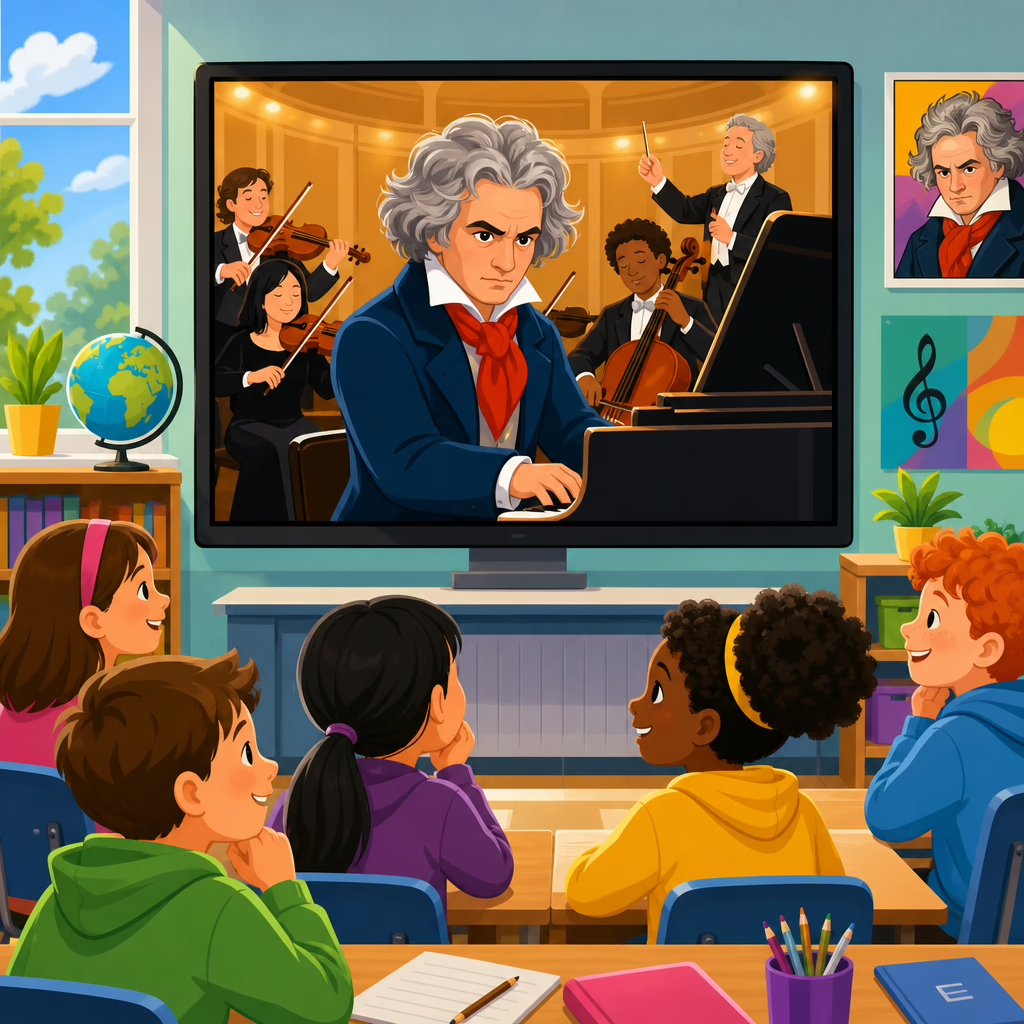
Best Streaming Performances of Beethoven for Classrooms
Teachers who want students to hear Beethoven at his most vivid now have an advantage no previous generation had: immediate access to world-class streaming performances that can be selected for age level, lesson objective, class length, and discussion focus. In classroom terms, a streaming performance is a legally available audio or video recording delivered through a platform such as YouTube, Medici.tv, Digital Concert Hall, Apple Music, Spotify, or Naxos Music Library, while a useful performance is one that reveals musical structure, historical style, instrumental color, and emotional character without demanding specialist background from listeners. I have built Beethoven listening units for mixed secondary classes, college surveys, and teacher training sessions, and one lesson keeps proving true: the right recording can teach form, rhetoric, and interpretation faster than a lecture can. That matters because Beethoven sits at the center of Western concert music curricula, yet many students first meet him through flat background playlists or over-revered recordings that feel distant. Streaming lets an instructor choose a performance with visible conductor cues, period instruments, transparent textures, subtitles, movement indexing, and reliable timing. Those details make a practical difference when students are comparing a scherzo to a minuet, hearing sonata form unfold, or identifying how tempo changes alter mood. The best streaming performances of Beethoven for classrooms are not simply famous; they are pedagogically legible. They make students notice what Beethoven wrote and what performers decide. A classroom-ready performance should therefore combine strong musicianship, clear sound, easy navigation, and interpretive choices that are distinct enough to spark discussion but not so eccentric that they distract from the score. Selecting recordings on those terms turns streaming from passive consumption into active musical analysis.
What makes a Beethoven streaming performance classroom-ready
A classroom-ready Beethoven performance does four jobs at once: it captures attention quickly, presents details clearly, supports a defined learning goal, and remains easy to cite or replay. In practice, I screen for audio balance first. Students new to orchestral listening need to hear rhythmic motive, bass line, and inner voices without strain, so recordings with muddy hall resonance or heavy post-production are poor teaching tools even when artistically respected. Video can be even more effective, especially for younger classes, because bowing style, natural horns, timpani sticks, and conductor gesture make abstraction visible. A performance is also more teachable when movements are separately indexed. If a lesson asks students to compare the opening fate motive of the Fifth Symphony with its finale transformation, the ability to jump precisely between sections saves time and keeps attention focused.
Interpretive clarity matters just as much. Beethoven classrooms benefit from contrast, so teachers should favor performances that make tempo, articulation, and orchestral size audible issues rather than invisible assumptions. Historically informed ensembles such as Orchestre Révolutionnaire et Romantique or Freiburger Barockorchester often reveal lean textures and sharp accents that illuminate phrase structure. Modern symphony orchestras can be equally valuable when they project long lines and architectural breadth. The point is not to declare one style correct. The point is to choose a reading that lets students hear decisions. For broader guidance on evaluating full symphony sets, the main pillar guide explains the critical framework well: how to compare Beethoven symphony cycles like a critic. In classroom use, however, individual movement impact, platform convenience, and explanatory potential usually matter more than collecting a complete cycle from one conductor.
Best symphony performances to stream for general music classes
For general classroom use, three Beethoven symphonies consistently deliver results: the Fifth, the Sixth, and the Seventh. Each addresses a different teaching need. The Fifth Symphony teaches motive, dramatic continuity, and large-scale transformation. A highly effective streamed option is Carlos Kleiber with the Vienna Philharmonic in the widely circulated video performance. The precision of the opening Allegro con brio, the taut rhythmic discipline, and the undeniable sense of forward drive make it easy for students to grasp why this work feels inevitable rather than merely loud. Kleiber is especially useful when teaching the difference between intensity and speed; the pulse is alive, but phrase shaping remains disciplined.
The Sixth Symphony, the “Pastoral,” is ideal for cross-curricular lessons involving literature, nature painting, or program music. Nikolaus Harnoncourt’s readings, available in several streaming catalogs, work well because he avoids sentimental wash. Students can hear the distinction Beethoven himself drew between “more an expression of feeling than painting.” The storm movement lands vividly, while the surrounding scenes retain rhythmic backbone. When classes ask whether music can depict events without becoming cartoonish, this performance gives concrete evidence.
The Seventh Symphony excels in rhythm and dance energy. Carlos Kleiber again is a strong classroom choice, but so is a period-instrument performance by John Eliot Gardiner. In the second movement, students often expect a funeral march in broad, static terms. Gardiner shows instead how pulse, articulation, and terraced dynamics can sustain tension without heaviness. For comparative listening, this symphony demonstrates that “faster” does not automatically mean “lighter”; it can mean clearer phrasing and stronger harmonic direction.
| Work | Recommended streamed performance | Best classroom use | Why it works |
|---|---|---|---|
| Symphony No. 5 | Carlos Kleiber, Vienna Philharmonic | Motive, form, dramatic pacing | Unmistakable rhythmic focus and clear structural build |
| Symphony No. 6 | Nikolaus Harnoncourt, Chamber Orchestra of Europe | Program music, nature, expression | Detailed textures without sentimental blur |
| Symphony No. 7 | John Eliot Gardiner, Orchestre Révolutionnaire et Romantique | Rhythm, dance, interpretation | Lean sonority and audible articulation choices |
| Symphony No. 9 | Leonard Bernstein, Bavarian Radio Symphony forces | Choral finale, humanism, large-scale design | Visceral communication and visibly engaged performers |
Best streamed performances for focused lessons on interpretation
If the lesson goal is not simply to know Beethoven but to understand performance interpretation, choose recordings that invite direct comparison. The first movement of the Eroica Symphony is one of the best examples. A traditional modern-orchestra reading such as Herbert von Karajan with the Berlin Philharmonic presents a dark, blended orchestral mass and commanding legato line. A contrasting period-informed reading by Gardiner or François-Xavier Roth strips away weight, exposing sforzandi, phrasing breaks, and antiphonal dialogue. In class, students can mark the same passage twice and identify how orchestral layout, vibrato level, and tempo shape meaning. They usually hear immediately that interpretation is not decoration added after the fact; it changes the perceived structure of the piece.
Another superb interpretive case study is the slow movement of the String Quartet in A minor, Op. 132, particularly the “Heiliger Dankgesang.” For streaming access, the Takács Quartet and the Belcea Quartet are both strong options on major audio platforms. The Takács performance tends toward spiritual stillness and long-breathed phrasing, which helps students hear modal color and suspended time. The Belcea approach often projects more edge and contrast, making the “Neue Kraft fühlend” sections feel more physically renewed. This is valuable in classroom discussion because students can connect performance style to Beethoven’s recovery from illness and the movement’s alternation between chorale-like gratitude and revived motion.
For piano, the final movement of the “Waldstein” Sonata and the opening of the “Appassionata” reward comparison especially well. Alfred Brendel, Mitsuko Uchida, and Igor Levit each offer streamable interpretations that differ in weight, pedaling, and rhetorical pacing. In classes I have taught, Levit often reaches newer listeners first because his articulation is exceptionally direct in recorded sound, while Brendel can be better for advanced students ready to discuss long-range architecture. A good classroom practice is to play ninety-second excerpts rather than full movements at first, then ask what changed: left-hand presence, dynamic extremes, attack, sustain, or silence. That method turns opinion into observation.
Best Beethoven video performances for younger learners and mixed-ability groups
Video is often the most effective way to teach Beethoven in classrooms where students are not already confident listeners. The Berlin Philharmonic Digital Concert Hall is especially strong because camera direction usually supports musical events rather than distracting from them. In Beethoven, that matters. When brass enter in the Fifth Symphony finale or when a bassoon line comments under a lyrical phrase, a well-timed visual cue helps students connect sound to source. For mixed-ability groups, this reduces cognitive load. Students are not searching blindly for what matters; the performance itself guides attention.
Leonard Bernstein’s televised Beethoven remains valuable despite older production aesthetics. His conducting is physically legible, and students readily understand the relationship between gesture and ensemble response. In the Ninth Symphony, the shift from orchestral turbulence to the baritone’s entrance becomes dramatically obvious on screen. That visual drama supports discussion of why Beethoven brought voices into a symphony and how performance can frame an idea of universal fellowship without a single spoken explanation. For younger learners, a vivid conductor is not a gimmick. It is a bridge into active listening.
Another excellent source is the educational material attached to some orchestra channels on YouTube, especially when complete movement clips are paired with introductions by conductors or players. The best of these are concise and technically accurate. They can help students identify a fugato passage, a horn call, or a variation set before hearing the full excerpt. Teachers should still verify edition quality, subtitles, and copyright stability before assigning links. Broken links and auto-generated uploads waste class time. When possible, save platform playlists in advance and note timings for every excerpt you plan to use.
Best streamed Beethoven performances by genre: concerto, sonata, quartet, and overture
Although symphonies dominate many curricula, classroom engagement often improves when Beethoven is heard in several genres. For concerto lessons, Piano Concerto No. 4 is the standout recommendation. Murray Perahia’s performances, available on major streaming services, combine clarity and lyric intelligence, and the second movement’s stark dialogue between piano and orchestra is perfect for discussion. Students can debate whether they hear conflict, persuasion, or operatic scene. If a class needs stronger visual immediacy, a video performance by Martha Argerich offers electric stage presence, though teachers should frame her freedom as an interpretive choice rather than a neutral baseline.
For violin repertoire, the Violin Concerto with Hilary Hahn is one of the most classroom-friendly options in circulation. Hahn’s intonation, clean articulation, and unaffected phrasing allow students to hear Beethoven’s long melodic spans without mannered distortion. The first movement also helps explain Classical expansion into early Romantic breadth: themes unfold patiently, but the solo line carries unmistakable individual voice. In practical terms, it is easier for students to follow than many denser orchestral scores.
For piano sonatas, the “Moonlight” should not be the default simply because students know its name. The “Pathétique” is often better in class because its contrasts are more immediately legible. Daniel Barenboim and András Schiff both provide useful streamed readings. Barenboim emphasizes rhetorical gravitas, while Schiff often reveals inner detail with cleaner texture. For quartets, the Alban Berg Quartet in Op. 59 No. 1 and the Takács Quartet in Op. 131 are durable choices. For overtures, “Egmont” conducted by Claudio Abbado is especially effective because the political seriousness is audible from the opening bars. Students hear that Beethoven could create public drama in under ten minutes, which makes overtures excellent for shorter lesson segments.
How to choose the right platform and assign listening effectively
The best streaming performance is useless if students cannot access it reliably. For schools, platform choice should follow licensing, ad interruption, audio quality, and navigational control. Naxos Music Library remains one of the strongest academic options because metadata is consistent, timings are stable, and recordings are usually available by track. Digital Concert Hall and Medici.tv are superior for premium video, especially when visual pedagogy matters. Consumer platforms such as Spotify, Apple Music, and YouTube are convenient, but they vary in catalog permanence and ad burden. If you assign home listening, provide exact artist, ensemble, movement, and duration, not just a work title. “Beethoven Fifth” is not specific enough for meaningful discussion.
Listening tasks should be equally precise. Instead of asking students whether they liked a performance, ask which instrument states the motive after the opening, where the transition intensifies, how tempo affects suspense, or which interpretation makes a reprise feel most inevitable. In my own classes, short guided prompts outperform broad reflection every time. A three-minute excerpt with two focused questions yields better analytical writing than assigning an entire symphony without structure. The best classroom use of Beethoven streaming performances is therefore deliberate, comparative, and repeatable. Choose a recording with clear artistic identity, match it to a narrow learning objective, and let students return to the same passage more than once. That is how streaming becomes a serious teaching tool rather than background sound.
The best streaming performances of Beethoven for classrooms are the ones that make musical ideas audible, visible, and discussable within the limits of real teaching time. Strong classroom choices share four traits: dependable access, clear recorded sound, interpretive distinctness, and immediate connection to a lesson goal. For symphonies, recordings by Carlos Kleiber, Nikolaus Harnoncourt, John Eliot Gardiner, and Leonard Bernstein repeatedly prove their value because students can hear structure and character without needing advanced vocabulary first. For chamber and keyboard music, performers such as the Takács Quartet, Hilary Hahn, Murray Perahia, Mitsuko Uchida, and Alfred Brendel offer the same balance of authority and clarity. Video platforms add another layer by showing ensemble interaction, instrumental technique, and conductor gesture, all of which help younger or less experienced listeners understand what they hear.
The central takeaway is simple: do not choose Beethoven recordings for prestige alone. Choose them for teaching usefulness. A famous performance that blurs texture or hides formal landmarks can stall learning, while a well-recorded, sharply characterized stream can unlock motive, form, rhetoric, and historical style in minutes. Start with one symphony movement, one sonata excerpt, one quartet slow movement, and one concerto dialogue. Build questions around what students can actually observe. Then compare a second performance and let interpretation become part of the lesson. If you are planning a Beethoven unit, curate your streaming list now, test every link, and teach from performances that invite listening with purpose.
Frequently Asked Questions
What makes a Beethoven streaming performance especially effective for classroom use?
An effective Beethoven streaming performance for the classroom does more than sound impressive. It needs to support teaching goals clearly and practically. Teachers usually benefit most from performances that are easy to cue, legally accessible through school-friendly platforms, and vivid enough to hold student attention even during shorter listening segments. In other words, the best choice is not always the most famous recording, but the one that fits the age group, lesson length, and discussion focus.
For younger students or general music classes, a strong classroom performance often has immediate contrast, clear rhythm, memorable themes, and visible performer engagement if video is available. A movement from a symphony with a strong pulse or a short piano excerpt with dramatic dynamic shifts can help students identify form, mood, and instrumental color without needing advanced background knowledge. For older students, especially in ensemble, theory, history, or AP-level courses, a more nuanced performance may be valuable because it opens discussion about tempo decisions, phrasing, articulation, orchestral balance, historical context, and interpretation.
Video can be especially effective because students can see bowing, breathing, conducting gestures, keyboard technique, and ensemble communication. That visual layer often helps students connect what they hear to how music is produced. Audio-only recordings still work extremely well, especially when the objective is focused listening, comparative analysis, or score study. In both cases, the most effective Beethoven performances tend to be those with strong sound quality, minimal distractions, reliable playback, and sections that can be excerpted easily for repeated listening.
Teachers should also think in terms of teachable moments. A useful performance gives students something specific to notice: a famous motif, a sudden dynamic turn, a striking texture, a lyrical contrast, or a visible interaction between soloist and ensemble. When a recording naturally invites questions such as “Why did that feel tense?” or “How did the conductor shape that ending?” it is usually a strong classroom choice.
Which Beethoven works are usually the best starting points for students hearing him in class for the first time?
The best starting points are usually works that communicate quickly and clearly. Beethoven can be intense, expansive, and structurally complex, so first exposure works best when students can latch onto something immediately recognizable. For many classrooms, the opening movement or opening motive of Symphony No. 5 is one of the most effective starting points because the rhythmic cell is unmistakable and easy to track. It gives teachers an immediate way to discuss motif, development, repetition, drama, and orchestral texture.
Another excellent entry point is Symphony No. 6, the “Pastoral,” especially if the lesson connects music with imagery, nature, or emotional atmosphere. Students often respond well to the more descriptive qualities of this work, and teachers can guide discussion around how Beethoven suggests scenes without using words. The “Ode to Joy” from Symphony No. 9 is also highly useful because the melody is accessible, culturally familiar to many students, and ideal for discussing theme, variation, vocal forces, and the broader idea of music as a public, humanistic statement.
For keyboard-focused lessons, “Für Elise” can serve as a familiar doorway, but it is usually most effective when used briefly and then connected to larger or less overplayed works such as a movement from the “Moonlight” Sonata, the “Pathétique” Sonata, or the “Appassionata.” These pieces let students hear Beethoven’s range, from introspective lyricism to dramatic intensity. In string or chamber music settings, selected movements from the string quartets can be powerful, though they are often better introduced to older or more experienced students who are ready to listen for conversational texture and structural depth.
If the goal is immediate engagement, teachers often do best with shorter excerpts from larger works rather than assigning an entire symphony at once. A five-minute excerpt can create focus and confidence, while a full movement can follow once students have listening anchors. The strongest introduction is one that gives students a success experience early, helping them hear Beethoven as vivid and expressive rather than distant or intimidating.
How can teachers choose between audio-only and video performances of Beethoven?
The choice depends on what students are meant to learn from the listening experience. Video performances are often best when the objective includes performance practice, conducting, ensemble communication, instrumental technique, or audience awareness. Students can see how a conductor shapes a phrase, how a string section coordinates articulation, or how a pianist uses body motion to support sound. That visual evidence can make Beethoven feel more immediate and human, especially for learners who connect strongly to movement and gesture.
Audio-only performances are often better when the lesson emphasizes concentrated listening. Without visuals, students may attend more closely to form, orchestration, thematic development, balance, and expressive timing. Audio also works well for comparison exercises, where the class listens to two different interpretations of the same passage and discusses differences in tempo, dynamics, articulation, and emotional effect. In these situations, removing the visual element can prevent students from being overly influenced by stage presence or production style.
There are also practical classroom considerations. Video requires reliable display equipment, stronger internet stability, and enough screen visibility for all students. Audio may be simpler to manage and easier to repeat in quick segments. If class time is short, audio clips can be more efficient. If engagement is a concern, especially with younger students or mixed-attention groups, video often provides an advantage because it offers more entry points into the music.
Many teachers use both strategically. A strong approach is to begin with audio so students form their own listening impressions, then show video of the same passage to deepen understanding. That sequence encourages active listening first and observation second. Whether using audio or video, the key is matching the format to the learning outcome rather than assuming one is always superior.
What should teachers look for when comparing different streaming performances of the same Beethoven piece?
When comparing performances, teachers should listen for interpretive choices that are clear enough for students to notice and discuss. Tempo is usually the easiest entry point. One conductor or soloist may choose a brisker pace that emphasizes urgency and drive, while another may favor broader phrasing that brings out grandeur, tension, or lyric detail. Those differences help students understand that classical performance is not mechanical reproduction but thoughtful interpretation.
Articulation is another major factor. In Beethoven, the way notes begin and connect can dramatically shape the character of a phrase. A sharper, more accented approach can make a passage sound more forceful or restless, while a more connected line may highlight continuity and singing tone. Dynamics matter as well. Teachers can ask students whether contrasts feel sudden, gradual, explosive, restrained, or theatrical. In orchestral works, balance between sections can also change the listener’s experience, bringing different lines or textures into focus.
For classroom purposes, sound and production quality also matter. A historically important recording may be valuable, but if the audio is muddy or the video is distracting, it may not be the best choice for first exposure. A classroom-friendly recording should make musical details audible without requiring students to struggle through technical limitations. If a performance uses period instruments or historically informed practices, that can open excellent discussion about timbre, vibrato, articulation, and how Beethoven might have sounded in earlier performance traditions.
Teachers should also compare how well a performance supports a specific lesson objective. If the focus is sonata form, choose recordings where structural contrast is easy to hear. If the focus is expressive communication, look for especially compelling phrasing and dramatic pacing. If the focus is student performance, select recordings where technical and ensemble details are visible and audible. The best comparison is not simply “Which performance is best?” but “Which performance helps students hear the musical idea most clearly?”
How can teachers use Beethoven streaming performances to create stronger classroom discussion and deeper student listening?
The most effective way to use streaming performances is to move beyond passive playback. Students listen more deeply when they are given a clear purpose before the music starts. A teacher might ask them to track a recurring motif, identify changes in texture, describe the emotional arc of a movement, or notice how performers shape a climax. Even simple prompts such as “When does the music become more urgent?” or “What do you hear that makes this sound heroic, peaceful, or unstable?” can produce much richer attention.
Short, repeated excerpts are usually more effective than a single uninterrupted full-length hearing, especially in general classroom settings. Teachers can play a brief segment once for overall impression, a second time for a specific listening target, and a third time for discussion or written response. This method helps students hear details they would miss on first exposure. It also supports a classroom culture where listening is an active skill rather than background activity.
Comparison is one of the strongest discussion tools. Students can hear two performances of the same Beethoven passage and explain which one feels more dramatic, more lyrical, more disciplined, or more intense, using evidence from tempo, dynamics, and phrasing. This kind of guided comparison builds vocabulary and confidence. It also helps students understand that musical interpretation involves choices, not just technical execution.
Teachers can deepen engagement further by connecting listening to performance, movement, writing, or history. Students might conduct along to a phrase shape, mark a listening map, journal about tension and release, or connect a symphonic excerpt to the cultural and political world of Beethoven’s time. In ensemble classes