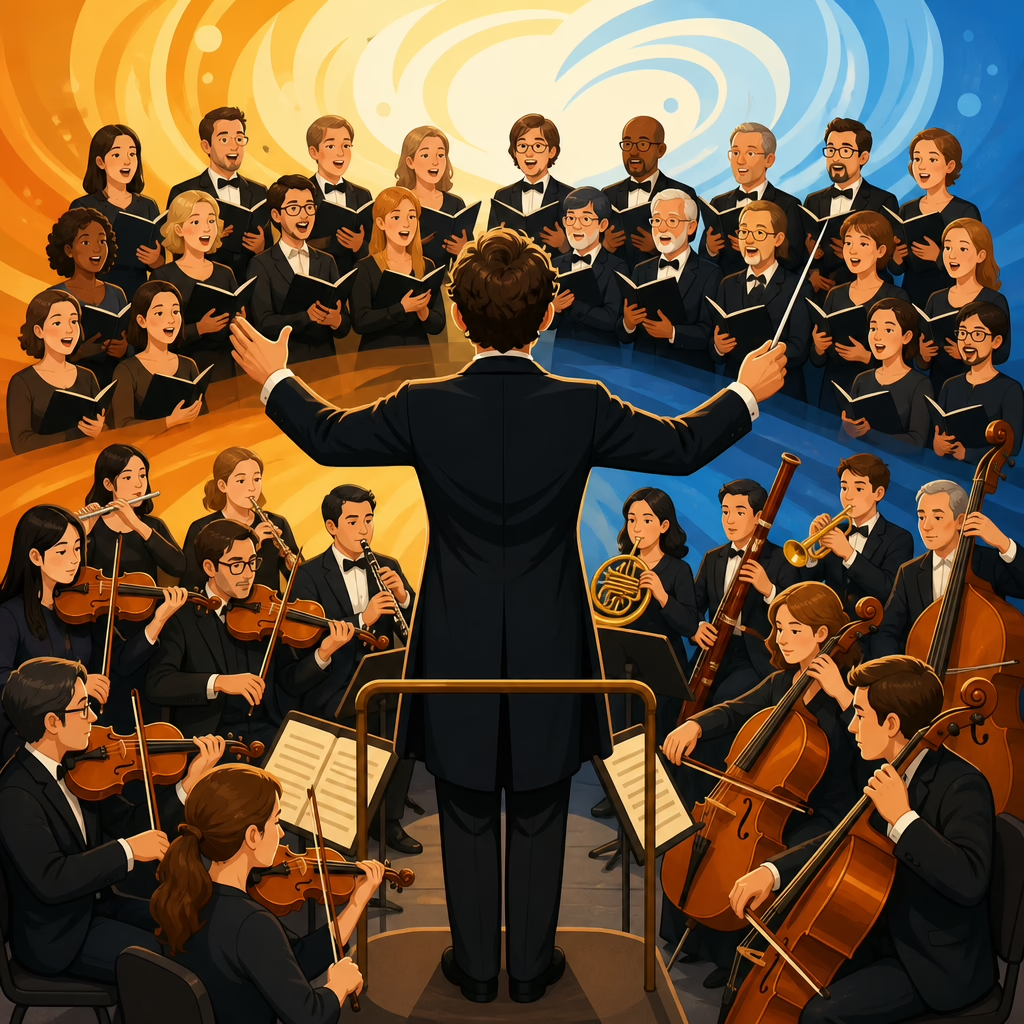
How Conductors Balance Choir and Orchestra in the Ninth
Balancing choir and orchestra in Beethoven’s Ninth is one of the hardest practical problems in performance, because the score demands symphonic weight, operatic projection, and textual clarity at the same time. The issue is not simply “loud versus soft.” It involves how a conductor shapes tempo, orchestral articulation, choral diction, seating, hall acoustics, and the pacing of climaxes so Schiller’s words remain intelligible without shrinking Beethoven’s orchestral architecture. In rehearsal rooms and concert halls, I have seen this balance decided less by grand theory than by dozens of precise choices: how much bow a string section uses under choral entries, whether trombones play through a consonant-heavy phrase, how long a fermata gives singers time to reset, and where the chorus stands in relation to timpani and brass.
In this context, balance means the audible relationship among four forces: orchestra, chorus, vocal soloists, and acoustic space. A performance is balanced when the listener can follow the text, feel the orchestral propulsion, and hear harmonic and rhythmic detail without strain. Beethoven makes that difficult on purpose. The finale moves from recitative-like rejection of earlier material to a theme-and-variations structure, military episode, double fugue, and apotheosis. Dynamics range from chamber-like passages to full fortissimo with piccolo, contrabassoon, trombones, percussion, and massed voices. Conductors who succeed understand that the score’s power comes not from constant maximum volume, but from controlled layering. The best performances preserve contrast, save reserves for structural peaks, and let the chorus ride the orchestral texture rather than fight it.
Why the Finale Creates a Unique Balance Problem
Beethoven’s Ninth asks the chorus to enter late and instantly become a structural equal to the orchestra. Unlike an oratorio, where choir is central from the start, the symphonic argument has already been built across three movements before singers appear. That means the conductor must integrate a new sound mass into an established orchestral world without making the finale feel bolted on. The baritone’s “O Freunde, nicht diese Töne!” is the hinge. If the orchestra is too heavy beneath it, the rhetorical turn is blurred. If too light, the arrival lacks authority. From that point onward, every return of the “Freude” theme tests whether voices and instruments are cooperating in one architecture or competing for audibility.
Text setting creates additional friction. German consonants help projection, but Beethoven often places them over thick orchestration and active accompaniment. Choral singers need enough time for synchronized diction, especially in fugato and at fast tempos. A conductor who drives the allegro too aggressively can gain surface excitement while sacrificing verbal definition. The opposite error is also common: broadening tempos so much that the line loses buoyancy and singers begin pressing tone to sustain long phrases. In practice, balance is inseparable from pulse. When beat placement is stable and subdivisions are clear, choruses can sing with less force and more focus, which often carries better in the hall than sheer volume.
Another challenge is register. Beethoven doubles voices with winds and brass in ways that can support or swamp them. Tenors are especially vulnerable when they sit in exposed upper-middle tessitura against bright orchestral colors. Altos can disappear when lower strings and trombones thicken the center of the texture. Basses may sound present close up but vanish in a reverberant hall if consonants do not speak. Sopranos can cut through, but if they dominate, the choral blend hardens and the text becomes top-heavy. Good balance therefore means managing spectral space, not just decibels.
What Conductors Adjust Before the First Rehearsal
The most effective balancing work happens before anyone plays. Conductors study the full score for density points, text-critical passages, and orchestral doublings that need restraint. I mark three categories in advance: passages where text must lead, passages where orchestral rhythm must lead, and passages where blend is the primary goal. For example, the first full choral statement of “Freude, schöner Götterfunken” needs immediate textual presence, so string articulation and brass dynamic ceilings must be planned accordingly. In the Turkish march episode, rhythmic character matters as much as words, so orchestral profile can be sharper. In the Adagio-derived broad moments later in the finale, blend and harmonic weight matter most.
Ensemble size is the next variable. There is no single correct ratio, but oversized modern orchestras with underpowered choruses create predictable problems. A chorus of 80 can balance a classical-sized orchestra far more easily than a romantic-scale band of 100-plus players using modern instruments at full weight. Conductors often solve this either by scaling the orchestra down or by choosing a larger, professional chorus with excellent diction and stamina. Historically informed groups use leaner strings, narrower vibrato, lighter sticks, and natural brass technique to increase transparency. Modern symphony orchestras can achieve similar clarity, but only through disciplined dynamic control and articulation.
Stage layout matters more than many listeners realize. If the chorus stands too far behind the orchestra, consonants arrive late and presence drops. Risers help by lifting the singers above the brass line. Antiphonal violins can improve rhythmic definition in the fugue, while placing basses to the side rather than directly behind the chorus can reduce low-frequency masking. Timpani position is crucial: directly firing into the chorus can cause singers to overcompensate and shout. Many conductors test positions during rehearsal in the actual hall because the same seating plan behaves differently in Boston Symphony Hall, the Musikverein, or a dry modern auditorium.
| Balance variable | Common risk | Typical conducting solution |
|---|---|---|
| Orchestra too large for chorus | Text becomes unintelligible in tuttis | Reduce string numbers or cap brass dynamics |
| Chorus placed too far back | Late consonants and weak projection | Use higher risers and move chorus forward |
| Fast finale tempo | Blurry diction in fugues | Clarify subdivisions and lighten accompaniment |
| Reverberant hall | Brass and timpani smear inner detail | Shorter articulations and stricter dynamic terracing |
| Heavy string vibrato | Covered vowels in middle texture | Narrow vibrato and cleaner bow releases |
Rehearsal Techniques That Actually Improve Balance
Conductors do not fix Ninth-finale balance by repeatedly asking for “less orchestra” or “more chorus.” Those instructions are too vague. Useful rehearsal work isolates what the ear needs to perceive. One reliable method is text-first drilling: chorus sings a passage in rhythm on consonants and vowels alone while orchestra listens, then orchestra plays underneath at half dynamic, then both combine at tempo. This exposes exactly where instrumental attacks obscure verbal rhythm. Another method is sectional subtraction. Remove brass, then woodwinds, then lower strings, and add them back one layer at a time. Players hear which line actually carries the phrase and usually self-correct.
Bowings and articulation are often more important than nominal dynamic markings. In Beethoven, a string section playing short, buoyant strokes at mezzo-forte can leave much more room for the chorus than a legato mezzo-piano spread across the bar. Winds can support text by tapering off final notes before major consonants. Trombones, indispensable for grandeur, must articulate with precision rather than mass. I have repeatedly found that asking brass for narrower, more vertical attacks preserves impact while reducing the blanket effect that covers syllables. Timpani also shape clarity. Hard sticks can define rhythm brilliantly in some halls and become destructive in others.
Choral preparation is equally technical. Conductors who get clean results insist on unified German vowels, especially on “Freude,” “Götterfunken,” and “Tochter.” If each section modifies vowels differently under pressure, overtones scatter and the choir sounds smaller than it is. Consonant timing must be earlier than many amateur choruses expect, because large ensembles need milliseconds for collective alignment. Breath planning is another hidden factor. If singers snatch breaths at random points in sequential phrases, the line thins and the orchestra appears louder even when it is not. Professional choruses assign staggered breathing and rehearse phrase endings almost like percussion cues.
Tempo, Dynamics, and the Shape of Climaxes
Many listeners assume balance is mostly a matter of volume, but tempo is the master lever. A fast pulse can help projection because the orchestra speaks lightly and does not sit on the sound. Yet speed becomes counterproductive if diction collapses. Conductors such as Toscanini favored tensile momentum, producing thrilling transparency but occasionally pushing choral comfort. Furtwängler often broadened transitions and climaxes, creating monumental architecture, though slower pacing required exceptional choral support to keep words present. Neither approach is automatically right. The real question is whether the chosen tempo allows the chorus to articulate text with energy instead of force.
Dynamic planning must be hierarchical. Beethoven writes many fortes, but they are not equal in structural meaning. If a conductor lets early tuttis expand to absolute maximum, the final Prestissimo and closing peroration have nowhere to go. Skilled conductors create dynamic ceilings for each section: opening choral statements may sound full but still leave reserve; fugues build through articulation and harmonic tension before sheer loudness; brass are held back until the architecture justifies release. This is how performances gain inevitability. The choir sounds larger because it is not constantly competing against orchestral overstatement.
One of the most misunderstood balancing points is the tenor solo and male chorus march episode. Because the scoring is lighter and more characterful, some conductors relax too much and lose rhythmic bite; others overplay the percussion and Janissary color, turning the section into parody. The balance goal here is narrative contrast without caricature. The tenor must ride the texture clearly, the men’s chorus needs spring in the consonants, and piccolo, triangle, cymbals, and bass drum should color the march rather than dominate it. When handled well, this episode refreshes the ear so the later choral climaxes arrive with renewed force.
How Hall Acoustics and Recording Change the Equation
What works in the score and rehearsal room may fail in performance because acoustics rewrite balance. Reverberant halls flatter choral blend and grandeur, but they can smear diction and blur fugal entries. Dry halls improve intelligibility yet expose any choral thinness or harsh brass timbre. Conductors adapt by modifying articulation lengths, not by abandoning the conception. In a live acoustic with a long decay, shorter orchestral releases and cleaner rests create space for consonants. In a dry room, strings may need more sustain to prevent the choral sound from feeling unsupported. These adjustments are practical, immediate, and venue specific.
Recordings add another layer. Microphone placement can rescue or distort the relationship listeners would hear in the hall. A close-miked chorus may sound ideally clear on headphones while the orchestra loses scale; a distant ambient setup may preserve grandeur but bury text. This is why comparing recordings of the Ninth requires caution. Some famous studio versions are balanced at the mixing desk in ways no audience experienced live. When evaluating interpretations, it helps to compare multiple recordings or read session notes when available. For a broader framework on listening critically across Beethoven cycles, see this guide to comparing Beethoven symphony cycles like a critic.
What to Listen for in Great Performances
A well-balanced Ninth finale has several audible signs. First, you can understand the rhetorical function of the text even if your German is limited, because phrase shapes and consonants are clear. Second, the orchestra retains its symphonic identity; inner strings, winds, and timpani still contribute character instead of turning into an undifferentiated backdrop. Third, climaxes feel earned. The final pages should sound overwhelming because earlier sections were proportioned intelligently, not because everyone played loudly from the start. Fourth, soloists emerge naturally from the ensemble without sounding spotlit or detached. When these elements align, the finale feels inevitable rather than merely massive.
Listeners should also notice whether the chorus changes color according to function. In the opening strophic statements, warmth and unanimity matter most. In fugues, rhythmic exactness and crisp diction become the priority. In the broad concluding affirmations, blend must expand without losing core. Great conductors cue these shifts physically and musically: smaller beats for transparency, broader preparation for vowels, tighter left-hand control for brass ceilings, and precise eye contact at consonant releases. The result is not a generic “big choral sound,” but a sequence of calibrated textures serving Beethoven’s form.
Conductors balance choir and orchestra in Beethoven’s Ninth by treating the finale as a problem of structure, acoustics, diction, and orchestration all at once. The winning approach is never brute-force loudness. It is proportional thinking: choose forces that fit, place them intelligently, rehearse text against texture, control articulation, and pace dynamics so the biggest moments arrive with true necessity. When this work is done well, Schiller’s words carry clearly, the orchestra keeps its full symphonic strength, and the closing pages achieve the rare combination of grandeur and intelligibility that makes the Ninth feel transformative.
For performers, the practical lesson is simple: solve balance early and specifically, not by instinct in the final rehearsal. For listeners, the takeaway is just as useful: judge a Ninth not only by excitement, but by how clearly it lets chorus and orchestra speak as one. The next time you compare performances, listen for text, texture, and dynamic reserve. Those details reveal the conductor’s craft more reliably than decibel level ever will.
Frequently Asked Questions
Why is balancing choir and orchestra in Beethoven’s Ninth considered such a difficult conducting challenge?
Because the finale of Beethoven’s Ninth asks for several kinds of power at once. A conductor is not just trying to make the choir “louder” or the orchestra “quieter.” The real challenge is preserving the full symphonic force of the score while also allowing Schiller’s text to be heard clearly and naturally. Beethoven writes with immense orchestral energy, but he also expects vocal lines, choral declamation, and solo quartet passages to carry meaning, rhetoric, and character. If the orchestra dominates too heavily, the words disappear and the movement can feel blunt. If the conductor reduces the orchestra too much, the architecture loses weight and the music no longer sounds like Beethoven at full scale.
The difficulty is increased by the fact that different musical textures require different solutions. A fugal choral passage does not need the same treatment as a broad hymn-like statement of “Freude,” and a solo baritone entrance requires a different balance strategy than a full chorus over brass and timpani. Conductors must constantly adjust tempo, articulation, orchestral attack, dynamic layering, and even the emotional pacing of the movement. What works in one hall, with one chorus and one orchestra, may fail completely in another acoustic.
There is also the human factor. Choruses vary in size, diction, projection, and stamina. Some orchestras naturally play with a dense, dark sonority that can cover consonants and inner vocal detail. Some concert halls favor orchestral bloom but blur text. So balancing the Ninth is not a fixed formula. It is an ongoing process of hearing how all the forces interact in real space and then making musical decisions that protect both textual intelligibility and orchestral grandeur.
What musical tools do conductors use to help the choir be heard without weakening the orchestra?
Experienced conductors usually begin with clarity rather than raw volume. One of the most effective tools is articulation. If the orchestra plays with clean attacks, disciplined releases, and transparent rhythmic definition, the sound can remain powerful without becoming thick or vocally destructive. Strings may be asked to play with more lift and less blanket-like legato in passages under choral text. Brass can be brilliant without over-sustaining. Woodwinds can be shaped to color the texture instead of adding unnecessary density. In other words, a conductor often creates space for the choir by refining the orchestral sound, not by simply asking everyone to play softer.
Tempo is another major balancing tool. If the music moves too slowly, orchestral sonority can spread and become heavy, making the text harder to project. If it moves too fast, singers may lose precision in consonants and ensemble. Conductors often choose tempi that let the chorus articulate German text clearly while still preserving the forward impulse Beethoven needs. This is especially important in contrapuntal or rhythmically driven sections, where textual clarity depends on the chorus being able to place consonants together with confidence.
Dynamic hierarchy also matters. Beethoven’s markings are essential, but conductors shape dynamics internally, deciding which lines must lead and which must support. A full forte does not mean every section should sound equally prominent at all times. The bass line may need weight while upper strings play with less mass, or brass may need to crown a climax only after the text has landed. Conductors also work carefully on transitions into climaxes. If the orchestra arrives too soon at maximum sound, the choir has nowhere to go and will be buried at the very moment the music should become most communicative. Good balance is often the result of restraint before the peak, not just management at the peak itself.
How important are diction and choral technique in solving balance problems in the Ninth?
They are absolutely central. Even with excellent orchestral control, a choir that does not sing with unified diction will struggle to project text through Beethoven’s scoring. Clear consonants, aligned vowels, and rhythmic precision can dramatically improve audibility without any increase in vocal force. In practice, this means conductors and chorus directors spend considerable time deciding exactly where consonants occur, how long they last, and how vowels are shaped across the ensemble. When a large choir places final consonants together and energizes the front edge of words, the text cuts through the orchestral texture far more effectively.
Projection technique matters just as much as pronunciation. A choir that sings with pressed tone may sound loud nearby but carry poorly into the hall. By contrast, a well-focused choral sound with a unified vowel core can travel through orchestral texture with surprising efficiency. Conductors often encourage singers to prioritize resonance, vertical alignment, and textual energy rather than shouting. The goal is not to overpower the orchestra but to produce a concentrated vocal signal that remains intelligible even in dense passages.
Choral technique also affects stamina, which is critical in the Ninth because the finale is long, strenuous, and emotionally cumulative. If the chorus oversings early, fatigue will reduce both intonation and diction later on, exactly when Beethoven often asks for the greatest impact. That is why rehearsals frequently address not just notes and rhythm, but pacing of breath, conservation of vocal resources, and consistency of articulation over long spans. In a successful performance, the audience usually perceives this as inevitability: the choir seems present, powerful, and understandable because the technical work underneath has been done with exceptional care.
Do seating arrangements and hall acoustics really make a big difference in balance?
Yes, often more than audiences realize. Physical placement can significantly change how the choir and orchestra blend, project, and interfere with one another. A chorus placed too far behind the orchestra may lose textual immediacy, especially if brass and timpani are directly in front of it. If the singers cannot hear the orchestra clearly, ensemble problems can also arise, which makes diction less clean and balance even worse. Conductors therefore think carefully about spacing, riser height, and the relative position of the chorus to winds, brass, and percussion. Sometimes a small adjustment in elevation or distance can improve clarity more effectively than repeated requests for different dynamics.
Hall acoustics are equally decisive. In a resonant space, orchestral sound may bloom beautifully but linger long enough to blur choral consonants. In a dry hall, text may come through more clearly, but the orchestra can sound exposed and the choir may feel unsupported. Conductors adapt by modifying tempi, articulation length, and dynamic pacing to suit the room. In a live acoustic, they may ask for shorter orchestral releases and more energized consonants from the chorus. In a drier room, they may allow more sustained orchestral line while encouraging the choir to sing with warmth and connection.
Acoustics also affect what performers hear on stage, which is not always what the audience hears in the hall. A balance that seems acceptable from the podium can sound completely different ten rows back or under a balcony. That is why experienced conductors use rehearsals in the performance space strategically, often listening from the hall or relying on trusted colleagues to report what carries and what disappears. In Beethoven’s Ninth, these practical details are not secondary logistics; they are part of the interpretation itself, because the relationship between text and orchestral mass is shaped by the room as much as by the score.
How do conductors rehearse the finale to build both dramatic power and textual clarity over the course of the movement?
Strong rehearsals usually focus on layers. Rather than treating the finale as one giant loud choral event, conductors break it into functions: recitative-like declarations, lyrical statements, martial episodes, fugues, solo quartet textures, and large public climaxes. Each of these requires different balance priorities. Early in rehearsal, conductors often establish rhythmic precision and diction separately from sheer volume, because once a large ensemble starts singing and playing at full intensity, it becomes much harder to fix unclear text or muddy ensemble. The foundation is built through clean entrances, coordinated consonants, disciplined orchestral attacks, and a shared understanding of where the line is going.
Another key rehearsal principle is pacing. Beethoven’s finale can sound exhausting if everything is intense all the time. Conductors therefore shape long-range energy so the largest climaxes feel earned rather than constant. This helps balance in a practical sense: if the ensemble saves true maximum sonority for selected moments, the choir has a better chance of being heard when those moments arrive. Rehearsals often include work on gradation—how to crescendo without thickening, how to maintain momentum without rushing, and how to intensify articulation without turning the orchestral texture opaque. These details are what allow dramatic power and verbal clarity to coexist.
Conductors also spend time aligning the chorus and orchestra conceptually. The singers must understand where they are leading the argument and where they are embedded in the symphonic texture; the orchestra must know when it is driving the drama and when it is supporting the delivery of text. In the best performances, this creates a sense that everyone is participating in the same rhetorical narrative. The words are understandable, the orchestra remains monumental, and the movement unfolds with cumulative inevitability instead of episodic struggle. That outcome is rarely accidental. It is usually the product of highly focused rehearsal decisions that connect technical balance directly to the expressive meaning of Beethoven’s score.