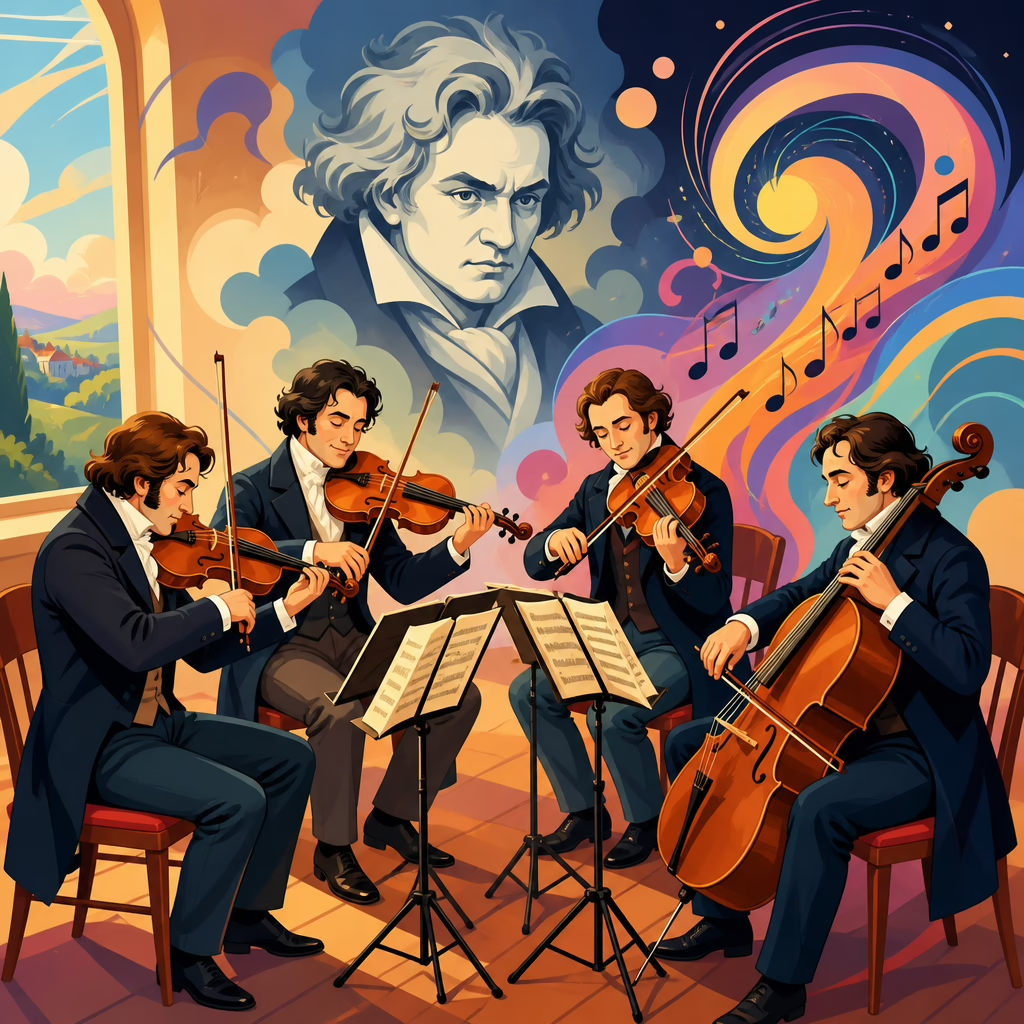
How String Quartets Shape the Late Beethoven Sound
Late Beethoven is often described in terms of transcendence, abstraction, and formal daring, yet the most revealing way to hear that language is through the string quartet. In the quartets Beethoven wrote during his final years—especially Opp. 127, 130, 131, 132, 133, and 135—the medium itself shapes the sound: four solo voices, equal in importance, exposed in texture, and capable of extreme intimacy as well as symphonic force. When listeners ask what makes the late Beethoven sound unmistakable, the answer is not only harmony or form. It is the way quartet writing turns every idea into conversation, conflict, prayer, and release.
By string quartet, musicians mean the standard ensemble of two violins, viola, and cello, along with the repertoire written for that combination. In Beethoven’s late style, that ensemble becomes a laboratory. Because there is no orchestral mass to hide within, every rhythmic displacement, registral leap, sforzando accent, and sudden silence carries unusual weight. I have worked through these scores in rehearsal and coached younger players on them, and one practical lesson returns every time: what appears on the page as a small gesture often determines the emotional architecture of an entire movement. A single inner-voice suspension in Op. 132 can pull the harmony off balance for bars; a cello recitative in Op. 131 can feel like spoken drama.
This matters for listeners as much as for players. Many recordings of late Beethoven succeed or fail not on technical accuracy alone but on whether the ensemble understands how quartet texture generates meaning. These works are not mini-symphonies reduced for four instruments. They depend on transparency, on sharply profiled character changes, and on the tension between collective blend and individual speech. That is why one ensemble can make Op. 127 sound noble and architectural, while another reveals volatility and fragility without changing a note.
Understanding how string quartets shape the late Beethoven sound also sharpens the way we compare performances across Beethoven’s output. The same listening habits used to assess balance, pacing, articulation, and structural control in orchestral cycles become even more exacting in chamber music; readers interested in that broader critical framework can compare approaches in the main guide at https://lvbeethoven.com/how-to-compare-beethoven-symphony-cycles-like-a-critic/. In the late quartets, however, every decision is magnified. The ensemble cannot rely on sheer volume, and Beethoven uses that limitation as expressive power. The result is a sound world at once concentrated and vast, where private utterance achieves monumental effect.
Why four independent voices create the late Beethoven sound
The defining trait of late Beethoven quartet writing is radical polyphonic equality. Earlier classical quartet style often distributed roles conventionally: first violin carries melody, cello anchors harmony, and the inner parts fill texture. Beethoven certainly inherited that model, but in the late quartets he repeatedly dissolves it. The viola introduces crucial motives, the second violin destabilizes meter, and the cello rises into tenor or even alto register to claim thematic prominence. Because each line matters structurally, the listener hears thought unfolding from within the texture rather than being projected from a dominant surface melody.
That equality changes the sonic character in three ways. First, it increases interpretive tension. If all four players speak with equal rhetorical urgency, balancing them is not a matter of simple hierarchy; it becomes dynamic negotiation from phrase to phrase. Second, it clarifies harmony. In orchestral Beethoven, chordal impact can come from massed sonority. In the quartets, harmonic shock often arrives through linear friction: appoggiaturas rubbing against sustained notes, dissonances delayed in the inner parts, or voice crossings that temporarily erase instrumental identity. Third, it intensifies silence. When four soloists stop together after dense contrapuntal activity, the break feels like the end of speech.
Op. 131 offers a clear example. Its opening fugue in C-sharp minor is not simply learned counterpoint. It establishes a world in which entry order, timbral placement, and phrase overlap create emotional gravity. A quartet that voices the subject too homogeneously can make the passage pious and static. One that differentiates color while preserving line reveals anguish, concentration, and motion. The late Beethoven sound emerges from that exact balance: austerity animated by human breath.
Texture, register, and the exposed edge of intimacy
String quartet texture gives Beethoven access to extremes of register and articulation that would diffuse in thicker scoring. He writes high violin lines that hover almost without support, then drops the cello into bare octaves or recitative-like declamation. He spaces chords so widely that the middle seems hollowed out, then compresses the ensemble into close, almost vocal dissonance. In rehearsal, these passages feel perilous because intonation and timing are naked; in performance, that peril becomes expressive electricity.
Consider the “Heiliger Dankgesang” from Op. 132. Its Lydian-inflected chorale writing depends on purity of interval and sustained control. The movement does not sound profound merely because it is slow and solemn. It sounds profound because four instruments must sustain a communal utterance while remaining individually accountable for every pitch and inflection. When the contrasting “Neue Kraft fühlend” sections arrive, the textural release is physical: pulse returns, articulation brightens, and the ensemble seems to breathe again after ritual suspension.
Late Beethoven also exploits registral ambiguity. In Op. 130, lines pass so quickly among players that thematic identity becomes fluid. A motive can begin as accompaniment and end as declaration. That fluidity is essential to the sense that the music is thinking aloud. The quartet medium allows Beethoven to switch between confessional nearness and public monumentality without changing forces. One moment the music resembles private speech among four people in a room; the next it suggests symphonic breadth achieved through spacing, attack, and harmonic span rather than orchestral weight.
Form becomes drama when players must negotiate every transition
The late quartets are famous for unconventional form, but their formal daring is inseparable from quartet performance conditions. Beethoven links movements attacca, inserts abrupt character breaks, and juxtaposes fugue, dance, aria, march, and recitative within a single large design. In orchestral music, continuity can be maintained through sheer sonic momentum. In quartet writing, coherence has to be actively negotiated through shared pulse, cueing, bow distribution, and rhetorical agreement. That necessity shapes the sound the listener perceives.
Op. 131’s seven connected movements are the classic case. Analysts rightly emphasize tonal planning and cyclical structure, yet in performance the work lives or dies by transition management. The shift from the opening fugue into the brisk Allegro molto vivace must feel inevitable without losing shock. The tiny bridge into the Andante cannot sag. The Presto needs demonic lightness, not generalized speed. Because only four players carry the whole structure, formal contrast sounds like psychological transformation rather than mere sectional design.
Op. 135 shows the same principle in compressed form. Its finale, with the “Muss es sein?” and “Es muss sein!” opposition, depends less on programmatic label than on conversational timing. The question must hesitate genuinely; the answer must land with earned certainty. Quartet ensembles that over-project the motto turn the movement into anecdote. Those that shape the surrounding transitions make it convincing as late Beethoven irony: grave and playful at once.
| Work | Quartet feature | How it shapes the sound |
|---|---|---|
| Op. 127 | Broad variation writing and chorale texture | Creates grandeur through resonance and patience rather than orchestral mass |
| Op. 130 | Sharp contrasts between lyric grace and disruptive complexity | Makes instability audible inside elegance |
| Op. 131 | Continuous multi-movement design with opening fugue | Turns form into an unbroken psychological journey |
| Op. 132 | Chorale austerity against renewed-motion episodes | Frames suffering and recovery through exposed ensemble breathing |
| Grosse Fuge, Op. 133 | Dense counterpoint and extreme rhythmic attack | Pushes four instruments toward orchestral violence while retaining chamber clarity |
| Op. 135 | Economy, wit, and compressed motivic argument | Reveals late style through concentration rather than scale |
The Grosse Fuge and the limits of quartet sound
No discussion of the late Beethoven sound is complete without the Grosse Fuge, originally the finale of Op. 130 and later published separately as Op. 133. It is often described as orchestral in conception, but that can mislead. Its power comes precisely from being a quartet piece asked to behave beyond normal quartet limits. The violence of its accents, the brutality of its trills, the stretto writing, and the registral collisions all matter because four players must make them legible in real time.
In practical terms, the Grosse Fuge tests ensemble coordination more relentlessly than almost any piece in the repertoire. Bow strokes must articulate rhythm like percussion while still sustaining line; intonation has to survive under stress; metric dislocation must sound intentional rather than ragged. When those demands are met, the listener hears not chaos but organized extremity. The music’s notorious difficulty is therefore not incidental. Beethoven builds the late style partly by exposing effort itself. Strain, resistance, and near-breakdown become audible features of the sound.
This is one reason recordings differ so markedly. Some quartets emphasize granite weight, producing a monumental reading. Others prioritize dance impulse and reveal that even the fugue’s harshest pages derive energy from bodily rhythm. The best performances keep both truths in play. They do not smooth the work into academic counterpoint, and they do not exaggerate roughness for effect. They let the quartet medium show how intellect and physical attack are fused.
What to listen for in great recordings of the late quartets
For listeners comparing recordings, the central question is not simply whether an ensemble sounds beautiful. In late Beethoven, beauty can be secondary to conviction, contrast, and structural hearing. I listen first for voicing: can I follow all four lines without the texture becoming analytical and dry? Then for tempo relationships: does the ensemble make linked sections feel proportionate, especially in Op. 131 and Op. 132? Next for articulation: are accents, sf markings, and hairpin dynamics treated as local color only, or as structural signals that shape long-range tension?
Historic and modern ensembles answer these questions differently. The Busch Quartet brought volatile rhetoric and gripping line, even when tonal polish was not the primary goal. The Végh Quartet often found spiritual gravity through flexible pacing and dark color. The Alban Berg Quartet combined precision with a strongly architectural sense of shape. More recent groups such as the Takács Quartet, Quatuor Ébène, and the Belcea Quartet tend to offer cleaner textural separation and a wider dynamic spectrum captured by modern engineering, though each brings distinct priorities in vibrato, attack, and expressive profile.
Recording quality matters more here than in denser repertoire. Close microphone placement can illuminate inner voices, but it can also flatten perspective and exaggerate attack. A more natural acoustic may preserve blend and resonance, though at the risk of obscuring contrapuntal detail. The ideal recording lets you hear both the grain of individual instruments and the composite sonority they create. If a performance makes you aware of conversation, not just sound, it is probably getting close to the core of late Beethoven.
Why the quartet medium reveals Beethoven’s last musical language so completely
The late Beethoven sound is not a mystical essence floating above instrumentation. It is the product of compositional thought meeting the disciplined vulnerability of four string players. Through the quartet, Beethoven could make counterpoint feel urgent, harmony feel bodily, and formal experiment feel like lived experience. He could strip away surplus color and discover greater expressive range in attack, register, spacing, and silence. That is why these works continue to challenge performers and reorient listeners. They are severe, tender, argumentative, and visionary because the medium allows all those states to exist at once without dilution.
For anyone serious about performance and recordings, the lesson is practical. Listen to how the voices balance, how transitions are negotiated, how dissonance is sustained, and how silence is timed. Those details are not secondary polish. They are the mechanism by which the late Beethoven sound comes into being. Start with a few contrasting recordings of Opp. 131 and 132, compare how each ensemble handles continuity and inwardness, and then return to Op. 130 and the Grosse Fuge. The more closely you hear the quartet medium at work, the more unmistakable late Beethoven becomes.
Frequently Asked Questions
Why are the late string quartets the best place to understand Beethoven’s late style?
The late string quartets are often the clearest window into Beethoven’s final musical language because they strip away everything nonessential. In a symphony, a piano sonata, or even a large choral work, color, volume, and sheer scale can partly disguise how the music is built. In the quartets, nothing is hidden. There are only four players, each functioning as an individual musical personality, and every gesture is fully exposed. That transparency makes it easier to hear the traits people associate with “late Beethoven”: abrupt contrasts, long spiritual arcs, startling silences, dense counterpoint, hymn-like simplicity, and a willingness to let form unfold according to expressive necessity rather than convention.
The medium also perfectly suits Beethoven’s late preoccupation with equality among voices. Instead of treating one instrument as the leader and the others as accompaniment, he distributes meaning across all four parts. A phrase may begin in the violin, be challenged by the viola, deepened by the cello, and completed by the second violin. This creates a kind of musical conversation that feels philosophical rather than merely decorative. The listener does not just hear melody supported by harmony; the listener hears ideas being examined from multiple angles at once.
Works such as Opp. 127, 130, 131, 132, 133, and 135 show Beethoven using the quartet not as a small ensemble version of orchestral thinking, but as a unique instrument of thought. The intimacy of the texture allows him to move from monumental declarations to private confession in a matter of seconds. That flexibility is one reason the late quartets feel so unmistakable. They reveal Beethoven’s final style not simply because they contain his most daring ideas, but because the quartet medium makes those ideas audible in their purest, most concentrated form.
What is it about four equal voices that shapes the late Beethoven sound so strongly?
The equality of the four instruments is central to the sound-world of the late quartets. Beethoven does not use the ensemble as a hierarchy with a dominant first violin and subordinate accompaniment. Instead, each instrument carries structural, harmonic, and emotional weight. This means the music gains depth from interaction rather than from surface brilliance. The result is a texture that can feel argumentative, prayerful, fragmented, or unified depending on how the voices converge or diverge.
This equal-voice writing changes how listeners experience harmony and melody. In much earlier chamber music, one can often identify the tune immediately and hear the other parts as support. In late Beethoven, the “theme” may be broken into motives that travel between instruments, overlap in unexpected ways, or emerge from polyphonic writing rather than sing out cleanly on top. Because of that, the ear is drawn inward. Listening becomes more active. One begins to hear the music as a field of relationships rather than a simple foreground-background design.
That equality also gives Beethoven extraordinary expressive range. When all four instruments speak with one purpose, the quartet can sound almost orchestral in force. When they separate into distinct lines, the music can feel searching, solitary, or unsettled. This constant negotiation between individual voices and collective statement is a defining feature of the late Beethoven sound. It mirrors the broader tension in these works between order and freedom, discipline and spontaneity, earthly struggle and something more transcendent. The medium does not merely carry those meanings; it helps create them.
How do the late quartets balance intimacy with symphonic power?
One of the miracles of Beethoven’s late quartets is their ability to sound both inward and immense. On one hand, the quartet is the most intimate major instrumental medium available to Beethoven. Every line is personal, every entry matters, and every silence feels charged. On the other hand, he writes with such structural ambition, emotional breadth, and dynamic boldness that the music often seems larger than the forces producing it. This paradox is a major reason the late quartets leave such a profound impression.
Beethoven achieves symphonic power not by increasing the number of instruments, but by intensifying musical thought. He uses extreme registral contrasts, thick contrapuntal layering, sharply defined rhythms, and weighty harmonic progressions to create a sense of scale far beyond the ensemble’s size. Fugal passages can sound monumental because each instrument is fully independent, driving the music forward with concentrated energy. Chordal writing can feel massive because the harmony is presented with complete conviction and without any unnecessary filler. Even a single sustained note can become overwhelming when placed at the right structural moment.
At the same time, the quartet’s intimacy prevents grandeur from becoming impersonal. A movement like the “Heiliger Dankgesang” from Op. 132 can feel like a public utterance and a private prayer at once. The Cavatina from Op. 130 speaks with an almost unbearable closeness, yet its emotional resonance is vast. This blend of chamber-scale vulnerability and symphonic seriousness is one of the signatures of late Beethoven. The string quartet allows him to compress enormous emotional and formal weight into a space where every nuance remains humanly audible.
Which musical features in Opp. 127, 130, 131, 132, 133, and 135 make the late Beethoven sound unmistakable?
Several recurring features across these quartets contribute to the unmistakable late Beethoven sound. One is formal unpredictability. Beethoven no longer seems interested in fulfilling expectations simply because tradition demands it. Movements expand, contract, connect without pause, or interrupt one another with startling force. Op. 131, with its seven continuous movements, is a famous example of a work whose form feels discovered rather than inherited. This creates an impression of inevitability on Beethoven’s own terms, even when the music initially feels elusive.
Another defining feature is the mixture of learned counterpoint and radical expressive directness. Beethoven draws deeply on fugue, variation, and older sacred styles, but he uses them not as academic exercises but as living expressive resources. The Große Fuge, Op. 133, is perhaps the most extreme instance: intellectually formidable, rhythmically aggressive, and emotionally uncompromising. Elsewhere, as in Op. 127 or Op. 132, variations become a way to meditate on a single idea until it opens into entirely new emotional terrain.
There is also Beethoven’s late way with contrast. He can move from rough humor to sublime stillness, from dance rhythms to severe polyphony, from folk-like simplicity to visionary remoteness. These shifts do not feel accidental. They are part of a broader language in which opposites coexist without being fully smoothed over. Add to this his use of silence, fragmented motives, unexpected harmonic turns, and textures that alternate between bare simplicity and astonishing density, and the result is a sound-world that is instantly recognizable. These quartets do not merely display late style as a list of traits; they embody a mind pushing musical speech to its furthest limits.
How should listeners approach the late Beethoven quartets if the music feels difficult at first?
The most helpful approach is to accept that difficulty is part of the experience, not a sign of failure. Late Beethoven often avoids immediate surface charm in favor of deeper forms of coherence and expression. A first hearing may feel disorienting because familiar markers are missing or transformed. Themes may not present themselves in a neat, singable way. Movements may unfold with unusual pacing. Contrasts may seem abrupt. Instead of trying to “solve” the music instantly, it is better to listen for character, texture, and the relationships among the four voices.
A practical strategy is to focus on one quartet at a time and return to it more than once. Listen first for broad atmosphere: where does the music seem solemn, restless, playful, prayerful, or defiant? Then begin noticing how Beethoven builds those states. Which instrument introduces an idea? How is it answered? When do all four voices unite, and when do they pull apart? This kind of listening is especially rewarding in the late quartets because the drama often lies in interaction rather than in obvious melodic display. Hearing a great performance can also make an enormous difference, since skilled ensembles clarify the logic of the writing without flattening its mystery.
It also helps to remember that these quartets reward familiarity more than almost any music Beethoven wrote. What first seems fragmented can later sound inevitable. What seems austere can become deeply moving. What appears abstract can reveal extraordinary tenderness and even humor. The string quartet medium is crucial here, because its transparency allows listeners to grow into the music’s language. Over time, the very features that make the late quartets challenging—their exposed textures, equal voices, formal daring, and emotional extremity—become the reason they feel so necessary, personal, and unforgettable.