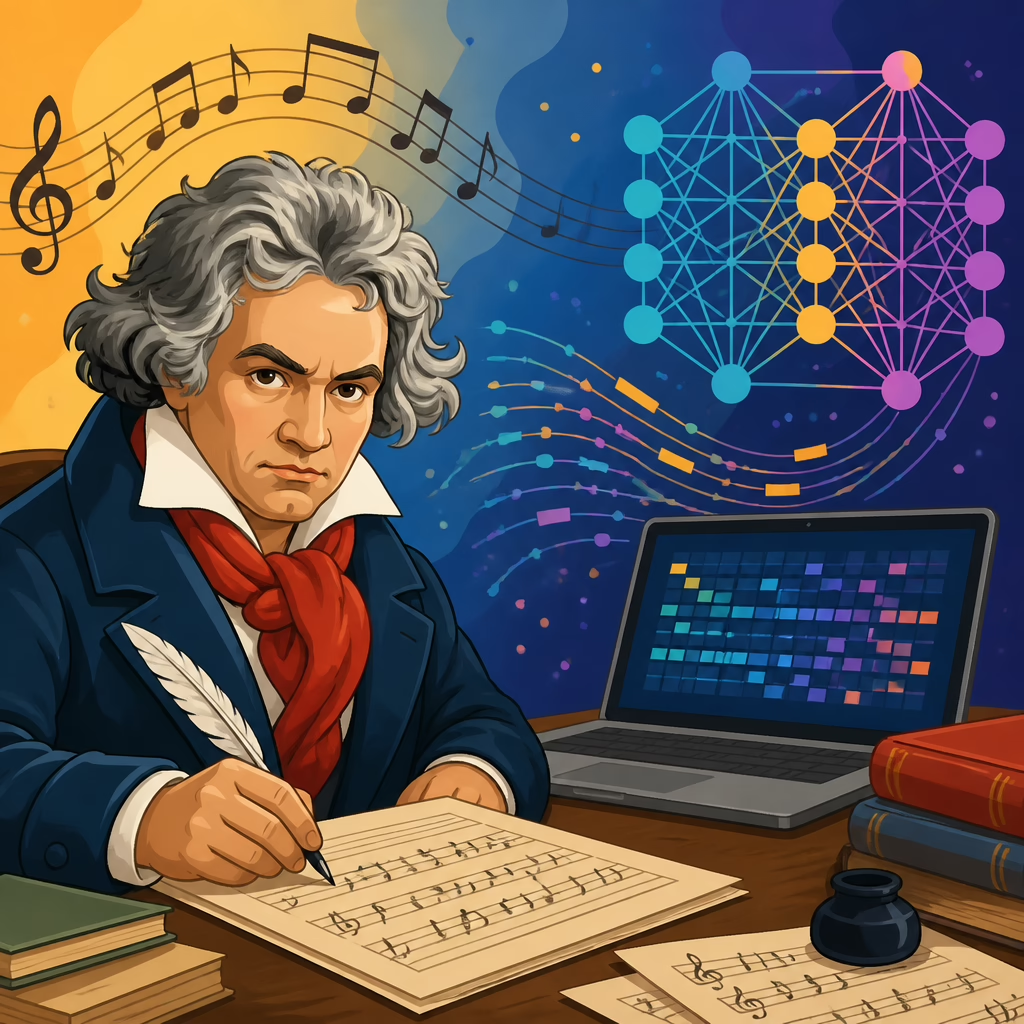
Machine Learning and Pattern Finding in Beethoven
Machine learning is changing how scholars, performers, and listeners study Beethoven by turning thousands of notes into measurable patterns that the human ear senses but cannot easily count. In this context, machine learning means computer methods that learn statistical regularities from data instead of relying only on hand-written rules, while pattern finding means identifying recurring structures such as motifs, harmonic progressions, rhythmic cells, voice-leading habits, and formal designs across works or within a single score. I have used these methods on symbolic music files, scanned editions, and performance datasets, and the practical value is clear: they let us test long-standing analytical claims, discover overlooked connections, and compare interpretations at a scale impossible with manual annotation alone. Beethoven is an ideal subject because his music balances strong thematic identity with relentless variation. A four-note idea may reappear transformed by inversion, rhythmic displacement, registral shift, or harmonic reinterpretation, making simple search inadequate. Good pattern finding therefore matters for more than cataloging similarities; it supports musicology, pedagogy, editing, and historically informed performance. When a model reliably detects motivic families or unusual harmonic pathways, it gives analysts evidence that can confirm intuition, challenge inherited assumptions, or point to passages worth close reading. The result is not a replacement for human interpretation. It is a disciplined way to ask better questions about how Beethoven builds coherence, tension, and memory across time.
What machine learning actually looks for in Beethoven scores
In practice, machine learning for Beethoven analysis begins with representations. Most projects use symbolic encodings such as MusicXML, MEI, **kern, or MIDI because they preserve pitch, duration, meter, articulation, and part structure in ways optical scans alone do not. The first job is feature extraction: converting notation into data points a model can compare. Common features include pitch intervals, contour, onset patterns, metrical position, chord labels, Roman numeral estimates, cadential markers, and texture density. For motivic study, analysts often use n-grams of intervals and rhythms, edit distance, or dynamic time warping to match similar sequences even when Beethoven stretches or compresses them. For harmony, hidden Markov models and more recent sequence models can estimate likely chord functions over time, especially when fed voice-leading cues and bass motion.
The crucial distinction is between exact repetition and transformational similarity. Beethoven rarely repeats a motive in mechanically identical form for long. In the first movement of the Fifth Symphony, the famous short-short-short-long cell appears in different keys, registers, orchestrations, and phrase contexts. A naive search finds literal copies; a better system finds the family resemblance by weighting interval contour and rhythm more heavily than absolute pitch. The same issue appears in piano sonatas, where a figure may migrate between hands or be absorbed into accompaniment. Pattern finding tools therefore need tolerance for ornamentation, rests, ties, and local reharmonization. When I tune these systems, the best results come from combining strict and flexible features rather than betting on one universal signature.
Supervised and unsupervised learning answer different questions. Supervised models require labeled examples, such as annotated cadences or known sonata-form boundaries, and they are useful when scholars already agree on the categories. Unsupervised methods, including clustering and topic-style models, are better for discovering unknown groupings, such as recurrent accompaniment types or transition textures across Beethoven’s middle-period works. Neither approach is magical. Their value depends on data quality, transparent assumptions, and musical validation through score study.
How motifs, themes, and variation are detected
Motif detection is the most intuitive application because Beethoven’s style is so tightly driven by small cells. Analysts usually start by segmenting a score into candidate fragments, then comparing those fragments with distance measures that reflect musical perception. Interval sequences capture transposition-invariant shape; inter-onset intervals capture rhythm; contour strings capture general rise and fall. More advanced systems create embeddings, numerical vectors learned from many examples, so fragments that function similarly end up close together even if they are not identical on the page. This is especially useful in Beethoven, where development sections fracture themes into compressed particles.
A practical workflow often combines rule-based and learned components. First, a parser identifies plausible phrase onsets using meter, rests, slurs, and cadential cues. Next, fragments are normalized by transposition or tempo scaling. Then a clustering algorithm groups similar fragments, and the analyst reviews clusters against the score. I have found that this human-in-the-loop stage matters more than any single algorithm. Beethoven’s notation encodes intention imperfectly: accents may imply motive boundaries, but so can harmonic arrival, registral leap, or a sforzando on a weak beat. A fully automatic system tends to over-segment texture and under-read rhetoric.
The payoff is concrete. In the “Eroica” Symphony, machine grouping can show how accompanimental figures participate in thematic work, not merely support it. In the late string quartets, pattern detection often reveals long-range motivic recall that is easy to miss when surface texture changes rapidly. In piano sonatas such as Op. 111, similarity search can connect opening gestures with later transformed appearances, helping explain why distant passages feel related. These findings do not replace Schenkerian, Formenlehre, or Caplin-style analysis; they create a reproducible layer of evidence that can support or refine those readings. For readers who want the broader technical context, the main guide on how AI tools can help analyze Beethoven scores provides the surrounding workflow, but motif analysis remains one of the sharpest lenses for this repertoire.
Finding harmonic and formal patterns at scale
Harmony and form require a different toolkit because they unfold over larger spans and depend on hierarchical context. Beethoven’s harmonic language is not random chromatic color; it is a system of expectations, delays, tonicizations, and structural returns. To model that system, researchers often infer local chords, then estimate phrase functions, cadences, and key areas. Sequence models can track how likely one event is to follow another, while graph-based methods can map transitions among tonal regions across many movements. The question is not only “what chord is this?” but “what role is this harmony playing right now?”
One productive approach uses sliding windows over a score to calculate tonal tension, chromatic density, and cadence probability. When plotted across time, these measurements often align with formal landmarks such as exposition closures, development crises, and recapitulation preparations. In Beethoven’s sonata movements, this can reveal how he manipulates normative form. A recapitulation may arrive with unusual harmonic preparation; a transition may overperform its instability; a coda may function as a second development. Machine learning helps because it can compare many movements and identify where a movement follows or departs from the larger stylistic baseline.
| Analytical target | Typical features | Useful methods | Beethoven example |
|---|---|---|---|
| Motivic recurrence | Intervals, rhythm, contour, register | n-grams, dynamic time warping, clustering | Fifth Symphony opening cell across movements |
| Cadence detection | Bass motion, soprano scale degree, metrical stress | Hidden Markov models, supervised classifiers | Delayed authentic cadences in piano sonatas |
| Key-area mapping | Pitch-class distribution, chord function, modulation cues | Sequence models, tonal centroid analysis | Remote key regions in late quartets |
| Form estimation | Cadence density, thematic return, texture change | Segmentation models, change-point detection | Expanded codas in middle-period symphonies |
Real-world results are strongest when harmonic and thematic evidence are combined. A passage may look formally ambiguous if judged by cadence alone, but thematic return plus tonal stabilization can identify its function. This mixed evidence is especially important in Beethoven because rhetorical force often arrives before textbook closure. Models that integrate multiple layers of data consistently outperform single-feature systems.
Performance data and what pattern finding reveals beyond the score
Not all Beethoven pattern finding concerns notation. A second frontier uses performance data from audio recordings or expressive timing extracted from MIDI-enabled pianos. Here the goal is to detect recurring interpretive choices: tempo rubato, articulation shaping, dynamic contour, timing at cadences, and micro-timing around motives. Signal processing tools convert recordings into beat-level features, then alignment algorithms synchronize performance with the score. Once aligned, machine learning can compare many performances of the same movement and identify where interpreters agree, where schools diverge, and where an individual artist is distinctive.
This matters because Beethoven interpretation is full of inherited claims that are rarely tested systematically. Does a particular crescendo invite broadening? Do performers consistently linger before a structural return? Are sforzandi treated as local attacks or phrase-level pivots? By examining aligned recordings, clustering tempo curves, or modeling dynamic trajectories, researchers can answer those questions with evidence. In one common pattern, performances of slow introductions show more inter-performer variance than main allegros, suggesting shared pulse becomes more stable once meter and motive lock in. In scherzos, accent placement often predicts timing flexibility better than tempo marking alone.
These methods also expose the gap between score instruction and executed sound. Beethoven may write a simple repeated rhythm, yet performers shape it differently based on harmony, register, and expected arrival. Pattern finding can show, for example, that the same notated figure receives consistently longer final notes before cadences across many recordings. That is interpretive convention becoming measurable data. For teachers, this is valuable because it separates expressive habits grounded in structure from those based on fashion or studio lineage. For performers, it offers a mirror, not a mandate.
Limits, errors, and best practices for trustworthy analysis
Machine learning can illuminate Beethoven, but it can also mislead if the pipeline is weak. The first risk is data quality. Optical music recognition still struggles with dense textures, tied notes across systems, cue-sized notation, and older engraving conventions. A single parsing error can create false motives or impossible harmonies. That is why serious projects validate against authoritative editions, inspect extracted features manually, and document preprocessing decisions. The second risk is overfitting style with too little data. Beethoven’s complete output is substantial by human standards but small by modern machine learning standards, especially once divided by genre, period, and movement type.
Another limitation is that models often flatten hierarchy. A local pattern may be statistically common yet analytically trivial, while a rare event may be structurally decisive. Repeated Alberti-like motion in accompaniment tells us less than a strategically delayed dominant, but frequency-based systems may privilege the former. Good studies counter this by mixing descriptive statistics with theory-informed features and close reading. Cross-validation, held-out test sets, and ablation studies are not optional technical rituals; they are the minimum standard for claiming that a pattern is robust rather than accidental.
I recommend four best practices. First, choose representations that fit the question: interval patterns for motive, voice-leading for harmony, alignment features for performance. Second, report tolerances clearly, including how much rhythmic or pitch variation the system permits. Third, compare machine findings with accepted analytical landmarks and with deliberate counterexamples. Fourth, keep interpretation modest. If a model finds a recurring contour, it has found evidence of similarity, not proof of compositional intent. The strongest work on Beethoven uses computation to sharpen human judgment, not to bypass it.
Used carefully, machine learning makes Beethoven’s patterning more legible without reducing the music to numbers. It can trace how a motive mutates across a movement, map harmonic pressure over time, and measure interpretive habits across recordings. It also forces analysts to define terms precisely: what counts as the same idea, where a cadence begins, how a formal boundary is recognized. That precision is its real gift. If you are studying Beethoven scores, start with one clear question, one reliable dataset, and one method whose assumptions you can explain. Then test the result against the score, the ear, and the tradition. Done that way, pattern finding becomes a practical extension of musicianship, revealing connections that reward both scholarship and performance.
Frequently Asked Questions
What does machine learning actually mean in the context of studying Beethoven?
In this setting, machine learning refers to computer-based methods that learn patterns from musical data rather than following only fixed, hand-written instructions. Instead of telling a system in advance exactly what a Beethoven motif, cadence, or harmonic turn must look like, researchers feed it large collections of scores, symbolic note data, performance information, or annotated examples and let the model discover statistical regularities on its own. That can include recurring interval shapes, rhythmic figures, phrase lengths, modulation habits, accompaniment textures, and voice-leading tendencies that appear across sonatas, quartets, symphonies, and other works.
This matters because Beethoven’s music is rich in relationships that are easy to hear but hard to count consistently by hand. A listener may sense that a short rhythmic cell keeps returning in transformed form, or that a transition passage feels characteristically Beethovenian, but measuring those impressions across thousands of measures is labor-intensive. Machine learning makes it possible to scale that work. It can compare passages, cluster similar ideas, estimate which features tend to co-occur, and reveal how a small motive evolves through augmentation, fragmentation, transposition, inversion, or changes in harmonic context.
Importantly, machine learning does not replace traditional analysis. It complements close reading by giving scholars a way to test claims, discover overlooked connections, and ask new questions. A music theorist might already suspect that Beethoven favors particular developmental strategies in middle sections; a machine-learning model can help evaluate that suspicion across a larger corpus than one person could manually annotate. In that sense, machine learning becomes a tool for evidence-based musical interpretation, connecting computational measurement with style history, analysis, and performance practice.
What kinds of patterns can machine learning find in Beethoven’s music?
Machine learning can detect a wide range of patterns, from very small local features to large-scale formal designs. At the most basic level, it can identify recurring motifs, interval sequences, rhythmic cells, contour shapes, and accompaniment figures. For example, a model may track how a four-note idea reappears in altered rhythmic form, how a syncopated gesture migrates between voices, or how a melodic shape is preserved even when the exact pitches change. These are the kinds of relationships that often drive Beethoven’s sense of unity and development.
At the harmonic and contrapuntal level, models can examine chord progressions, key relationships, cadential routines, and voice-leading behavior. That includes studying which harmonic pathways Beethoven uses to intensify transitions, how he approaches dominant preparation, how often he delays resolution, or how inner voices contribute to motivic coherence. Pattern-finding systems can also compare the same harmonic function across many pieces to see whether Beethoven treats it consistently or creatively varies it depending on genre, period, or expressive aim.
On a larger scale, machine learning can help map phrase structure, thematic rotation, recapitulation strategies, developmental density, and formal balance. In sonata-form movements, for instance, it may identify common markers of exposition, development, and recapitulation, while also showing where Beethoven bends expectations. It can reveal that a passage functions like a transition even when its surface details differ sharply from textbook examples, or it can measure how motivic compression increases tension near climactic points. The result is a more quantified view of how Beethoven builds coherence across entire movements, not just within isolated themes.
How do scholars and performers use these computational findings in practice?
For scholars, machine learning provides a way to test analytical ideas against a broader body of evidence. Instead of relying solely on a few famous examples, a researcher can examine patterns across dozens of Beethoven works and ask whether a feature is typical, exceptional, developmental, or genre-specific. This is useful for questions of style, chronology, authorship, revision, and influence. If a scholar wants to know whether Beethoven’s late works show more compressed motivic reuse, more abrupt tonal shifts, or more unusual phrase asymmetry, computational methods can supply measurable support for those claims.
Performers benefit in a different but equally practical way. A pianist, conductor, or string quartet can use pattern analysis to clarify what needs emphasis in interpretation. If machine-assisted study shows that a tiny rhythmic cell governs an entire movement, that insight can shape articulation, phrasing, timing, and voicing decisions. If harmonic tension consistently peaks around specific voice-leading events, a performer may choose to pace crescendos or rubato around those moments more deliberately. In other words, machine learning can help translate hidden structural relationships into audible interpretive choices.
Listeners and educators also gain value from these findings. Teachers can use visualizations of motif recurrence, tonal motion, or formal return to make Beethoven’s music more accessible to students. Curious listeners can better understand why a movement feels tightly knit or dramatically inevitable. Rather than reducing art to numbers, computational analysis often deepens appreciation by showing how much expressive power Beethoven draws from disciplined patterning. The technology helps people hear with greater awareness, especially in works where the surface energy can make underlying structure easy to miss.
Can machine learning explain why Beethoven sounds distinctive, or is that too subjective?
Machine learning can contribute meaningfully to that question, but it does not solve it completely. Beethoven’s distinctiveness is partly a matter of measurable musical habits and partly a matter of human interpretation. On the measurable side, models can identify features that recur unusually often in his music compared with that of contemporaries: certain motivic working methods, rhythmic insistence, developmental density, dynamic contrast patterns, harmonic pacing, registral extremes, or formal disruptions. When those traits are quantified across a large corpus, they begin to outline what makes Beethoven recognizably Beethovenian.
However, style is not just a checklist of features. Two passages may share many measurable attributes and still feel different because of context, expressive weight, genre, tempo, instrumentation, or historical expectation. Machine learning can say that Beethoven often transforms short motives obsessively, favors certain transition intensifications, or manipulates rhythmic energy in distinctive ways, but it cannot by itself capture the full experience of drama, struggle, wit, or transcendence that listeners associate with his music. Those broader meanings still require interpretation by musicians, historians, and audiences.
The strongest approach is therefore a hybrid one. Machine learning can identify statistically distinctive fingerprints, while traditional criticism explains why those fingerprints matter. For example, a model may show that a movement derives an unusually large percentage of its material from one compact cell. The human analyst can then argue that this economy creates an impression of inevitability or psychological pressure. In that sense, machine learning helps ground stylistic judgments in evidence without pretending that evidence alone exhausts musical meaning.
What are the main limitations or challenges of using machine learning for Beethoven analysis?
One major challenge is the nature of the data itself. Beethoven’s music reaches us through scores, editions, sketches, performance traditions, and sometimes conflicting editorial choices. Before a machine can find patterns, the music has to be encoded in a usable form, and that process involves decisions about ornamentation, articulation, dynamics, tempo markings, repeats, enharmonic spelling, and segmentation. Small encoding choices can influence what a model sees as similar or different. If the input data is inconsistent, the output patterns may reflect editorial noise as much as musical structure.
Another limitation is that machine learning models are only as informative as the features they are given or the representations they learn. Some systems work with pitch and rhythm only, which may overlook timbre, texture, notation, rhetorical function, or historical convention. Others are statistically powerful but difficult to interpret, meaning they can classify or cluster passages without clearly explaining why. In music analysis, that is a serious issue because scholars need reasons, not just results. A model that says two transitions are related is most useful when it can also point to the motivic, harmonic, or formal basis of that relationship.
There is also the broader risk of reductionism. Beethoven’s music is not simply a collection of countable events; it is an artistic practice shaped by instrument technology, patronage, genre tradition, improvisatory habits, audience expectations, and expressive aims. Machine learning can reveal hidden regularities, but it can also tempt users to overvalue what is easy to measure and undervalue what is hard to formalize. The best computational work acknowledges that limitation. It treats algorithms as tools for discovery and comparison, not as final judges of meaning. When used carefully, machine learning sharpens our understanding of Beethoven; when used uncritically, it can flatten the richness it is trying to illuminate.